Monday, August 05, 2019

How To Overcome Fear Of Failure

I've been engaged in an intensive research program exploring unique edges in the market.  The gist of the research is an identification of "who is trapped" in the market when buyers can no longer lift the market and sellers cannot push it lower.  The research is promising (note the recent post on market strength), but it has come with a unique challenge.  The anticipated unwinds of buyers and sellers play out over multiple days and rarely in a straight line.  That means that anyone seeking to benefit from those unwinds has to endure temporary, but very uncomfortable, adverse movement and drawdown.

That really is a challenge, because sometimes the trade idea itself will be wrong.  In such a situation, it can be difficult to distinguish between normal adverse movement and just plain being wrong.  The fear of failure and loss makes it easy to cut the winning ideas short or stop out of eventual winners.  As I recently tweeted, conviction in our trades matters little if we lack the courage of our convictions.

So how do we deal with this discomfort and overcome the fear of failure?  Here are three approaches:

1)  Adjust the Trading - We're accustomed to thinking about how our mindset affects our trading, but how we trade also impacts our psychology.  When we extend our holding period, we are increasing the variability of our returns.  In essence, holding trades longer is sizing up.  If we trade too large over a longer holding period, the adverse movements may not be tolerable.  We need to size positions so that they will matter if they work out, but won't debilitate us if they don't.  We can't win the game if we can't stay in the game.  A second trading adjustment is that I will put on small size initially and only add if I see growing evidence that a top/bottom has been put into place.  I'm not trying to call precise tops and bottoms.  If I am anticipating a good move in the market, I don't need to capture every tick.  Finally, I find it helpful to distinguish between the trade and the idea underlying the trade.  The trade is simply a way to structure good risk/reward in pursuing the opportunity of the idea.  If the trade doesn't work out, I want to stay on the front foot intellectually and ask myself what I would need to see to re-enter the market.  That's only possible if the initial trade is sized moderately, giving room to re-enter.  In short, we want to trade with full awareness of the possibility that this particular trade may not work out, so that stopping out is not failure, but an opportunity to reevaluate the idea.

2)  Adjust the Body - I'm a big fan of using deep breathing and visualization exercises to prepare for adverse outcomes.  The idea is to visualize what we're afraid of in vivid detail (getting stopped out, for example) while we do two things:  a) breath deeply and slowly and keep ourselves calm and focused; b) continue the visualization to include how we would deal with the stop out, how we would talk to ourselves, etc.  This trains mind and body to not overreact to setbacks, normalizing our responses and making it easier to accept losses as part of a bigger picture of winning.  Performance anxiety occurs when fear of outcome interferes with the process of doing.  If we can train ourselves to not overreact to negative outcomes in our pregame preparation, that training carries over to our actual performance.  When trades move against us, we can take deep breaths, place ourselves in a state incompatible with anxiety, and then visualize how we will deal with the situation.  The key is normalizing setbacks so that they don't feel like catastrophes.

3)  Adjust the Attitude - It's important to get to the point where it's possible to embrace our losses, because those can be our greatest learning opportunities.  Our losses are there for a reason.  They can teach us to become better.  Perhaps we need to improve our trading ideas.  Perhaps we need to improve how we express those ideas as trades.  Perhaps we need to improve our sizing and management of the positions we enter.  Perhaps it's our lifestyle and states of mind/body that need work.  What can we take away from losing that will bring us to winning?  If we can use our losses to study our game in greater detail and make incremental improvements in our processes, then those losses are no longer threats.  They are our teachers.  We won't overreact to losses if we can embrace them.  We are fallible.  We will fall short at times.  Those can be great opportunities to start again, smarter and wiser.

Very often, traders will have good ideas but will set stops so close that they never participate in the anticipated movement.  They are playing to not lose, not to win.  Their journals reflect frustration, not learning.  It's one of the paradoxes of performance that we are ready to win when we are no longer threatened by loss.

.

Friday, August 02, 2019

Staying Up When You Have Been Drawing Down

I've received a number of emails and comments in response to the most recent Forbes article describing the pain of losing in financial markets.  We don't usually talk about losing and how difficult that can be.  It's more fun to speak about success and profits and always getting better.  But that's not the real world.  As the article makes clear, not all who pursue trading can make a living from their craft.  If I'm a tennis player, I may not make the cut for pro tournaments, but I can enjoy my sport at a local club, playing against local competition.  If I'm just average as a trader, I consistently lose money.  That is not sustainable.

Many entrepreneurs build a number of start-ups before they hit upon a winning idea and execution.  Years of ups and downs, wins and losses, precede any appearance in the Olympics.  In most performance domains, losing is a necessary part of winning.

If you have been drawing down in your trading, what is most important is to step back and ask yourself a couple of key questions:

1)  Am I looking for opportunity in the right places?  So often, the difference between success and failure lies in what you are trading.  As I mentioned to a young trader recently, you can be the best well-driller in the world and, if you're looking for oil in the wrong places, you'll go broke.  The restaurant that works in the downtown location might fail in suburbia.  You can only know what works by studying traders who are actually successful and seeing first hand what they're trading and how.

2)  Is trading truly my area of opportunity?  As I describe in the book I'm writing (due out later this month), sometimes it's our strengths that derail us, not our weaknesses.  When I tried trading full-time, I found myself interacting with other traders and helping them--and losing trading opportunities in the process.  The reality was that I became a psychologist for a reason.  Being a meaningful part of people's lives is what really gets me up in the morning.  When trading took me away from who I actually am, my trading suffered.  

In the Forbes article, I link to a number of training resources and communities that can help us make the most of our trading.  That can help you determine if there are niches in markets that capture your strengths.  But before you worry about winning make sure you're playing the right game.  What are you really good at?  What gives you your happiest and most fulfilling experiences?  Your wins in life--inside and out of markets--can educate you about who your are and what you do best.  Your losses can be a wake up call, a nudge to become the best version of yourself that you can be.

Tuesday, July 30, 2019

Tracking The Market's Strength

Above we see a helpful chart from the excellent Index Indicators site.  Note that we're hovering near all time highs in SPX, but the number of stocks trading above their 20-day moving averages has been tailing off and now stands a bit above 57%  This waning of strength is also reflected in the intermediate-term new high/new low data, as tracked at Barchart.com.  Yesterday, we saw 578 stocks across all exchanges register fresh monthly highs and 605 make new monthly lows.  Even on a three-month basis we had 330 new highs and 316 new lows.  Not exactly resounding strength for an index at its highs.  The average 14-day RSI for the 500 SPX stocks is currently about 54, down from the 60s earlier this month.  

Meanwhile, a number of sectors of the market are trading below their highs, including financial shares (XLF); energy stocks (XLE); industrials (XLI); raw materials shares (XLB); healthcare (XLV); midcap stocks (MDY); and small caps (SLY).  Internationally, we're seeing notable failures to approach new highs among emerging market stocks (EEM) and European stocks (VGK).  Indeed, stocks outside the U.S. as a whole (EFA) have been underperforming.

Volume in SPY has been extraordinarily low, telling us that we neither have bearish catalysts to bring institutions to divest their holdings nor bullish catalysts to justify richer valuations.  For July, we've averaged about 49 million shares traded daily.  Compare that to an average volume of almost 84 million shares this past May.  It may well be the case that it will take a distinct catalyst to bring market participants off the sidelines and generate the next significant market leg.

It's been helpful to stay open minded and flexible on a day-to-day trading basis, but I am completely on the sidelines in my investment account.  I need to see evidence of breadth strength to justify a longer-term bullish position and so far that evidence is missing.

Further Reading:


.

Friday, July 26, 2019

Wiring Our Brains For Trading Success

A major theme of this blog and the Trading Psychology 2.0 book is that success in trading is just as much a function of cognitive strengths as personality ones.  How we learn very much impacts our ability to pick up patterns in markets and trade them successfully.  Yes, emotional factors can derail our trading, but it is our capacity to process market information efficiently and effectively that ultimately determines our ability to trade well.

An interesting study at CalTech looked at people's brain activity during a trading exercise.  What researchers found is that the capacity to read the intentions of other people was key to understanding what was going on in markets.  In other words, reading the market was not so unlike reading people.  As I reviewed the study, I was reminded of a recent conversation I had with a skilled trader.  He was using a program called Bookmap to identify buy and sell orders in the market, including a historical view of where buys and sells were placed at each point in the market day.  This allowed him to see which orders were being continually placed and pulled in the market (fake buyers and sellers) and which ones represented genuine supply and demand at particular price levels.  It was as if he were at a poker table reading the bluffing and bidding of the various participants.

The above study, interestingly, did not find any correlation between short-term skill in reading markets and skill at solving mathematical and logical problems.  Recognizing patterns in order flow is a different cognitive skill from analyzing markets and finding longer-term opportunity.  Another provocative finding from the study was that participants became better at reading order flow when it was displayed with graphics and not just presented as numbers on a ladder.  How information is organized can help or hinder our processing of that information.

A variety of cognitive skills are important to the performance of athletes, including attention, visual processing, and memory.  Tools are available to assist in the perceptual-cognitive training of these skills.  Research is under way to identify the neurophysiological factors associated with peak performance and ways of training for those.  Traders typically focus on patterns to trade and secondarily on keeping themselves calm and in a good mindframe.  Might it be the case that wiring our brains for trading success is less about finding "setups" and patterns to trade and more about cultivating our degree of focus (concentration); our breadth of focus (flexibility of perception); our strength of focus (ability to sustain effortful information processing); and our depth of focus (ability to take in more information at one time)?  

This is an area of tremendous promise.  If we were trying out for a sports team, no doubt we'd work out in a gym.  If we're trying out for trading success, perhaps a mind gym is what we need.

Further Reading:


.

Sunday, July 21, 2019

How Do We Make Changes In Our Trading?

There are many different approaches to change in the world of psychology.  A fascinating body of research suggests that these work surprisingly similarly, with similar results.  Although the theories underlying these approaches (psychodynamic, behavioral, cognitive, systems, humanistic, etc.) are quite different, their common effective ingredients account for much of their success.  When I reviewed short-term approaches to change, one fascinating common ingredient stood out:  all the successful therapies begin by shifting the cognitive, physical, and emotional states that we are in.

As I emphasize in my new book, which will be out in August, in our usual states of mind and body, we think and do usual things.  If we want to make meaningful changes in our lives, we have to exit our routines and experience our lives in fresh ways.  This is why newlywed couples go to new, inspiring places for their honeymoons; it's also why we find value in meditation, arts, travel, and celebration.  When we want our lives to feel special, we seek special experiences, not everyday routine.

So often, it is the pull of habit that keeps us from making changes.  Yes, we all need trading routines, but if all our trading is nothing more than routine, we'll achieve routine results.  It is important to follow robust, proven processes, and it is equally important to exit those routines when we want to make meaningful changes in our trading.  That's the tricky thing: we need habit to stick to what we do well, but we need to break habits when what we're doing no longer works.

So how do we break out of our routines and make changes in our trading?

In the most recent Forbes article, I explore a most unlikely topic:  forgiveness and repentance.  What do we mean when we say we repent for something?  It means we recognize that we've done something wrong and want to make amends for it.  It's no coincidence that every major religion embraces formal services for the purpose of forgiveness and repentance.  It's when we stand outside ourselves, look at our selves from a fresh perspective, and feel really crappy about what we see, that we can become filled with a desire to change.  Many life changes occur because we can no longer tolerate the status quo.  At that point, change feels like a need--an imperative--not merely a desire.  That's what happens when an alcoholic hits bottom.  Looking at the consequences of his drinking, he feels tremendous remorse.  In that new state of consciousness, he cannot go back to his old ways.

The article explains how this is relevant to trading.  When we make mistakes in trading--when we overtrade, when we fail to act on our ideas, when we take imprudent risks--we end up betraying the best within us.  We are most likely to make real changes in our trading if we own up to what we have done wrong, feel the pain of that betrayal, and find the courage and motivation to be better than we've been.  It's a kind of hitting bottom, and it's a great purpose for a trading journal.

No pain, no gain is a common slogan.  This is true emotionally as well as physically.  Great things were never achieved inside comfort zones.  It's the trader who can tap into the pain of f***ing up and find a way to forgive--but never forget--that finds the energy to make lasting changes.  Our successes and our failures are there to teach us something, in trading and in life.  Sometimes it's the pain of the failures that brings us back to what we're meant to be doing and to what brings us that success.

.  

Thursday, July 18, 2019

What Is Your Trading Gift?

Here is a question I recently posed to the developing traders at SMB:  What trading do you do that is gifted?

Per Picasso's quote above, our life's goal should be to find where our gifts lie and then make the most of those strengths and passions.  If you have a gift for something, whether it be artwork, sports, or trading, you can point to very specific things that you do that express that giftedness.

The idea is that we shouldn't make a career out of anything we're not gifted in.  Why settle for being OK?  Our gifts are what can make us extraordinary.

When we receive a gift, we are grateful.  We treat it with specialness.  Back in 2006, I needed a new car and, to my surprise, my Mom and Dad wrote Margie and me quite a nice check for a car I very much liked.  Their act was special precisely because I didn't need the gift.  They wrote the check solely out of wanting to contribute to our happiness and success.  You can believe their gift meant a lot to me.  I drive that car to this very day and treat it like my baby.  Even more, that gift inspired Margie and me to always be giving to our children and grandchildren, through gifting, but also by giving of ourselves.  Not out of need, but out of caring.  When we are overflowing with gifts in life, it's easy to share with others.  That is the true meaning of wealth.  

If that car is special to me, how much more so should I treat my life's gifts!  A gift is something we value and treasure and treat with honor.  If you are gifted in your trading, that is the only trading you need to be doing.  Everything else waters down what you've been given and cheapens it.  If you have a trading gift, your only priority as a developing trader should be to nurture and develop that gift.  And if your gifts lie in areas other than trading, that's important to know.  You shouldn't dilute those special gifts by settling for mediocre returns in markets.

So what is your trading gift?  

Only a review of what you do well and a careful analysis of how you do it will reveal what makes you special.  I recently interviewed a trader interested in joining SMB.  He developed three strategies for trading stocks and sophisticated ways of identifying the stocks that could be traded in each of those strategies.  This has given him multiple ways to win each day.  I have no doubt that this individual is gifted in his trading.  His gift is to define unique opportunity and trade it rigorously.  Like so many gifted traders, it's not that he plays the game better than others.  He has found a different game to play and win, based upon his analytical and creative strengths.

When we view our best trading as a gift we've been given, we don't want to be doing anything elseIt isn't discipline that keeps us doing the right things; it's pride and gratitude.  Does the trader I met with feel tempted to play every breakout and trending move?  Of course not.  Do I feel a need to get a new car each year?  Not a thought.  When we truly value what we do--and we truly feel grateful for our gifts--that grounds our actions.  To do anything else would be an unbearable self-betrayal.

In some areas of life, you are gifted.  Somehow, some way, you are meant to unwrap those gifts, hold onto them, and turn them into something special.  Life is way too short to do anything other than what we're meant to be doing.

Further Reading:


.

Monday, July 15, 2019

Finding Edges In Markets

A few things I've been thinking about regarding trading edges:

1)  I went back to 1994 and tested monthly data for SPY, looking at short-term momentum as measured by a two-period RSI.  Interestingly, a median split of the data found returns over the next 10 months that were over twice as high following market strength as following market weakness.  That is, over the longer time frame, we have seen momentum effects.  Over none of the quartiles, on average, did we see anything close to negative returns.  

2)  What if the rise of algorithms (which often draw upon large data samples to learn patterns) has combined with the risk aversion of portfolio managers and the needs of day traders to create markets that are most efficient on short time frames?  What if the greatest edges are to be found over time frames that traders either cannot trade or do not want to trade?  What if opportunity is more a function of holding period than short term "setups", breakouts, and catalyst-driven events?

3)  A number of daytraders are finding opportunity trading small stocks that are not traded by institutions.  These display a more orderly order flow and clearer trading patterns.  Could it be the case that even greater edges could be found by identifying the time frames no one wants to trade/is able to trade and exploiting patterns within those?  Might there be a significant edge in the ability to hold positions and not stop out when others must?  If one were to optimize that edge, what would the process of trading look like?  How would trading psychology differ?

Might the greatest impediment to trading success be the *need* to trade?  

Might the greatest opportunities exist at time frames no one looks at?

Further Reading:


.

Friday, July 12, 2019

Looking at the Market Through Different Lenses - 4: Momentum

A great way to lose money in financial markets is to play the same game as everyone else.  Yes, copying the masters is an essential phase of the learning process, as for artists.  At some point, however, you copy Master #1, Master #2, etc. and out of that learning find your own style, your own voice.  For the greats, the synthesis is something wholly new.  They don't just play the game better; they play a different game.  Impressionist painting is not a better form of realism; trading risk parity is not a better way of trading market direction.  Innovation is essential to elite success in markets, as in business and the arts.

Very often, the right question is not, "Why am I not making money in trading?" but rather, "Why *should* I make money with the kind of trading I'm doing?"  If you're looking at the same charts, the same stocks/instruments, the same data as others, why *should* your results be distinctive?

Lack of innovation is a hallmark of mediocrity.  It doesn't matter how much "passion" you profess for trading.  High levels of success never came from being a "me too" performer.

Above is a chart of the recent market, where each data point represents a large number of price changes in the ES futures.  That is, we draw a fresh bar every time ES makes X number of price changes.  As I've indicated in the past, this normalizes market behavior over the course of slower and busier market periods, making it easier to identify market cycles.  The red line is what I call the "Power Measure", calculated over a moving 40-bar window.  It is a rolling correlation of absolute price movement (price range) and net directional price movement (price change).  A simple way to think of the Power Measure is to consider whether the green (up) bars on a chart are larger or smaller than the red (down) bars over a given lookback period.  That is, are we seeing more upside or downside momentum?

Interestingly, the Power of a market is relatively uncorrelated with its rate of change.  Some deep thinking about high and low momentum up and down markets bears fruit.

Note how negative Power readings (downside momentum) occurring at higher price lows offer good buying opportunities; positive Power readings (upside momentum) at lower price highs become candidates for selling.  If upside and downside momentum cannot generate fresh price highs and lows, we have a situation in which buyers and sellers become trapped in their positions.

The goal of this post and the three others in this series (see links below) is not to get you to think about markets the way I do.  Rather, it's to illustrate the importance and value of viewing markets through fresh lenses.  It doesn't matter how much emotional control you exercise in your trading if you're part of the herd in your idea generation.

Previous Posts in This Series:


.

Tuesday, July 09, 2019

Looking at the Market Through Different Lenses - 3: Volatility

When I model the market, I typically include three variables:  1) a measure of short-term performance; 2) a measure of longer-term performance; and 3) volatility.  I think of volatility as a regime measure, so that--for a given vol regime--I want to see what happens when the market has been short-term and longer-term overbought or oversold.  The most common measure for volatility is VIX, which captures the movement anticipated in the options market (implied volatility).  Another measure would be "realized" volatility, which I measure by a moving average of the average daily true range.

I find value, however, in tracking unique volatility measures.  One, for instance, looks at volume bars in the ES futures and tracks *their* realized volatility.  That measure, which I dub "pure volatility", represents the amount of movement we get per unit of trading volume.  That has been quite helpful as a regime measure, but also helps in terms of sizing positions, as it captures the degree of movement one can expect for a given trading volume.

Yet another measure was one that I created in 2012, a regression equation designed to predict the VIX from two variables:  the net directional movement over a several week period and the realized volatility of the daily bars during that period.  These two variables were very significantly predictive of VIX.  When I looked at the residuals, however, I noticed additional value.  The "excess" VIX--the amount that VIX exceeds or falls short of what it "should" be given the regression formula--tells something about the psychology of the market.  It is the degree to which options participants are anticipating unusually high or low movement.

The excess VIX is plotted against SPY (blue line) above.  Note that spikes in excess VIX have been associated with intermediate-term market bottoms.  When I performed a quartile split on the daily data, an interesting pattern emerged.  Returns have been significantly better than average when excess VIX has been in its lowest and highest quartiles.  Specifically, over the next 20 trading sessions, SPY has averaged a gain of almost +1.2% when excess VIX has been in the extreme quartiles and only +.23% in the middle quartiles.  

What that suggests is that there is a momentum effect when options players price in very low volatility relative to what would be expected and a value effect when they price in too much volatility.  Much of the market's uptrend over this period came from occasions when VIX was priced "too low" or "too high" relative to its norm.  This is an interesting finding, given that the results are entirely out of sample.

This is a good example of the value of assessing the psychology of the market, not just our own psychology.  It's also a good example of the value of going beyond traditional measures to create unique indicators that capture what others miss.  (Note:  the recent Excess VIX has been in its third quartile, where VIX is relatively fairly priced.  There has been less upside edge in the market over the next 20 trading sessions at such times.)

Further Reading:

.

Sunday, July 07, 2019

Why Trading Psychology Matters

The recent Forbes article poses a key question:  Does your career actualize your self?  In other words, does the work you perform--whether as a trader or something else--serve as a pathway for your development as a person?  

Trading psychology matters because why we pursue profits in financial market matters.  To paraphrase Ayn Rand, the search for self-esteem is the surest evidence of its absence.  If we need profits from markets to feel good about ourselves--if it's all about the calls we make in markets and the moves we "catch"--then we will always be frustrated when the probabilities don't pay off for us.  

Here is an important trading psychology principle:


If you're trading for the right reasons, your market participation will bring out the best in you.
  
If you're trading for the wrong reasons, your market participation will bring out the worst in you.

Does trading expand you and make you a better human being--one who is more aware and more self-aware; one who is capable of acting decisively on unique insights--or does trading so narrow and frustrate you that you never develop?

We always exist in a relationship with the work we perform, just as we exist in romantic relationships.  The best relationships bring out the best in us.  They inspire us to be more than we are.  The worst relationships are focused on, "What can I get out of this?"  Markets can challenge and inspire us, or they can drown us in narrow self-interest.

Trading psychology matters, because if we have the wrong trading psychology, the odds are good we're pursuing markets the wrong way.  When I work with the traders at SMB, I have the privilege of reading their trading journals.  Some are entirely focused on how much money was made and how much was left on the table.  Other journals make minimal reference to P/L and instead focus on process and self-refinement.  Over time, that difference makes a difference.  

In the Forbes article, I summarize the qualities of self-actualization that have appeared in recent research.  A great self-assessment is to ask yourself how often you experience those things in your trading.  The challenging thing about trading is that it can be a powerful platform for building your strengths--or a certain path to losing your soul.

.

Sunday, June 30, 2019

Looking at the Market Through Different Lenses - 2: NYSE TICK

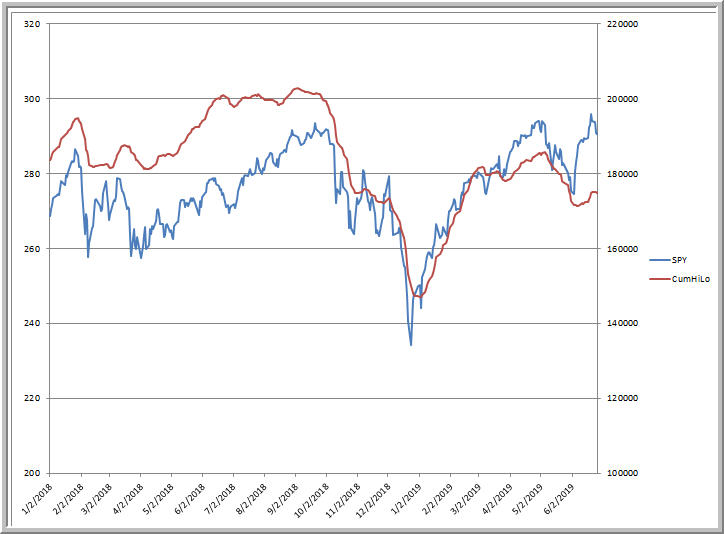
The first post in this series took a look at cumulative fresh monthly highs minus monthly lows among all listed stocks.  This is a nice way of capturing intermediate term strength and weakness among shares, as we should see more new highs than new lows during solid uptrends and vice versa.  As we saw in the post, the recent strength in the large cap stock indexes has not been confirmed by the cumulative new highs/lows, reflecting breadth weakness, particularly among midcap and small cap shares.

In this post, we examine breadth through a different lens.  Above we see SPY (blue line) plotted against a cumulative line constructed from the five-minute values of the NYSE TICK.  Recall that the TICK ($TICK on most platforms) is a real time measure of the number of NYSE shares trading on upticks minus those trading on downticks.  By adding the values to one another over time, as we do with advance-decline lines, we can gauge whether there is overall more buying or selling pressure in the market.

Note that the cumulative TICK has tended to top out ahead of the market, reflecting growing selling pressure even as SPX makes new highs.  This pattern is seen at present, as the Cumulative TICK is well short of its highs of earlier this year and early in 2018.  Again reflecting relative weakness among the smaller cap components of the NYSE Index, the Cumulative TICK has been particularly weak during this most recent rise in prices.

All of this gives me pause regarding the intermediate-term outlook for stocks.  Price has moved higher, but fewer stocks are participating in the strength.  This pattern has been playing out with a vengeance globally.  If we look at weekly charts of European equities (VGK); global stocks minus the U.S. (EFA); and especially emerging market shares (EEM), we can see significant relative weakness with respect to U.S. stocks.  Those same weekly charts reveal relative weakness across many sectors of the U.S. market, including XLE (energy); smaller cap shares (IWM); financial shares (XLF); homebuilders (XHB); and raw material stocks (XLB).

In the past, lengthy periods of breadth divergence have given way to meaningful bear markets, as many bulls are trapped in their positions and eventually have to protect their profits.  This occurred in 1999-2000 and again throughout 2007-early 2008.  The current divergence from early 2018 through the present is not encouraging in that regard.  I need to see a meaningful pickup in breadth to justify a medium-term exposure to stocks.

Further Reading:

.

Thursday, June 27, 2019

Looking At The Market Through Different Lenses: 1 - Cumulative Highs/Lows

In these posts, I will take a look at the overall U.S. stock market (SPY) through some non-traditional lenses that help inform my view.  The key is not getting stuck viewing the market through any one lens, but rather using the different perspectives to synthesize an overall market perspective.  This is fundamentally a creative process, assembling information into fresh views.

Above we can see SPY (blue line) plotted against a cumulative line of daily fresh 20-day new highs minus 20-day new lows for all exchange listed shares.  (Raw data from Barchart.com).  The idea here is that breadth will be expanding over time for strong markets and waning for weak ones.  As markets top out, they become more selective in their strength, with certain sectors holding up well and others leading the way to the coming decline.

Note that we have made marginal new highs in SPY recently, but the cumulative line has failed to confirm.  It appears we are making a lower high in that line currently, given the relative weakness of smaller-cap shares.  This pattern of extended non-confirmation of the cumulative line showed up in 2007 prior to the large decline of 2008.  I treat this information as a cautionary signal for the market longer term, but do not form a market opinion solely upon one such yellow flag.

Further Reading:

.  

Monday, June 24, 2019

Three Tough Questions Traders Need To Ask Themselves

I work with traders who do a great job of tracking their most recent trades and figuring out what they did right and wrong each day.  What they don't do as well is ask the big questions.  It is like a company that gets better and better at manufacturing their product, but fails to look at the bigger picture of supply/demand for that product.  It doesn't help to get better at making manual typewriters or flip phones when those are becoming extinct.  No amount of focus on tactics can substitute for effective strategy.

Here are three sets of questions traders need to ask themselves periodically:

1)  Is what I'm doing truly unique, or am I simply part of the consensus?  What, specifically, in my trading approach and process is different from what the herd is doing and how, specifically, is that giving me an edge?

These are questions every business needs to ask.  Why should you succeed?  What makes you different and better?  How do you know that you have a genuine edge?  There are many "me too" businesses and many "me too" traders.  It is difficult to think of highly successful business or traders who are playing the same game as their competitors, the same way.  

2)  How am I building my business?  What am I researching and developing today that will help provide tomorrow's profits?  How am I actively adapting to market conditions to find new sources of edge?

Many traders spend all their time trading and very little time developing new frameworks for exploiting financial markets.  They are like businesses that keep churning out a product or service, never adapting to the changing needs and desires of consumers.  Look at the great technology businesses, retailers, and pharma firms.  All heavily invest in research, development, and technology and all have a pipelines of innovations.

3)  How, specifically, does my lifestyle provide me with an edge in this peak performance activity of trading?  What do I do each day to maximize my energy, focus, wellness, and emotional well-being?  How do my review processes actively create new goals and learning for the future, so that I am always growing?  If I saw a professional athlete with my lifestyle, would I expect him/her to succeed?

One dynamic I've emphasized over the years is that performance professionals are always training.  They spend more time preparing to win than actually participating in formal competition.  Can we expect ourselves to be disciplined in trading if we lead undisciplined lives?  Can we expect to maximize our focus in trading if we are continually distracted by our phones, televisions, and chats?  Our time outside of trading is our training for trading, by design and by default.

The above questions make a great backbone for a trading business plan.  Yes, it helps to review trading each day, but it's the overarching plan and vision that keeps us energized and inspired.  As the old saying goes, failure to plan can amount to planning to fail.  We're not likely to reach any distant destination if we don't have a map and travel plan.  Writing out your plan can be a solid grounding that aligns your daily efforts with your larger life goals.

Further Reading:

.

Thursday, June 20, 2019

Trading Psychology Techniques - #10: Overcoming Overconfidence

I have found that runs of winning trades are just as dangerous for traders as runs of losers.  It is very common that we anchor ourselves to our most recent returns, trading too small after we lose money and too large after wins.  This means that we're often too small when we turn our trading around and too large when we encounter inevitable losing trades.  The overconfidence dynamic is common among momentum traders who become more confident in the trade as it goes their way, adding to positions that have already moved in their favor.  This greatly changes their average price and makes them vulnerable to normal reversals.

The mistake traders make in anchoring themselves to recent returns is a failure to recognize randomness in the outcomes of a few trades.  A 50/50 win/loss ratio for an active trader means that strings of four losing trades (or days) will inevitably occur.  If every such series leads to a loss of confidence and a micro-managing of the trading process, it will be difficult to sustain consistency.

On the other hand, it's inevitable that such a trader will have strings of winning trades or days simply by chance.  If this leads to overconfident thinking and a doubling down on risk-taking, the trader will quickly give back those gains.

A great exercise to combat overconfidence is to visualize the scenario in which it's January 1st and you are neither up money or down money.  Would you take the trade that you're contemplating if your P/L was flat?  If so, how would you size that trade?  How much would you risk?  If the trade is truly a good one, you would take it on January 1st and size it reasonably.  If the trade is more marginal--the result of overconfidence--you would be much less likely to put it on with a flat P/L.  By vividly imagining a flat P/L, you help yourself get flat in your head, reducing emotional pulls.

Another useful technique is to actively rehearse, prior to putting on the trade, what you would need to see to tell you the trade is wrong and that you need to exit.  When we're overconfident, we often don't process adverse scenarios.  By making such processing an active part of your preparation, you give yourself a more balanced perspective during the life of the trade.  

"This, too, shall pass" is a great mindset after periods of both losing and winning.  Imagine the surgeon about to operate.  You don't want that surgeon to be wildly excited and overconfident, and you don't want that surgeon to be fearful and hesitant.  Each trade is a kind of surgery, and the best you can do is stick to the best practices that have produced favorable outcomes in the past.

Further Reading:

.

Monday, June 17, 2019

Trading Psychology Techniques - 9: Conquering Negativity

The past three posts in this series have dealt with building self-awareness; facing trading fears and anxieties; and overcoming frustration and anger.  In this post, we will tackle negative thinking patterns and how these can be turned around.

The first principle and most important practice is to live a positive life outside of your trading.  It is impossible to sustain an optimistic and constructive mindset during trading if what you are reinforcing during your other hours is negative.  If you take a look at the recent Forbes posting, you'll notice a non-traditional take on the recent Father's Day holiday.  The idea is to turn the holiday into a positive emotional experience by widening its meaning.  This is something that can be done in many areas of life.  Spending time with friends, relationship partners, family, and colleagues is great, but how can we make this time truly fun, inspiring, and meaningful?  As I point out in the book that I am currently writing (due out during the summer), the key is avoiding routine and seeking experiences that are special.

How can we possibly turn our thoughts and behaviors around if we are stuck in a life of routine?

The cognitive approach to conquering negativity is especially powerful.  That requires building the self-awareness to recognize when you are talking to yourself in ways that are not helpful and constructive.  As I've mentioned in my books, a great way to reinforce that self-awareness is to regularly ask yourself, "Would I be talking to someone else I cared about who is in my situation the same way that I'm talking to myself?"  This is helpful, because it reframes our thought patterns as conversations.  Very often, if we view our thoughts as ways that we're talking to ourselves, we can see that the conversations are negative and serve no constructive function.

Once we can recognize the negative thinking patterns, we want to tune into their destructive consequences.  By reminding ourselves that this kind of thinking robs us of energy, takes away our focus, and causes us to be less productive and creative in generating ideas, we gain the ability to become angry at our own negativity.  This is a very important principle.  We are most likely to change a pattern when we view it as an adversary: as something that stands in the way of our happiness and success.  Reminding ourselves of the consequences of our negative self-talk helps us marshal the energy to engage in a much more helpful processing of our situation.

That sequence--recognize negativity, challenge negativity, replace negativity with more constructive self-talk--can become a positive habit pattern if repeated multiple times per day for many days.  Yes, of course, negative thoughts will pop into your head, but you'll be able to quickly smack them down if you immediate recognize their consequences and generate more helpful ways to view the situation.  In my own trading, I turn negative thoughts into learning thoughts.  If each of my losses and mistakes can teach me something--something about me, something about markets--then I can actually value my mistakes and stay positive in the face of temporary drawdown.

Negative things always happen in life.  The resilient person doesn't internalize those setbacks.  Setbacks exist for a reason, and we can turn them into fuel for our personal development and the development of our trading.

EXPANDING YOUR MINDSET:  LESSONS FROM FATHER'S DAY
.  

Thursday, June 13, 2019

Trading Psychology Techniques - 8: Overcoming Frustration

The last post in this series focused on ways of overcoming our trading fears.  Many times, it is frustration that can take a trader out of the zone and disrupt trading plans, including risk management.  When trades don't work out--or when we miss good opportunities--there is plenty of room for anger and frustration.  Frustration occurs when we have a strong set of desires or needs and those are thwarted.  Getting stuck in a traffic jam when we have to make an appointment is a great example.  

There are two types of methods that can help us overcome frustration:

1)  Behavioral - This would include relaxation/visualization exercises, biofeedback work, and meditation.  In these techniques, we learn to recognize the signs of frustration as they are occurring (angry thoughts, physiological arousal, pounding the table, etc.).  We then pull back from the frustrating situation and perform exercises that calm us and require us to sustain focus.  For example, in meditation we might slow and deepen our breathing, keeping it quite regular, while we maintain focus on a peaceful image.  By entering cognitive and physical states incompatible with frustration, we can short circuit the anger and prevent it from dominating our actions and decisions.  One powerful variation of the behavioral method is to engage in guided imagery when we are not trading and vividly imagine scenarios that normally might frustrate you.  While you are imagining the frustrating scenes in great detail, you are keeping yourself chilled:  slow, deep breathing, maintaining stillness, etc.  Doing this exercise repeatedly allows you to internalize the calm response when the frustrating situation occurs in real life.  The key is repetition, so that your calming becomes an automatic response to situations that don't work out.

2)  Cognitive - Cognitive methods look at our thoughts and mind states as triggers for our emotional responses.  As the above quote suggests, frustrations are generally preceded by strong expectations and needs.  If we strongly expect a trade to work out--and, even more, if we need it to work out--we set ourselves up for frustration when our scenario doesn't play out.  Such expectations and needs occur when we place too much ego into our trading, so that our feelings about ourselves rise and fall with our profits and losses.  One technique that works well for me is to size initial positions moderately and view the initial trade as a hypothesis.  If my hypothesis is disconfirmed, I can take a modest loss and use that information to potentially take a trade in the other direction.  By viewing my idea as a hypothesis rather than a conclusion, I am mentally prepared to be wrong and, indeed, am in a mindset where I can accept the loss as money well spent for market information.  Risk management is a powerful tool for keeping frustration manageable.  I never want to lose so much in one day that I can't come back over the course of the week.  I never want to lose so much in a week that I can't go green on the month.  When we can frame losses as challenges, they can energize us, not frustrate us.

Trading with too little capital and expecting unrealistic returns to make a wonderful living set us up for disappointment and frustration.  I know developing traders who view each day and week as a verdict on whether or not they'll succeed at what they're doing.  That is simply too stressful for the purpose of maintaining consistency in trading.  We are much more likely to be consistent in our trading if we sustain a consistent mindframe.  That means training ourselves to accept and learn from losses and treat them as learning opportunities, not as existential threats.  Practice in behavioral and cognitive methods can help us create positive habit patterns that defuse frustration and keep us in control of our trading.

Previous Posts in This Series:


.

Sunday, June 09, 2019

Three Key Mistakes Traders Make In Evaluating Their Trading

Ongoing evaluation of our trading enables us to learn from experience and guide ourselves toward improvements.  We cannot change what we do not observe and measure.  Successful traders study themselves--and their performance--every bit as diligently as they study markets.

On Monday, June 10th, I will participate in a webinar with the good folks at Bookmap, where we will discuss ways of evaluating and improving our trading.  The session will be at 11 AM Eastern Time and will include time for Q&A.  Registration is free and available here.

Traders make a number of mistakes when trying to evaluate themselves.  Here are three of the most common:

1)  Too general and subjective - The trader doesn't drill down to identify what he or she has done well or poorly in specific trades.  The evaluation simply notes general problems like fear of missing or traded too small.  The evaluation should not only identify specific mistakes, but also highlight specific ways of correcting those.  That turns the evaluation into goal setting and planning.

2)  Not enough information - The traders I work with at SMB utilize software that captures information on all trades all the time.  That way the traders know exactly how many winning and losing trades they've had; the average sizes of winners and losers; the win rate as a function of time of day; a breakdown of P/L by strategy; and much more.  All this information provides useful information about what the trader is doing well and what needs improvement.  Many, many times, the areas that stand out as needing work are ones that the trader was not focusing on.  In the webinar, I'll discuss the use of software to aid our evaluation.

3)  Not tailored to the trader - Some of the best evaluation comes from knowing what you do best and how you do it.  That way, you can evaluate yourself according to your best practices.  A generic evaluation sheet is probably better than none, but most helpful is an assessment that grades you on the dimensions most crucial to your success.  For example, if certain ways of managing your time and energy help your trading, those should be part of your evaluation.    

Many traders could be advancing much faster if they would only improve their learning processes.  In the Monday webinar and in future blog posts, I look forward to outlining ways in which we can become more effective learners.

.

Monday, June 03, 2019

Trading Psychology Techniques - 7: Facing Your Fears

A while back, I worked with a trader and reviewed his P/L statistics.  Keeping good statistics on your trading is a universal best practice.  The patterns of wins and losses--and the progress over time--reveals a great deal about your trading--and your trading psychology.

What made this trader unusual was a pattern of small wins and small losses.  He had a daily loss limit and never came near that number, either on the downside or the upside.  

When we examined his trading, it was clear that he had profit targets on his trades and he had stop loss levels.  These were appropriate, given his daily limits.  He gave himself room to be wrong with his stops and also gave room to trades to run if they worked out.

So what's the problem?

As we examined his trading, we quickly saw that he rarely let his trades stop out and he rarely hit his profit targets.  He stopped out of trades quickly when they went against him and he took profits quickly when trades went his way.

In short, his trading was an exercise in fear.  When he feared loss, he quickly exited.  When he feared losing gains, he quickly exited.  Over time, that had him playing small ball as a trader.  Psychologically, it meant that he was always acting on fear.

We reinforce what we act upon.  If we act on fear, we reinforce fear.  If we act out of frustration, we reinforce frustration.  Is it any wonder that, fearfully exiting one trade after another, this trader never developed confidence in what he was doing?

An important psychological rule is that we can only overcome our fears by directly facing them.  If I am afraid of going outdoors, I cannot develop confidence by staying indoors.  What I need is to experience the very thing that I'm afraid of and see--in my own experience--that nothing terrible happens if there is an adverse outcome.  In that sense, we don't gain confidence from success alone.  We gain confidence by failing--and seeing that we can bounce back.

This is where the use of imagery is tremendously helpful.  We can visualize, in great detail, having a winning trade reverse on us or having a trade hit its stop, and mentally rehearse how we would like to deal with that situation.  If we mentally rehearse these scenarios again and again, they become familiar to us and no longer so threatening.  That reinforces confidence, because we're telling ourselves that we can fail and bounce back.

Note that what we're doing with such imagery methods is sustaining a state of self-awareness while talking ourselves through the fearful episode.  With sufficient practice, we can become quite good at invoking the self-awareness in real time.  What we've rehearsed with imagery comes back to us during actual trading.

The trader I met with learned to redefine his fears.  Once he realized that playing small ball guaranteed he would never reach his goals, he became fearful of being fearful.  In other words, he changed his perspective.  The problem wasn't losing money; the problem became preventing himself from making money!  In the state of self-awareness, he now viewed his situation differently, and that enabled him to trade very differently.

Further Reading:

.