Sunday, April 09, 2023

What Makes for Success: Five Perspectives From Trading Psychology


Here are a few observations from my recent research and work with traders:

1)  The success of a trader is directly related to the speed by which they turn losing trades and drawdowns into actionable improvements.  The best traders engage in active review processes to ensure that they learn from setbacks.  Those reviews also allow them to learn from successes.  A major source of poor performance among traders is failing to engage in timely and regular deliberate practiceSuccessful market participants study themselves intensively, just as they study markets intensively.  Unsuccessful participants don't study; they are too busy trading.

2)  There are two types of traders:  a) those who are risk-takers and need to learn to limit losses; and b) those who are risk-minimizers and need to expand gains.  We tend to manage our trading the way we manage risks and rewards in other areas of life, because--ultimately--we are managing ourselves emotionally.  The challenge is to understand how we are wired and how to best express and manage that in our trading.  Many trading problems occur when we attempt to take risk in ways that interfere with our self-management.

3)  I'm hearing more from relatively inexperienced traders who are harvesting money by selling option premium.  It makes me cautious.  The history of 2023 thus far has been for game-changing news to greatly impact how markets trade--and how they trade relative to one another.  Note the recent interest in the shadow banking system and its vulnerabilities:  here, here, and here.  After recent banking concerns, it wouldn't take much of a headline to throw markets into a tizzy.  The idea is to maintain flexibility even when acting decisively.  Maintaining "conviction" has not worked well for many traders thus far this year.

4)  Recent posts have focused on breadth as measured sector-by-sector--and especially the phenomenon of breadth thrusts.  My latest research examines differences in breadth between U.S. sectors and how these are related to SPX returns going forward.  At present, consumer staples shares are outperforming consumer discretionary stocks by a pretty good margin over 5 and 20-day periods.  Going back to 2020, when that has occurred, next 10-20 day SPX returns have been negative and significantly below average.  Shifts to more defensive positioning among sectors appear to precede overall market weakness, an idea I'll be exploring in detail going forward.  Breadth shifts may be as important to forward returns as breadth thrusts.

5)  Imagine that you are at a racetrack and you are allowed to alter your bets at set intervals during the race.  No doubt you would alter your risk taking as the race evolves.  The best traders develop good bets, but then actively update risk and reward over the life of the trade to maximize gains and minimize losses.  The inability to update one's "bets" in the face of changing market conditions has been a major source of performance problems so far this year.  Many traders lack a robust process for walking forward and updating risk and reward in real time.

Further Reading:

.  

Sunday, April 02, 2023

Breadth Thrusts in the Stock Market: What Comes Next?

 
The previous post noted a late week bounce in stocks that had a defensive quality, with consumer staples and utility shares outpacing stocks in such sectors as energy and consumer discretionary.  On Monday there was another bounce, but the percentage of energy shares above their five-day moving averages went from about 22% to almost 96%.  The beaten down real estate stocks went from 43% to 63%; financials went from 17% to 58%.  Consumer discretionary shares went from 25% to 46%.  Tuesday the overall market (SPY) dipped, but again we saw a rising percentage of XLY, XLE, XLF, and XLRE stocks above their five-day averages.  By Wednesday, fully 94% of all SPX stocks were trading above their five-day moving averages.  In other words, we went from a defensive market theme to an aggressive one, creating a breadth thrust:  the great majority of shares participated to the upside.  This strength continued through the week.  The change of market theme was signaled by a shift in the patterning of market breadth.

So what does this market breadth thrust suggest going forward?  We can look from two perspectives:

1)  The presence of strength - I went back to 2006 and identified all market occasions in which more than 90% of SPX stocks were above their 3, 5, and 10-day moving averages at the same time.  Interestingly, out of well over 4000 market days, this only occurred on 42 occasions.  Over the next five trading sessions, the market was down by an average of -.26%, compared with a gain of +.18% for the remainder of the sample.  No particular edge here, even going out 20 days.  Returns over a next 20-day period were volatile, with 17 of the 42 occasions rising or falling by over 5%.

2)  The absence of weakness - If we get a true breadth thrust, we should see very few stocks demonstrating weakness.  I track the number of NYSE stocks giving sell signals on two technical indicator measures:  the Bollinger Bands and the Parabolic SAR.  These track price action over differing time periods.   On Friday, we had 10 or fewer stocks giving sell signals on both measures.  Out of almost 900 market days in my database, this only occurred on 7 occasions.  Again, very unusual.  The number of occasions is too small for reliable statistical inference, but it is noteworthy that the market overall underperformed over the next ten trading sessions and outperformed 30 days out.  Most interesting, four of those seven instances occurred as a cluster in April of 2020.  The question this invites is whether the current period (possible Fed pivot in rate policy due to bank concerns) is similar to the 2020 period (Fed pivot in the face of COVID impact).

Analyses such as these are meant to help in the formulation of credible market hypotheses, not the generation of infallible ideasBreadth thrust may be most important in the context in which it occurs.  If it occurs as a "blowoff" following a period of strength, we would expect volatile and negative returns going forward.  If it occurs following a protracted selloff, we would expect volatile and positive returns going forward as a function of short-covering and new buying.  At present, I'm open to the notion that we are, indeed, seeing a regime shift in the stock market, reflecting a change in central bank policy.  If that is the case, near-term weakness could become an opportunity to participate in longer-term cyclical strength.

Further Reading:

What Market Strength Told Us Earlier This Year

.

Sunday, March 26, 2023

Understanding Market Themes From Sector Breadth


For years, I have kept breadth data on the overall stock market, tracking shares making fresh highs and lows over various periods and the percentages of stocks trading above their short, medium, and longer-term moving averages.  What I've found is that shifts in breadth often precede shifts in overall market direction.  This is because certain parts of the market will break down or rebound ahead of the market averages.  Conversely, during trending moves, we will see the great majority of shares participate in market rises or declines.  The breadth extremes are an excellent alert for overall market momentum.

This is a good example of how trading psychology is about the market's psychology, not just about our personal emotions and behaviors.  Breadth data are helpful in tracking changes in the sentiment of market participants.  

Recently, I have built out spreadsheets that track breadth on a sector by sector basis, as well as breadth for various factors such as small cap vs. large cap and growth vs. value.  The idea is that the patterning of breadth changes among the sectors helps us track market themes.  

So let's take an example from the recent market (data from the excellent Barchart site):

In the last two trading sessions of the past week, the overall SPX moved higher by almost 1%.  Overall short-term breadth (stocks trading above their five-day moving averages), rose from about 26% to about 45%.  Interestingly, over that same time, the same breadth for consumer discretionary stocks went from about 20% to 25%.  The breadth for consumer staples shares went from 27% to 85%.  The breadth of energy stocks went from 61% to 22%; the breadth of financial shares went from 25% to 17% and the breadth of utility stocks rose from 0% to 73%.  

This tells us several important things:

1)  The move higher has not been a broad trending move.  It is quite mixed.

2)  The move higher has benefited more defensive sectors (consumer staples, utilities) and not sectors that reflect economic growth (consumer discretionary, energy).

3)  The recent reassurances regarding the banking sector of the economy have not yet pushed financial shares meaningfully higher.

When we couple the pattern of market breadth with the movement of interest rates (lower), we again see defensive buying (bonds).  Interestingly, large cap tech stocks have similarly acted as a relative safe haven, with breadth over the past two sessions moving from 26% to 54%.

The bottom line is that the patterning of breadth reflects a defensive market with lower rates, suggesting concerns regarding recession.  In tracking breadth going forward, I will want to see if the recessionary hypothesis/theme gains traction or reverses.  The shifts in the patterning of breadth among equities, as well as the shifts among asset classes and geographic regions, allow us to update our forecasts for markets and economies.  This enables us to be open-minded and flexible, even as we assertively pursue themes in play.

Further Reading:

.

Sunday, March 19, 2023

Making Passion Your Purpose

 
This post begins with a music video, old concert footage of Neil Young and company doing "Like a Hurricane".  It's a great song, but the important thing is to watch Neil during the two extended guitar solos.  This is not someone playing a song; it's the song playing itself through him.  The passion with which he plays is tangible.  Living life passionately is not easy, but as Neil observed, "It's better to burn out than to fade away".

A lot of us are fading away.  We're doing the same things.  We do the same things the same way and glorify it as "discipline" and "process".  We focus on working harder until we forget how to truly play.  We track all that we do in efforts at improvement until little is left to spontaneity.  If we approached romantic relationships the way the approach markets, we would quickly lose all passion and life together would become little more than a well-oiled routine.

If we are to make passion our purpose, then we have to make time for the new and different:  new experiences, fresh perspectives, expanded relationships, and opportunities to truly feel what we're doing.  The challenge of peak performance is maintaining the spirit and energy of what we're doing even as we work on improvement and mastery.  That is why the practice sessions of great teams--athletic teams, military teams--combine exercises that rouse motivation and teamwork with exercises that build skills.  Go into any locker room at halftime:  the great teams will fire themselves up, not unlike Neil Young's absorption in his music.

Wanting to make money is not passion.  Filling out trading journals and reviewing performance is not passion.  All these are necessary, but not sufficient for peak performance.  Passion comes from absorbing ourselves in what we love.

What do you love about markets?  How can you so absorb yourself in that love that your trading takes on the quality of Neil Young's guitar solos?  

Or are you working so hard to take emotion out of your trading that your trading career is fast-becoming a passionless romance?

This past week I've created a historical database of breadth statistics for a wide variety of market sectors, so that it's possible to see where money is flowing in and out of the market--and then backtest the significance of such shifts.  That is leading to new discoveries--new ways of detecting market regime changes in real time--and that fires up the passion.  More to come--

Further Reading:

Passion, Purpose, and Why Traders Fail

.

Saturday, March 11, 2023

Broad Stock Market Selloff: What Comes Next?

 
If everyone agreed on the value of an asset, there would be no price movement.  When price movement becomes volatile, we know that there is meaningful disagreement regarding value.  This was an important dynamic in the stock market this past week.  Let's see if we can look at the market from a data-driven perspective and gain some insight into what was going on--and what that could mean going forward.

The first important piece of information was that the past week's selloff was indeed broad.  Consider the following:  Out of the 500 stocks in the SPX average, the number making five-day new lows minus the number making five-day new highs was 442, and the number making twenty-day new lows minus new highs was 331.  The percentage of stocks in the SPX universe closing above their five-day moving averages was 1.98.  Only a little over 6% of stocks closed above their five-day averages.  Everything.  Was.  Weak.

The second important piece of information was that trading following the news of the SVB failure significantly differed from the trading up to that point.  Prior to the news, we were seeing weak stocks and weak bonds, as traders feared that inflation would be "sticky" and that the Federal Reserve Bank would need to raise rates more than expected earlier.  Following the news, selling became much more intense.  We saw elevated volume, elevated implied volatility readings (VIX), and elevated negative NYSE TICK numbers.  Indeed, the first tell that the SVB news was a game changer was the persistent TICK readings below -1000.  That can only occur when there is aggressive selling of large baskets of stocks.

The third important piece of information was that correlations within and across markets shifted dramatically.  Financial shares, such as those making up the XLF ETF, aggressively led the downside.  Fixed income, which had been trading lower in anticipation of higher yields, became a safe haven and rallied aggressively.  The market's narrative had changed from strong economy/inflation/higher rates to bank failure/economic uncertainty.  It would have been difficult for market participants to detect this regime change if they were not tracking volatility, volume, breadth, and market correlations.

So what might follow from such a selloff?  I went to my breadth database, which goes back to 2010, and I identified all occasions in which over 400 of the SPX 500 stocks closed at five-day lows and over half closed at 20-day lows.  Out of 3298 market days, only 38 met these criteria.  In other words, such broad selloffs have been rare.  Interestingly, instances of these selloffs have tended to cluster.  We had four occasions in early 2020; four in late 2018; three in August of 2015; and seven from August to November, 2011.  Across all 38 instances, there was a tendency to bounce the next day (24 up, 14 down for an average gain of +.93% vs. +.03% for the rest of the sample).  By ten days later, there was no upside edge whatsoever.  What was striking was that, over the next ten days, the market moved up or down more than 4% on fifteen of the occasions.  In other words, volatility tended to persist; direction was a crapshoot.

There is a temptation among short-term traders to look for bounces in assets that are oversold.  The problem with this idea is that we need to understand *why* we have gotten to such an oversold point.  The recent market activity has been abnormal.  That is why only a little more than 1% of days since 2010 have shown such weakness.  When a bank is at risk of failing and other banks are moving lower in sympathy, the result is a level of volatility that tells us that investors are questioning underlying value.  The first step in charting a trading or investing strategy is to recognize that we have entered relatively uncharted waters.  Trading with "discipline" and blindly following the "setups" and ideas from earlier this month is dangerous indeed.

Further Reading:

Using Breadth and Strength to Track Market Cycles

.  

Sunday, March 05, 2023

The Most Important Factor in Successful Relationships


As I emphasized in the Trading Psychology 2.0 book, research in psychology is clear that we are most productive, creative, and successful when we experience high levels of happiness, fulfillment, energy, and closeness to others.  This is an important reason why burnout is such a risk in high performance fields.  Once we prioritize tasks over our well-being, we drain ourselves of the very things that we need to be at our best.  Imagine if someone cared about you and said, "I want to spend more time with you" and you responded, "I don't have time for you!"  That would never happen in a truly loving relationship, but it's basically how many of us relate to ourselves.  

Abraham Maslow, the well-known psychologist, made the distinction between deficit needs and being needs.  A deficit need is one in which I try to fill something missing in myself.  For example, if I don't feel that I am lovable as I am, I may seek a partner who is so needy that they will stay with me.  I am filling a gap in my life--and in my self-esteem.  If I am secure and want to maximize my life, I will seek a partner for their values, strengths, and achievements.  Indeed, in a good relationship, a partner typically possesses strengths that we lack.  That is how relationships make us better:  we absorb the positive qualities of who we are with.  If, however, I'm threatened by the strengths of the other person, I will respond to them with insecurity and defensiveness and, eventually, the relationship will fail.

Good relationships are built on a foundation of positives.  Unsuccessful relationships are fundamentally self-focused, using other people to (vainly) fill our gaps.  When we seek out people based on their needs, their growth and development become threats to us.  That is how many marriages end.

This is as true in work relationships as personal ones.  A great hire for a team is someone who makes everyone else better with unique skills and experience.  A secure manager looks for people who make them better; an insecure manager looks for people who won't leave them.  A secure leader celebrates the successes of others; an insecure manager responds with envy.

The most important factor in successful relationships is the desire to find people who are better than us in some areas of life.  We become who we surround ourselves by.  Our approach to relationships can either become an engine of growth or a prison of insecurity.

Further Reading:

Our Relationships Shape Our Relationship With Ourselves

.    

Sunday, February 26, 2023

The Most Common Weakness I Observe Among Traders

 
There is a myth among developing traders that all you need to do for success is find a style of trading that fits your personality and then stick to that style with discipline and consistency.

What nonsense.

Consider other performance domains, such as basketball or surgery or opera singing.  Does a basketball team stick with a single defensive style regardless of the competition?  Do surgeons follow techniques based upon their personalities or based on objective scientific data?  Do professional singers adopt the same style to every composition they perform? 

The reality is that high performance professionals learn to adapt their styles to the conditions of performance.  A tennis player adapts to clay and grass courts.  A football team adapts to changing defensive alignments.  Actors adapt to their roles.

The most common weakness I observe among traders is that they seek a style of trading and attempt to fit that style into all market conditions.  For example, a trader may seek to profit from trend or momentum, only to become frustrated when markets are "choppy"  A trader may seek to trade one time frame when market cycles operate on very different scales.

My favorite analogy for this situation is the dancer who has a single style of dancing regardless of the music playing.  While everyone else is slow-dancing to a waltz, they are thrashing about, mosh-pit style.  Then they wonder why no one will dance with them...

The first question a trader must ask is not about "setups" and what is moving.  The first question is:  How is this market behaving and does that behavior present opportunities that I can exploit?  Before you start dancing, you listen to the music.  Before you begin surgery, you study the patient's condition.

Having a single style that you impose across all markets is not discipline; it is inflexibility.  Some of the best market opportunities come from occasions when trades that had been working suddenly don't work.  That can be a wonderful heads-up that conditions have changed and that it's time to adapt.

Further Reading:

The Challenge of Adapting to Changing Markets

.

Sunday, February 19, 2023

Reaching Your Goals Through Gentle Power


In her remarkable book Gentle Power, Emilia Elisabet Lahti describes how true leadership requires an integration of strength and power on one hand and love and gentleness on the other.  The combination of these qualities creates a trait known in Finland as sisu.  It is through sisu that we are able to persevere under challenging conditions, transcending fatigue and frustration to find our emotional and spiritual second wind.  A while back, I wrote an article pertinent to sisu, citing the mixed martial arts accomplishments of Kyle Maynard, who was born without arms and legs.  Interestingly, Maynard practiced for his bouts by mentally rehearsing all his anxieties and fears in advance.  By training himself to face his greatest fears, he built his mental strength.

Lahti would view this as an excellent example of gentle power:  facing adversity, but in a manner that is supportive and constructive.  In the Gentle Power book, she describes her incredible 50-day running journey across New Zealand, in which she ran the equivalent of a marathon each day.  She was accompanied by a single trainer and otherwise faced each day in solitary contemplation.  On the twelfth day of the journey, she was overcome with pain and swelling.  As she ran, the insight came to her, "The pain ends when you make it end".  She realized that, all her life, it had been easier for her to be hard on herself than merciful.  That insight led her to take a break from the run, allow herself to heal, and ultimately finish the route.  She found a way to persevere:  by supporting herself.

How relevant this idea is for all of us who participate in performance activities.  Our very achievement orientation and desire to win make it easier for us to be hard on ourselves than supportive.  The idea is not to give up on our quest; nor is it to allow our quest to drive ourselves into the ground.  Only through the sisu of gentle power can we find ways to move forward that also take care of us.  As Lahti points out, this is tremendously important for leadership.  As a team, we must push ourselves, but in ways that preserve teamwork and the bonds of mutual support.

Our life is our ultramarathon quest.  Whether and how we finish will depend upon our power--and our gentleness.

Further Reading:


.

Sunday, February 12, 2023

Our Physical Experience Shapes Our Mindset

 
In a recent post, I highlighted the role of physical experience in our psychological states.  That post raised a fascinating possibility:

Could it be the case that, just as we read others through their "body language", we process our experiences of ourselves through our bodily states?  What if we are continuously reading our own body language and internalizing what we're reading as our self-image, self-concept, and self-esteem? 

Most of us are familiar with the cognitive framework in which what we think influences how we feel.  There is undeniable importance to this perspective.  If we immerse ourselves in negative self-talk, it's inevitable that we will feel anxious, depressed, frustrated, and resentful.  Equally important is the observation that we are much more likely to lapse into negative self-talk when we lack energy and vitality.  

Suppose we are trying to grow a beautiful garden.  We could select the best flowers and plants and plant the best seeds we can find.  Ultimately, however, the garden will not thrive unless we attend to the soil and water.  What is good for the roots ultimately shapes the beauty of the flowers.

Most psychology is "top-down":  change your behavior by changing your mind.

What if, however, we are more like the garden and need to grow from "bottom-up"?

The important insight in the above quote is that "we are continuously reading our own body language and internalizing" our experience.  Is there a relationship between how we move our bodies and our mood?  Our energy level?  Is there a relationship between how we breathe and how we experience the world?  Is there a relationship between the strength and flexibility of our bodies and our overall energy level and life perspective?

When we are trapped in negative habit patterns, might those be the result of our imprisonment in routine physical states?

Can we expect to have a fresh and energized trading psychology when our bodies are sitting inertly for hours at a time, staring at screens?

If we want to change our mindset, perhaps the most important question is, "What can I be doing right here, right now, to produce the mindset I want?"  We change by doing.  We become our experience:  that is our water and soil.

Further Reading:

Using Our Bodies to Program Our Minds

Body as Gateway to Mind

Renewing Mind by Renewing Body

.

Sunday, February 05, 2023

What is the Path to Your Greatness?


Many traders long for great profits.  How many do truly great things to achieve those profits?  If you were to do the things that would earn unusually positive returns, you would be doing unique things--you would be far from consensus.  You would have unique ways of generating ideas and managing the positions based on those ideas. You would have an ongoing pipeline of projects to get better and better and exploit new and different market conditions.  You would not be a one-trick pony making money in bull or bear markets or in conditions of volatility.  You would cultivate ways of succeeding across many market conditions.

Most importantly, great people don't magically achieve their status.  Their greatness comes from doing unique and special things each day, each week.  I invite you to read this older post:  It asks the important question, "How can people experience themselves greatly if there's no single thing during the day that they undertake in an exemplary way?"

Greatness does not come from working harder at routine activities.  It comes from expanding ourselves beyond those routines.  Creative geniuses by definition operate outside the box in much of what they do.  Because they pursue what speaks to them, they are able to achieve unusual levels of absorption and productivity, fueling the development of expertise

What speaks to you?  What are the little things you do greatly?  You will find your greatest success by building upon the exemplary things you already do with passion and uniqueness.

Further Reading:

The Role of Creative Insight in Trading

.

Sunday, January 22, 2023

Changing Your Trading Psychology By Changing Your Body

 
A fascinating finding from research in psychology is that lasting changes in thought, feeling, and behavior require processing of our experience in states of heightened emotional arousal.  When we are in novel modes of consciousness, we become more open to new ways of viewing ourselves and the world.  One of the most powerful gateways to shifts in our states of awareness is the body.  We see this in meditation, yoga, and hypnosis.  We also see this principle at work in psychotherapy, when the enhanced emotional experience of a relationship with a therapist helps us get in touch with feelings and opens the door to new perspectives on ourselves.  Think about visualization exercises in behavioral work or self-talk exercises in cognitive therapy.  We change our viewing by shifting our doing.

Of course, we don't need to be in therapy to enhance our states of awareness and our physical states.  Indeed, there is much to be said for using our physical states during the day to keep ourselves from falling into the ruts of routine.  Research in psychology tells us that high levels of positive emotional experience (well-being) are essential to optimal productivity and creativity.  An important dimension of well-being is our energy level.  We cannot expect to be dynamic people or performers living in static bodies.

Many of our most successful change efforts begin with the body.  We can use our bodies to program our minds, as in biofeedback and self-hypnosis, enabling us greater access to our "gut" intuitions.  In a prior post, I noted that what we internalize is much more a function of what we do than what we say and think.  How we move the body greatly impacts our psychology.  Think about how different kinds of dance impact our experience; think about how we use anchoring to cement new behaviors.  Across the great religious and spiritual traditions of the world, we see how the body is a gateway to change, as in the case of fasting and shifting the body during prayer.

In her insightful and practical book Body Aware, Erica Hornthal, a licensed therapist and dance therapist, explains how utilizing the body to promote change is not just about physical exercise.  How we move--from hour to hour and day to day--greatly impacts our experience of ourselves.  "It is through the body that permanent change occurs, ultimately bringing new patterns of thought and speech...We must address how the body is wired, or in some cases 'miswired,' to fundamentally rewire the mind.  A body that is stretched by new experiences changes the mind's dimensions forever" (p. 74).    

Could it be the case that, just as we read others through their "body language", we process our experiences of ourselves through our bodily states?  What if we are continuously reading our own body language and internalizing what we're reading as our self-image, self-concept, and self-esteem?  As traders, we could be religiously keeping journals, studying markets, and collaborating with others, but if we are physically inert, not eating well, and not getting optimal sleep, can we expect to be truly open to fresh learning from our reviews and teamwork?  We can set goals and push for greater performance, but if we're experiencing ourselves as static and constrained, will we ever truly internalize the right mindsets?  As Erica Hornthal notes, a resilient mindset begins with a resilient body.

Further Reading:

Radical Renewal - The Spirituality of Trading

.

Saturday, January 14, 2023

What Does Recent Stock Market Strength Tell Us?


I've found that if you look at enough market indicators, you'll always find reasons to be long or short, and you'll always find reasons to trade.  Far better than following a host of canned indicators is constructing a select number of measures that make sense to you and then learning (and backtesting) their ins and outs.  Chasing multiple rabbits is a great way to wind up with none.

Kudos to the SentimenTrader service, which consistently offers excellent research for equity traders and investors.  They recently highlighted the upward breadth thrust in the market--a situation in which many stocks go from being oversold to overbought in a relatively short period of time--and noted the historical tendency for such moves to continue higher.  A common scenario that explains the pattern is that bears miss the market bottom and then miss the initial thrust higher and so view pullbacks as opportunities to ride the new trend.  That keeps pullbacks relatively modest and helps to create a trending move higher.

One of my favorite indicators comes from data offered by the Stock Charts site and their scans.  Each day I track how many stocks in the NYSE universe closed above and below their upper and lower Bollinger Bands.  When many stocks close above their respective bands, that tells you that there is unusual strength--and it is broad.  

Just in the past week alone, we've had three days in which over 400 stocks closed above their upper bands.  To put this into perspective, since 2019, when I first began archiving these data, there have only been 15 prior occasions of individual days with over 400 stocks closing above their bands.  Such days of strength are rare--and now we're seeing a cluster of such strong days.  Somewhat similar clusters occurred in June and November of 2020; both led to higher prices in the medium term.  Indeed, following the 15 occasions of breadth strength, SPY was higher 11 times, lower 4 times over the next 20 trading sessions.  Average gains were +2.45% vs. +.85% for the remainder of the sample.  Interestingly, following the strong days, there has been no significant directional edge over the following five trading sessions.  It's not unusual to get some consolidation before the trend resumes.

I'm currently working on an intraday breadth thrust model to see how well it anticipates short-term patterns of momentum.  That will require a new and different indicator and perhaps a new way of thinking about breadth.  This could open the door to intraday measures of breadth thrust.  

We hear a lot about traders' "edge" in the markets.  Edges, I've found, are always evolving--and the successful traders are the ones who evolve along with markets.  As an increasing amount of capital is being traded by highly leveraged funds, we're finding a growing number of portfolio managers managing risk on a short-term basis.  This is creating shorter-term patterns of momentum and reversal that can be exploited by nimble traders employing the right tools.  

Further Reading:


.

Friday, January 06, 2023

Being Honest With Yourself

 
The person we long to be is not necessarily the person we're meant to be.  Many people pursue ideals that don't represent their true strengths and how they can best succeed.  They develop a picture of who they *should* be and work harder and harder at climbing that ladder, only to eventually find it's leading against the wrong wall.  

Consider a few examples:

*  The hedge fund accumulates more and more capital and expands into an increasing number of liquid strategies and markets, only to lose its edge and and performance;

*  Money managers expand their teams again and again, only to find that they are much better at managing portfolios than managing people;

*  A trader works harder and harder at perfecting their "setups", only to find that they are locked into patterns that don't work in new market conditions;

*  Traders spend more and more time on their performance, only to find that their self-absorption creates dead-ends in their relationships.

Here is my fable, based on the recent post:

The caterpillar is not content with being a little creepy-crawler and so hires a performance coach.  The coach convinces the caterpillar that he can be a much bigger caterpillar and move much more quickly.  The coach then gives an inspirational talk and tells the caterpillar that he should not be content with being a caterpillar.  He should become a large, fearsome snake!  So the caterpillar works harder and harder at becoming a snake, only to fail again and again.  But that's not the sad part.  The caterpillar spends so much time trying to be a snake that he never enters the chrysalis and thus never becomes a butterfly.

The important reality is that there are two forms of growth.  One type of growth is improving who you are and what you do.  The second type of growth is transforming who you are and what you do.  Look at Apple; look at Amazon; look at McDonalds.  All are very different companies from when they began.  Year over year, they became better versions of themselves, but periodically they became different versions of themselves. 

In other words, there is a time for becoming a better caterpillar, and there is a time for becoming a butterfly.

Many, many performers hit dead ends because they keep trying to become better caterpillars and never evolve and transform.

The hard part is being honest with ourselves and recognizing when it's time to get better at the game we're playing and when it's time to play a different game.  It's not easy to let go of the past and begin an uncertain future.  If we never enter our chrysalis, however, we will never take flight.

Further Reading:

Trading Psychology 2.0:  Developing Best Practices and Robust Processes

Be Your Best Self

.

Sunday, January 01, 2023

How To Start Your New Year


The recent post pointed to how recent research and practice in psychology can help us develop spiritually.  Our ability to detect patterns in the world crucially hinges upon our state of consciousness.  Jumping from dataset to dataset, trading pattern to trading pattern, and journal entry to journal entry merely adds to the clutter inside our heads.  The caterpillar is transformed into the butterfly, not by becoming a better creepy-crawler, but by withdrawing from the world and emerging as a different creature.

As the Radical Renewal book points out, it is no coincidence that the world's great religions make space for periods of "sabbath", when we stop doing and instead reflect.  If making changes were as simple as writing goals in a journal and re-viewing our actions, we would all be butterflies.  What we learn from research in psychology is that important life changes are inevitably preceded by significant emotional arousal.  It is the pain of hitting a dead end and the resolution to do things differently that leads us to abandon what isn't working and embrace a new and different future.  But in between acknowledging our dead-ends and finding our new paths is a difficult period when we are withdrawn in our chrysalis, neither caterpillar nor butterfly.

"There is nothing as whole, or as perfect, as a broken heart," Menachem Mendel of Kotsk observed.  It is the broken heart that energizes lasting efforts at change.  That is why members of Alcoholics Anonymous embrace the idea of "hitting bottom".  One key to success in developing as a trader:  hitting bottom--again and again--without depleting your capital.

Then, from that low spot, study, study, study what you did well in markets in 2022:  every good idea, every successful trade.  Look for the patterns to your success, your glimpse into a future built upon the best of who you are:  the butterfly you're meant to be.

Happy--and successful--2023!

Further Reading:

.

Sunday, December 25, 2022

Evidence-Based Spirituality: Finding Personal Peace


I'd like to call attention to a most interesting and valuable recent book, Mindful Cognitive Behavioral Therapy by Seth Gillihan, Ph.D.  CBT is a popular framework for addressing psychological issues by teaching techniques for changing our thought and action patterns.  What is unique in the Gillihan text is the use of CBT to enhance mindful awareness and spiritual development.  According to Gillihan, "The practice of listening for the call of our inner voice, or spirit, is what many call mindfulness, and effective therapy is a way of answering that call."  Rather than employ CBT to replace negative thoughts with constructive, positive ones, mindful cognitive-behavioral therapy quiets all that self-talk and replaces it "with thoughts, actions, and mindful awareness that nourish our whole beings".  

In other words, when we still the mind and look inside, the result is in-sight.  Or, in the terms of Radical Renewal, in quieting the ego, we tap into the soul.  Gillihan's insight is that the same methods that help us change our thought patterns can also help us still them.

More broadly, we are witnessing a revolution in psychology.  Spirituality, once the domain of philosophy and religion, is finding evidence-based support in research.  We are finding that spiritual growth furthers our personal growth; that a key to performance psychology can be found in spirituality; that we can train the mind for transcendence.  We're discovering that gratitude changes the brain; that spiritual strengths are also keys to psychological well-being; and that spirituality impacts our well-being through health-related behaviors.  Through spirituality, we find stress reduction and so many other mental health benefits that there have been calls for the mental health professions to embrace insights and practices from religion.

What if all the major approaches to psychological helping can be directed toward our finding personal peace and self-awareness?  Perhaps psychology is just as effective at self-transcendence as self-actualization.  And perhaps performance--in life and in financial markets--is less a function of the ego's "conviction" and more related to the in-sight that comes to minds at peace.

Further Reading:

.
Sunday, December 18, 2022

Your Mental Sharpe Ratio


We are all familiar with the Sharpe Ratio, which calculates the amount of risk that we incur (drawdown) for a given amount of profit.  A positive, but low Sharpe means that we've made money over the relevant time period, but that we incurred quite a bit of drawdown along the way.  A high, positive Sharpe means that we have made money with a relatively smooth equity curve:  a steady trend rather than a choppy one.

Consider what I call the Mental Sharpe Ratio.  How much mental capital do we expend per unit of profit made?  If we make money, but find ourselves emotionally drained, frustrated, or anxious along the way, that would be a positive Sharpe Ratio but a negative Mental Sharpe.  If we lose money while learning a new strategy, but find the process intellectually stimulating, competitively challenging, and positively engaging in terms of teamwork, then we have a negative Sharpe Ratio, but a high and positive Mental Sharpe.

Too much of trading psychology is focused on reducing drains on mental capital.  That's helpful but will only make a negative Mental Sharpe less negative.  If we are approaching markets in ways that make use of our greatest strengths, interests, and values, then our trading should be *giving* us energy.  It's like a romantic relationship.  A good life partner inspires us and brings out the best in us.  A job is often draining, not a calling. 

If you're finding yourself working on your trading psychology day after day, it's like being in a marriage that you constantly have to work on.  Something isn't right.  The fit might not be there; what you're doing is most likely not your calling.  Review your most positive periods of Mental Sharpe:  that is very likely what you're meant to be doing in your trading.  Review your highest periods of Mental Sharpe outside of trading:  that is what you're meant to be doing with your life.

Further Reading:

Is Your Trading Purpose-Full?

Radical Renewal - A blog book on the spirituality of trading

.

Tuesday, December 06, 2022

The Three Essential Sources of Your Trading Edge


Few concepts in trading are as poorly understood as that of having an "edge".  In a literal sense, the idea of edge--in trading, as in poker--means that you have a skill and strategy that provides you with a non-random, probabilistic advantage over other players.  Often, however, traders refer to an "edge" if they believe they have unique insights into markets, if a strategy has worked recently, or if a strategy is copied from someone believed to be successful.

Based on successful traders and portfolio managers I have worked with,  I would argue that "edge" comes at the intersection of three factors:

1)  What You Are Good At - A true edge, in finance as in sports, has to be grounded in your unique talent.  Having a talent may not, in itself, provide an edge, but it is difficult to imagine possessing an edge without a distinctive talent.  One trader I've worked with is unusually social and outgoing and is quite good at reading other people.  He talks with many market participants all day long and obtains an unusually good feel for how people are positioned, what they are thinking, etc.  He can also sense changes in their tones of voice and levels of conviction.  Many times, he can identify when they are shifting views before the shift has even occurred.  That social talent has also helped him build an effective team of analysts, who he has also learned to read quite well.

2)  Who You Are Making Money From - A genuine edge has to make conceptual sense.  It can't just be a pattern ("setup") that has recurred in the recent past.  Anyone can backtest 20 patterns and find the one that tests as statistically significant at the p=.05 level!  A true edge comes from understanding other market participants and how they behave, so that you can profit from their activity.  For instance, perhaps you're trading a meme stock and understand how retail traders identify and trade with momentum.  Perhaps you're trading earnings news for a stock and understand how investors respond to beats and misses.  Perhaps you're trading reversals in markets and understand how trend-followers behave.  The edge, in markets as at the poker table, comes from knowing who is at the table and how they behave.

3)  How You Develop Your Skills - The reality is that someone could have a talent and could learn about tendencies of other market participants and still not make money if they haven't developed the trading skills needed to implement the conceptual edge.  Skill development comes from repeated experience guided by corrective feedback, a process known as deliberate practice.  Even after you identify valid patterns in markets, how do you size trades based on those patterns?  How do you structure the trades to maximize reward relative to risk?  These are skills that need to be honed.  Many traders fail because they do not follow a systematic process of skill development.

If you understand the three components of edge in trading, you'll appreciate how silly it is for market gurus to tout "setups" that make money.  It's like someone telling you successful pass plays on a football field.  Unless you actually develop the skills of a quarterback, understand your opponent, and implement those plays in ways that utilize your team's strengths, those "successful plays" will fail miserably.  It's not as easy as simply trading with discipline or trading your personality.  Success in the trading business is like any entrepreneurial success:  it requires talent, passion, objective opportunity, and the ability to learn from experience.  

Further Reading:

.

Thursday, November 24, 2022

Trading Consciously


Note:  The following is from an essay I wrote a couple of decades ago, recently discovered in a stash of old papers.

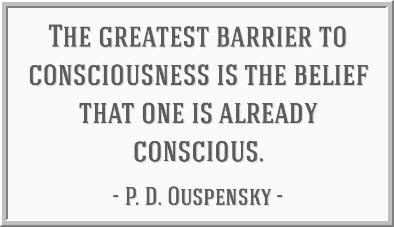
A therapy for the mentally well begins with the realization that change is impossible while we remain in our habitual states of consciousness.  Talking about our problems or working on changing behavior while remaining in our characteristic states is like trying to improve the reception on a TV by switching channels.  "What can one do in sleep?" Ouspensky asks his students.  "One can only have different dreams--bad dreams, good dreams, but in the same bed.  The dreams may be different, but the bed is the same".

Such is the state of most coaching, counseling, and therapy.  It changes the content of our thoughts, but we remain in the same "bed".  True change requires that we awaken and rise from our bed.  Because when we can access different states of consciousness, we become able to process self-relevant information in qualitatively different, creative, and constructive ways.  

Several days ago I found myself running late for a morning meeting.  In a frenzy, I attempted to beat the clock by getting myself dressed, quickly checking the overnight trading in the financial markets, and getting my children ready for school.  I went to the closet to get my jacket, but it was nowhere to be found.  Twice I scanned the rack and could not find the jacket.  Meanwhile, the clock was ticking and I was growing frustrated with my mounting lateness.  Suddenly, without premeditation, I closed my eyes and evoked a piece of music that I have come to equate with a clear and calm state of mind.  I calmly walked back to the closet and began looking for the jacket between the hanging garments.  Sure enough, it had fallen off its hanger and was caught between two other articles of clothing.

What is important in all this is that, in my ordinary state of consciousness, I was incapable of seeing between the garments.  The jacket was lost as long as I remained in my normal mode.  Only once I had shifted to another state was I able to see.  How much else lies "between the garments", unseen, while we fuss and fume through the racks of life?

Ouspensky was correct:  As long as we believe we're conscious, we do not take the steps to live--and trade--consciously.


Further Reading:

Trading With a Higher Consciousness

How We Tranceform the Mindscape

A Radical Method for Quieting the Mind

.

Friday, November 18, 2022

Relapse Prevention: A Neglected Topic In Trading Psychology


A savvy trader at SMB Capital reached out with a dilemma.  Each month he creates a new goal to work on, but to his dismay he has found that, once he moves on to a new goal, a previous problem resurfaces!  Psychologists refer to this as the problem of relapse.  Old patterns of thought, action, and feeling become ingrained habits.  They are not only learned, but overlearned.  It is relatively easy to change a habit pattern when we put full attention to doing things differently.  It is also easy to fall back into that pattern when our attention is turned elsewhere.

This is a neglected topic in trading psychology.  We talk about making changes, but not so much about maintaining those changes.

It is discouraging to make a change and feel that you're making progress, only to fall back into old ways and re-experience negative consequences.  But relapse is an intrinsic part of the change process.  We will always relapse until we have turned our new, constructive patterns into positive habit patterns.  That means that we have to rehearse and rehearse and repeat and repeat our positive changes day after day until they become automatic, natural parts of us.  If we need to muster motivation and effort every time we want to do things constructively, we'll never be able to direct our willpower toward new goals. 

This is where psychological resilience is important.  When we relapse, we want to summon our determination to change and say that "This is not how my story will end!"  If I relapse after three weeks of positive change, that's progress compared with relapsing every week.  Relapse is a detour, not a failure.  If we're truly learning and growing, we make special efforts to learn from our relapses.  That enables us to respond differently and constructively to the situations that may have triggered our old ways.

What I emphasized to the smart trader who raised the question is that you never want to let go of Goal #1 when you formulate Goal #2.  Change is never a straight line.  We always need to be working on our old patterns, even as we tackle new ones.  As I emphasize in The Daily Trading Coach, we defeat relapse through repetition.

Further Reading:

The Power of Regret in the Change Process

The Secret to Changing Our Selves

.   

Sunday, November 13, 2022

Strong Two Day Rally: What Comes Next?


We've seen stocks trade solidly higher for the past two trading sessions.  What has been notable about the move is not simply how strongly we've bounced, but the breadth of the rise.  Notably, we closed the week with over 80% of all SPX stocks trading above their 3, 5, 10, 20, and 50 day moving averages.  Think about what that means:  the great majority of shares are quite strong on multiple time levels.  This generally occurs when money managers and large institutional investors allocate more of their capital to equities as an asset class.  Such allocation is typically not a short-term, tactical decision.

My breadth database goes back to 2006, encompassing almost 4000 trading sessions.  Interestingly, over that period, we've only seen 45 occasions with over 80% of stocks closing above those moving averages.  Such breadth thrust is relatively rare.  Over the next few days, there has been no distinct directional edge, but we begin to detect momentum 20+ days out.  Specifically, over the next 50 trading sessions, the SPX has been up 39 times, down 6 times for an average gain of +3.41% vs. +1.95% for the remainder of the sample.

My preference is to measure breadth in multiple ways and look for occasions in which backtests line up.  On Thursday, we saw 854 stocks across the NYSE universe close above their upper Bollinger Bands.  That database goes back to 2019, and Thursday's reading was the highest over that period.  Since 2019, when we've had more than 400 stocks close above their upper bands (N = 13), the next 20 days were up 10 times, down 3, for an average gain of +2.72%, compared with an average gain of +.81% for the remainder of the sample.

To be sure, market history is no guarantee of the market's future, but we can find probabilistic edges by understanding the behavior of market participants.  When institutions are reallocating capital to stocks, it pays (on average) to swim with the current and not against it.  It is a big mistake to think that trading psychology is simply about our own psychology.  Some of the best edges, in trading as in poker, come from reading the psychology of those on the other side.

Further Reading:


Sunday, November 06, 2022

Trading Psychology Advice - 3: Solution-Focused Trading


The first post in this series emphasized the importance of getting the right kind of help--mentoring vs. coaching--for your trading challenges.  The second post stressed the value of structuring your learning processes the right way, by first pursuing competence and then by cultivating expertise.  In this third and final post, I highlight a valuable approach to making changes--in life and in trading.    

The solution-focused approach that I write about in Trading Psychology 2.0 and throughout this blog reflects a unique psychological perspective.  Instead of solely focusing on our problems, we should examine occasions in which our problem patterns don't occur.  Very often, it is in the exceptions to our problems that we can identify what we are doing right.  So, for example, let's say that I have a problem with trading emotionally and impulsively during periods of frustration.  Well, I don't go on tilt every time something doesn't go my way, so what am I doing to not become overemotional at those times?  Upon reflection, perhaps I'm talking to myself differently on those occasions.  Perhaps my positions are sized or structured differently.  Whatever I'm doing when my problems don't occur could offer the kernels of solutions.  What's great is that these are solutions genuine to me:  ones that are already working.  

Furthermore, the exceptions to our problem patterns are usually there because they reflect some underlying strengths that we can leverage personally and professionally.  For example, I may find that I trade much more selectively and avoid marginal trades when I talk out my ideas with a trading partner or teammate and when they do the same with me.  My strengths in processing information interpersonally (talking aloud rather than writing or keeping ideas in my head) and my social strengths (enjoying working with others and helping them) enable me to be my best self during my trading.

What I've shared in my writings is that, in some measure, you are already the trader you seek to become.  The exceptions to your problems hold the key to your solutions.  By doing more and more of what works, we can become more and more of who we hope to be.  

Further Reading:

Keys to Solution-Focused Trading

Learning How to Lose

 .