Wednesday, October 25, 2023
Self Respect: The Missing Ingredient in Our Efforts to Grow
Thursday, October 19, 2023
How To Transcend Trauma
Sunday, October 08, 2023
How to Achieve the Goals You Set
As the previous post emphasized, when we focus our attention on fewer priorities and work consistently and intensively on those, we are much more likely to make progress than if we have a laundry list of changes to make and work on those as the need/desire arises. So, for instance, if we want to get in good physical shape, dedicated daily time with gym equipment and running is a great start. That time with lifting, stretching, and running has to challenge us, which means we always tackle more when a given level of effort becomes routine. If our pursuit of goals is not focused, frequent, and intensive, we're unlikely to sustain a consistent growth path.
We are most likely to succeed if our goals become our commitments. When I worked at a well-known hedge fund, the founder once commented that, "If it's not in your calendar, it's not part of your process". This most certainly applies to our trading processes: researching ideas, turning ideas into trades, monitoring markets, and managing risk/reward. It equally applies to any of our purposeful activities, including the personal goals we set.
When we commit to our goal-seeking in the daily calendar and create a dedicated time for making efforts at improvement, we experience our desired future every day. "Anyone who fights for the future lives in it today," Ayn Rand once observed. Fighting for the future daily means that we experience a piece of our future consistently, making it an intrinsic part of ourselves. What starts as passion and desire is expressed through regular effort and evolves into positive habit.
Imagine that you have a single hour every day to pursue one goal that will dramatically benefit your trading, your health, your mindset, or your relationships. Imagine that this is the first item to go into your calendar; routine work and home tasks have to fit around your one key objective. Every day, without fail, you are going to use a slice of your day to be your own performance coach and bring your real self closer to your ideal self. That way, you will spend a fraction of every day living in your future.
That is most likely to occur if we have very concrete targets to hit in pursuit of our goals. If we want to lose weight, we want to define a challenging but doable objective. If we are looking to improve our trading, we need to keep stats so that we can truly see our progress: number of winning/losing trades, average sizes of winners/losers, overall profitability, etc. If we are making improvements in our relationships, we want to very intentionally do more of the things that bring closeness, happiness, and fulfillment to our partners and to us.
Mental illness is when we live in the past every day. Mundane life is when we simply live life each day at a time. Greatness is when we live a consistent portion of each day in the future we are designing and building.
What future do you want to build? How can you immerse yourself in that future today?
Further Reading:
Blueprint for an Uncompromised Life
.
Tuesday, September 26, 2023
Two Questions to Ask in a Weak Stock Market
I'm looking forward this week to speaking with developing traders at SMB Capital, where I will share many of the lessons I've learned working with successful portfolio managers and teams at top hedge funds. For those interested in hearing some of those lessons, I'll also be talking with My Investing Club at 4:15 PM ET on Thursday the 28th; the link to register is here.
As a rule, it's important to know what is happening at time frames larger than the ones you're trading and also to know what is happening at time frames shorter than your typical holding period. The larger time frames place your trade idea into perspective, addressing whether--bigger picture--we are in range markets, trends, etc. The shorter time frames provide you with the concrete information needed to turn a good idea into a good risk/reward trade. So, for example, I might have the idea that stocks have entered a downturn due to "higher for longer" interest rates. I might then wait for weak bounces at lower price highs to exhaust themselves to enter trades on the short side.
When we become locked into single time frames, we can find good ideas but trade them poorly or we can find good trades that ultimately don't play out when they are swamped by what is happening in the bigger picture. Success in markets requires the deeper thinking of idea generation *and* the faster thinking of trading.
The most successful traders, however, go beyond deep and fast. They also see broadly. They don't just look at their stock or market; they look at other stocks and markets to place what they see in context. Specifically, there are two questions traders ask to think broadly:
1) Is the price action I'm seeing correlated with what is going on in different markets? Is this a move specific to a stock, sector, or overall stock market, or is there a bigger macro picture impacting currencies, rates, and international markets?
2) Is the price action I'm seeing accompanied by significantly different volume, volatility, and breadth than we've been experiencing recently? This gives us an idea of whether the market move is the result of new, larger participants entering the marketplace, which could help sustain a trend.
In the case of the recent stock market weakness, note that this began with the Fed announcement and subsequent conference call. During that trading session, we saw sustained negative levels of the NYSE TICK that we had not experienced recently. Following that session, we've seen very negative breadth and an expansion of stocks making fresh one- and three-month lows. Most importantly, during this decline, we've seen a significant rise in longer-term interest rates and strength in the U.S. dollar. In other words, the macro picture was perceived to have changed as a result of the central bank communications and larger institutions have acted upon this information. Seeing such dynamics in real time is essential to both trading and investing.
I look forward to building on these ideas in my group coaching sessions this week. If we can view markets deeply, quickly, and broadly, we'll be best positioned to know what to do and why we're doing it. A good trade requires vision; great trading requires flexibility of vision.
Further Reading:
Short Term Trading With NYSE TICK - A Three Part Series
.
Tuesday, September 19, 2023
Why Traders Are Losing Money In Recent Markets
I examined the last three years of daily data, focusing on the SPY and the percentage of stocks in the Standard and Poors 500 Index trading above their 5 and 20 day moving averages. (Data from the excellent Barchart site). I divided the data set into quartiles and specifically examined what happens following periods of very strong (top quartile) and very weak breadth (bottom quartile).
When the percentage of stocks trading above their five-day moving averages was in the top quartile (approximately 74+%), the next five days in SPY averaged a loss of -.14%. Note that this was during a period in which SPY rose by approximately 30% and the average daily gain was +.20%. When the percentage of stocks trading above their five-day moving averages was in the bottom quartile (approximately less than 33%), the next five days in SPY averaged a gain of +.57%. In other words, going with strength after a five-day period lost a trader money regardless of their mindset. Buying stocks,after five days of weakness--when it's scariest to be jumping into the market--was solidly profitable and more than doubled average returns.
Hmmm...
So now let's examine average returns after 20 days of strength and weakness. When 20-day returns have been strongest (over 73% of stocks trading above their 20-day moving averages), the next 20 days in SPY have averaged a loss of about -.31%. This is eye-opening, as the average 20-day gain during this period was +.79%. Conversely, when 20-day returns have been in their weakest quartile (fewer than 37% of stocks trading above their 20-day moving averages), the next 20 days have averaged a whopping gain of +1.85%. Going with strength systematically lost traders money; fading weakness achieved superior returns.
In short, traders lose money when they focus on trend and momentum. They are expecting strong and weak returns to continue into the future. What actually happens on average, however, is reversal. Stocks behave in a cyclical way. When markets *do* display momentum and trend, it is generally because longer-term cycles are dominant. The up or down phase of a longer-term cycle overwhelms any reversal tendencies in the short run. (Note how this opens the door to forecasting market movement as a function of the interaction of multiple cycles: a topic I hope to address soon).
The market tends to frustrate the expectations of traders. It is human nature to extrapolate the future from the past. This--regardless of a trader's psychology--will lose money over time. Drawing and following trendlines, going with breakouts, waiting for "price confirmation" to enter market moves: all, over time, lose money. It is not just our psychology that undermines our trading. It is our assumptions.
Further Reading:
The Secret to Overcoming Adversity
.
Tuesday, September 12, 2023
How to Lead a Visionary Life
* What is the one thing I most want to accomplish today in my personal life and in my work life that will make the day successful?
* What is the one thing I most want to accomplish this week in my personal and work lives that will make the week successful?
* What is the one thing I most want to accomplish this month in my personal and work lives that will make the month successful?
* What is the one thing I most want to accomplish this year in my personal and work lives that will make the year successful?
That's it: Every day, every week, every month, every year is guided by a singular vision. What one thing will lead you to look back on each day, week, month, and year and feel pride in what you've accomplished?
Once we have a vision, we cannot live on auto-pilot. The one thing you most want to accomplish becomes your mission statement--it pushes you and inspires you. The risk isn't trying and falling short; it's never trying and never finding out what we're capable of.
Further Reading:
Making Your Passion Your Purpose
The Profound Psychological Benefits of a Purposeful Life
.
Thursday, September 07, 2023
The Secret to Overcoming Adversity
For me, it was a powerful reminder that, no matter how bad our situations become, we always can rise above them through creative expression and achievement. When we create--a painting, a book, a scientific theory, even a trading system--we rise above what is and realize a vision of what can be. Indeed, the more we face loss and setback, the more important it becomes to create and immerse ourselves in meaning and beauty.
The secret to overcoming adversity is to transform your life into a work of art: to become so focused on creating what is beautiful and meaningful that everything else becomes secondary. Our relationships can become masterpieces; our careers can become paths for pursuing a vision of what is possible. All of us become artists when we approach life creatively and find the beauty in each facet of life.
As I was leaving the courtyard of Terezin where prisoners were herded into barracks, I noticed a smooth, round, quartz-like stone on the ground. I took the stone home with me, and it now sits on my desk where I do my writing. It's an immediate reminder of the horrors that I saw--and also the soaring human spirit that transcended the evil.
Every life setback--including setbacks in markets--is an opportunity to rise above loss and create the future. We tap into our Divinity when we become Creators.
Further Reading:
The Role of Creative Insight in Trading Success
.
Monday, August 28, 2023
The Wellness Grid: A Framework For Optimizing Your Trading Psychology
Note: Written aboard a ship on the Danube River, traveling to Prague, Czech Republic:
Imagine a 3x3 Wellness Grid:On the X axis, we have three dimensions of psychological wellness:
1) Happiness - How much joy we experience;
2) Fulfillment - How much satisfaction and pride we experience;
3) Energy - How much inspiration and excitement we experience;
On the Y axis, we have three dimensions of wellness in life:
1) Personal Life - What we are doing to develop ourselves as individuals;
2) Interpersonal Life - What we are doing to maintain, expand, and deepen our relationships;
3) Work Life - What we are doing to grow and succeed in the work we undertake.
With this Wellness Grid, we have a handy weekly report card that enables us to track over time how well we are maximizing the quality of our lives. We also have a framework for tracking the synergies in our lives: the degree to which improving one area of life creates benefits for other areas. And, of course, we can track how setbacks in one sphere of life might be impacting others.
If we are consciously working on the nine boxes of the Wellness Grid, what we're really working on is intentionality: the expansion of our free will. The idea is to live life in a state in which we're fully awake, not functioning on auto-pilot. We maximize our trading psychology when we maximize our capacities for living intentionally. The big enemy of mindset is not stress; it's the absence of well-being. We all need routines to live life efficiently, but when all of life becomes a set of routines, we are no longer fully alive--and we fail to grow. Ideally, each week, we push ourselves beyond our comfort levels in all nine areas of the Wellness Grid.
Further Reading:
Tacking Your Problems Will Never Optimize Your Life
Gurdjieff, Turtles, and Trading
.
Sunday, August 20, 2023
Weak Market: What Comes Next?
Let's step back a minute.
I observe two problems among market participants. The first is to construct trades without underlying robust ideas. Traders who look to charts for "setups" are particularly guilty of this mistake. The second problem is to generate big picture, top-down narratives based on fundamental data, but not anchor these themes in well-analyzed trades that provide favorable reward relative to risk in a shorter-term time frame. My experience with successful market participants is that they are both investors and traders. They generate robust bigger picture ideas through unique, rigorous analyses and they then translate those ideas into good trades by rigorously assessing shorter-term risk-reward.
In the terms of Daniel Kahneman, success in markets requires both deeper, slower thinking and faster, flexible thinking. In practice, this means having consistent strategies but flexibly adapting the implementation of those frameworks based upon current conditions.
So now let's look at the current market:
I notice that, across the NYSE universe, we have seen over 1500 stocks making fresh monthly lows and fewer than 1000 registering new three-month lows. That is what we would expect during a correction in a rising market. When one-month lows *and* three-month lows are high (bear market), next ten-day returns since 2010 have been negative. When one-month lows have been high and three-month lows have not been significantly elevated, next ten-day returns have been distinctively bullish--significantly above average.
In short, context matters.
When analyzing market returns, it's not enough to examine one time frame. We want to see how the shorter time frame fits into the market's larger picture.
Let's take a second example. This past week, looking across the NYSE universe, we have seen very few stocks giving buy signals on two technical trading systems, the Wells Wilder Parabolic SAR and the Bollinger Bands. These systems assess strength and weakness across shorter (SAR) and medium (Bollinger) time frames. When the number of stocks providing buy signals on the SAR has been weak but the number of stocks giving buy signals on the Bollinger measure has been relatively strong, next ten-day returns since 2019 have been flat to negative. When we have had few buy signals on both technical systems simultaneously, next ten-day returns have been solidly bullish.
Again, context matters.
Across a number of these kinds of analyses, we see favorable average near term returns after selloffs in rising markets. That's the perspective from the slower, deeper analyses. Now, going forward, if we see selling pressure that cannot result in lower prices, we can speculate that bears are trapped, will need to cover, and we could bet on higher prices going forward. Conversely, if we see that buying pressure is limited and/or cannot drive price meaningfully higher, we can entertain the idea that this time, indeed, may be different and follow that up with further analyses and possibly very different bets.
The most successful traders I work with look at new and different things and they look at things in new and different ways. Over time, unique returns cannot come from consensus thinking.
Further Reading:
.
Monday, August 14, 2023
Your Flaw Is Your Strength
The opal gem consists of small silica spheres and gaps between the spheres, which in one context could be considered flaws. However, the very gaps that occur on the opal's surface are what create the opal's beauty when light is shined. The light rays are diffracted by the spheres and gaps, which break the light into a fiery array of component colors. The Rabbi's point is that we are like opals: what are our flaws when viewed one way become our greatest sources of beauty in a different light.
Our flaws, in the right light, are our strengths.
For example, in one light, our ambition and achievement orientation are flaws, leading us to become so wrapped up in our work that we neglect our health and relationships. Those flaws lead us to trade from the ego, overreact to gains and losses, and chop ourselves up when big moves aren't realized.
In a different light, our ambition and achievement orientation lead us to define and seek goals and ideals and realize our vision for being the best possible version of ourselves.
There are so many ways in which our flaws and strengths mirror one another. Think about how our sensitivity in relationships can lead to caring, but also hurt and disagreements. Think about how our desire for self-development can result in personal growth--and in an insensitivity to others. Think about how our commitment to not losing money can stand in the way of making significant money.
We are like opals, and our challenge is to find the light that enables us to shine.
Here's a simple exercise to help with that challenge: Each week, identify the one most fulfilling, meaningful event that occurred to you during the past seven days. Then identify the one most frustrating, negative event over that same period. Then reflect on how the two are related and what made the positive experience so special and what made the negative experience so disappointing. What is the light in which you are simply a stone with spheres and gaps, and what is the light in which you shine? Over time, keeping this simple journal, you'll discover the contexts in which you display your fire.
The goal is not to eliminate your flaws, but to turn those into sources of beauty.
Further Reading:
.
Sunday, August 06, 2023
Why Do I Get Chopped Up In My Trading?
Sunday, July 30, 2023
Why Do I Blow Up My Trading?
Why does this happen? What can we do to keep ourselves aligned with sound practices and processes?
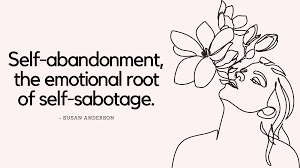
A reader recently reached out, explaining that he once in a while experiences losses that wipe out a large share of his monthly profits. It is frustrating to trade well most of the time, only to lose discipline and seemingly sabotage all we've accomplished. As the graphic above suggests, the root of self-sabotage is self-abandonment. We temporarily lose sight of what we're meant to do and instead act on impulse. In the terms of the Radical Renewal online book, we abandon the soul of what we do and allow our trading to become ego-driven.
I have never been convinced that the root of such self-sabotage is a deep-seated, inner desire to hurt oneself. It is usually not an absence of self-esteem that causes us to become reactive. Rather, we experience "triggers" that set off automatic and often harmful actions. The problem is a temporary loss of free will. Under a certain set of emotional and physical conditions, we behave in pre-programmed ways and become reactive rather than active. Quite literally, it is a loss of self-awareness that allows us to behave in ways that harm our best interests.
Consider the many situations in which we *never* go on tilt and behave reactively and self-destructively. We're not careful in crossing busy streets 99% of the time, only to occasionally walk directly in front of traffic. We don't operate machinery (lawn mowers, ovens) safely most of the time, only to occasionally cut or burn ourselves severely. Why don't we go on tilt in those situations? Reason one is that our egos are not involved, and reason two is that we are supremely aware of the dangers at hand. If I don't *need* to cross the road quickly and I'm mindful of the busy traffic, I am perfectly able to wait for a break in the flow of cars to cross safely. If I'm clearly aware of danger, I will act with caution. Always.
This is where it's helpful to engage in a "check up from the neck up" prior to any risk taking. If a surgeon is scheduled for a procedure, but is in an agitated state because of a personal circumstance, that surgeon will delay the operation. "Above all else do no harm" is the operative principle. If a pilot is about to take off for a flight, they reach out to the co-pilot and--together--go through the pre-flight checklist to make sure the plane is truly air-worthy. If something is wrong mechanically, the flight will be delayed. Above all else, do no harm.
The opposite of self-abandonment is self-awareness. If we approach each session of trading--each trade!--the way a surgeon approaches an operation or the way in which a pilot preps for a flight, then we are in the state we're normally in when we're crossing a busy street. The awareness of risk and danger enables us to do no harm. It isn't discipline or "process" orientation that enables us to not go on tilt when we're handling a carving knife in the kitchen. It's the immediate, acute awareness of danger. The key is self-awareness: knowing when we're in the wrong mindset for risk-taking. Like the surgeon, like the pilot, we must take danger so seriously that we're willing to postpone our performance until we're assured that we will "do no harm". If we've performed our own checkup from the neck up, we're not going to trade on impulse.
Further Readings:
Radical Renewal and the Spirituality of Trading
.
Monday, July 17, 2023
Finding and Following Your Inner Voice
This is a very tricky question and issue. On one hand, we could view our negative self-talk as an inner voice and allow our worst emotional patterns to control our trading. On the other hand, we know that the pattern recognition of intuition often manifests itself as an inner voice. When do we listen to that voice? When do we challenge that voice and replace it with one that is more helpful? Consider the example of regret. Is that a helpful prod that enables us to learn from our mistakes, or is it driving by the rear view mirror and interfering with what is happening here and now?
How can we innovate in tackling our trading psychology?
Consider the above quote from Craig Revel Horwood, choreographer and dance show judge. What he is saying is not simply to follow your inner voice, but to listen to that voice if it comes while you are following your passion. In other words, it is the absorption of being in the flow state during an activity we're passionate about that leads to the intuitions of the inner voice. If we don't have a passion for something, we will not arrive at any meaningful intuitions about that thing. Plumbing? Growing watermelons? Racing horses? I've never been involved in any of those and guess what? I have no intuitions whatsoever about how to do them well.
When we are absorbed in a passion, we experience things in new ways and generate fresh perspectives. It is the depth of involvement that generates the breadth of vision. Anything we do to more completely absorb ourselves in markets will enable us to see new things and innovate. As the Radical Renewal online book suggests, we find our inner voice, not by listening to the chatter and self-talk of the ego, but by fully engaging what speaks to our soul. The self talk of the ego is something we do on auto-pilot. True intuition comes to us.
And feelings of regret? When we're fully immersed in markets and feel regret, the odds are good that we can turn what we did wrong into a learning lesson and true growth. Regret may not feel good, but, as Radical Renewal points out, it is a path to growth in just about every spiritual tradition. The process of falling short and repenting is quite different from automatic, mindless self-criticism. One is a path to growth; the other interferes with our performance.
We can find and follow our authentic inner voice only in the full involvement of an activity we're passionate about. We find our uniqueness as traders when we are most absorbed in--and fascinated by--markets.
Additional Reading:
How We Can Improve Our Access to Intuition
The Role of Intuition in Trading Decisions
.
Sunday, July 09, 2023
Developing Your Uniqueness as a Trader
An important start toward cultivating our uniqueness is acquiring fresh data sets. In trading the overall stock market, one data set that I have found to be promising is the percentage of stocks within each sector trading above various moving averages. (Data from the excellent Barchart.com site). So, for example, I track the percentage of stocks within the energy sector (XLE), consumer discretionary sector (XLY), consumer staples sector (XLP), health care sector (XLV), etc. that are above their respective 20-day moving averages. This information tells us, not just if the overall market has been strong or weak, but which parts of markets have been particularly strong or weak.
Collecting new data enables us to ask new--and sometimes much better--questions.
So, for example, what have we seen going forward in the overall market (SPY) when consumer discretionary stocks greatly outperform or underperform consumer staples stocks? Is there unique information in relative breadth strength and weakness?
Sure enough, when the percentage of consumer discretionary stocks above their moving averages has been much greater than the percentage of consumer staples stocks over the past three years, we see notably weak returns over the next five trading days in SPY, but particularly strong returns over the next 20 days. Interestingly, this is a pattern we also see following unusually strong breadth thrust moves in the overall market: a tendency to consolidate/pullback in the next few days, followed by upside momentum. It makes sense that a relative breadth thrust among consumer discretionary stocks would display such momentum, as investors are counting on the kind of economic growth that sustains discretionary spending.
By contrast, when a large percentage of utility company stocks have been trading above their 20-day moving averages, the next 20-day returns in SPY have been negative, compared with solidly positive returns when few utility company stocks have been trading above their 20-day averages. The flight to the safety of yields has not been a promising medium-term indicator of returns for the overall market.
How about when traders aggressively move into small cap stocks? When the number of stocks in the SP 600 small cap index trading above their 20-day moving averages has been quite high, next 5-10 day returns in SPY have been negative, before subsequently going significantly higher. Once again, this is a pattern similar to that observed with general breadth thrusts.
And the current market? We've seen solid breadth among the industrial stocks (XLI) with the great majority of shares trading above their 20-day moving averages. Interestingly, over the past three years, that has led to short-term follow-through in SPY, but relatively weak returns over a next 20-day period. And recent breadth strength among real estate stocks (XLRE)? That, too, has been associated with relative weak SPY returns over a next 20-day horizon. Those developments, on top of recent narrowing of outperformance by XLY over XLP has me cautious on the market. Notice how the patterning of strength and weakness across sectors provides multiple perspectives on overall market performance as well as the performance of each sector. When the weight of historical evidence lines up with what we're seeing in current price action, we have the makings of a promising trade.
This is but one example of how we can develop distinctive returns by studying distinctive market information. I also collect databases of stocks making new highs and lows on a one- and three-month basis; stocks displaying buy and sell signals on various technical market indicators; etc. All are ways of understanding when moves tend to reverse and when they tend to continue. Trading success starts with looking at unique things, asking unique questions, and relying on objective data for answers.
Further Reading:
Trading With Breadth, Strength, and Momentum
.
Sunday, July 02, 2023
Is Your Trading Truly Meaningful?
A while back, I wrote a post about research that shows how living a purposeful life is a key to happiness and life satisfaction. That applies to our trading, as well. If we are purposeful about our development as traders, we are most likely to be successful *and* we are most likely to be fulfilled in our efforts. My article for Forbes several years ago summarized research regarding the amazing psychological benefits of living purposefully. It's when our life is inspired by a why that we are most likely to succeed in the quest for how.
As the John Maxwell quote above points out, having a genuine and meaningful purpose is a vital part of what gives our lives significance. The ego might look for more strokes, but what feeds the soul is the opportunity to make a "contribution" by doing something "noble". This is why spirituality is vital to trading careers and why so many of our trading psychology challenges occur when we place ego needs ahead of what enables us to thrive.
For many traders, the concept of trading spirituality is an oxymoron. Trading is all about making money; spirituality is not. But any activity can be pursued in a manner that is more or less soul-full. When we have an overarching life mission that improves us and our world, any activity can become a meaning-full path. We overreact to gains and losses--and we overtrade--when trading is simply about P/L. When we approach trading as a path for self-improvement, and when we work in teams where everyone is improving everyone else, suddenly we become part of "something noble and purposeful".
So let's step back and ask ourselves a few questions. Self-assessment can be uncomfortable, but no change ever comes from staying locked in our comfort zones:
What is your path to greatness? How does your development as a trader move you forward on that path? If you're not doing something meaningful and purposeful each day, how can you possibly hope to live a purposeful life? What meaningful and purposeful thing are you doing with your trading today? We are most likely to pour ourselves into activities that capture our strengths and our interests. How will today's trading be fulfilling and rewarding for you regardless of the ultimate profits and losses?
Great trading, like all things great that we do, comes from the soul. Perhaps the best thing for your trading psychology is to stand back from profits and losses and cultivate the spirituality of your trading. The key to mastering trading psychology is to always tap into what is more important to you than the profits and losses of trading.
*
Sunday, June 25, 2023
Making the Transition From Discipline to Commitment
Similarly, there was a time early in adulthood when dating was fun and there were lots of people I wanted to meet. If a relationship became more serious, I often had to hold myself back and rely on discipline to not go after other possibilities and opportunities. When I met my wife-to-be, Margie, I recognized early on that there was something special in our relationship. The idea of possibly losing that or watering it down with frivolous involvements was a complete non-starter. I felt a commitment to Margie and to our relationship and that was all that mattered. Other possibilities were not temptations. I did not need discipline to be a loyal boyfriend and husband. So it's been for the past 39 years.
Early in my trading career, markets were exciting and there were *so* many possible ways of making money. Out of that enthusiasm, I traded and traded and overtraded. I also lost money. With time, I discovered the kind of trading that made sense to me and that was successful for me. I worked on deepening what I was doing, eventually performing research on short-term price behavior and market breadth that gave me demonstrated edges in my trading. As I became committed to that style of trading, all the other things became less interesting to me. I didn't stop overtrading because I had become a ridiculously disciplined person, but because I became deeply dedicated to the best in me. My faithfulness to good trading was very similar to my commitment to my life's partner.
Just as we undergo a developmental sequence in our relationships with parents and potential life partners, we typically go through developmental stages in our trading. Perhaps overtrading is like overdating. It's what we need to do to find what's best for us and that can anchor our sense of loyalty, commitment, and dedication. Our relationship to markets evolves in ways similar to the evolution of our relationships with our parents and our romantic relationships. Focusing on discipline to short-circuit this developmental process may be a mistake. It's not what we need to stop doing that should be our priority, but rather identifying the best of us and pursuing that, because that will inspire our commitment and generate our consistency.
Further Reading:
To Increase Your Discipline, Focus on Your Fulfillment
Two Proven Methods for Building Happiness
.
Friday, June 16, 2023
How to Advance Your Development as a Trader: Key Ideas
I recently participated with Mike Bellafiore of SMB Capital in an excellent conference organized by TraderLion. The topic of our presentation, which you can watch via video, was trader development: the best ways of improving our performance in financial markets. Here are a few key ideas that we touched upon in the session:
1) Your niche in markets has to be discovered - Only by experimenting in different markets, on different time frames, with different sources of information can you figure out what makes sense to you and what you are good at. In medical school, students rotate through various clinical services, such as internal medicine, surgery, psychiatry, and family medicine, to experience those specialties first hand. It is only after experiencing all the major areas of medicine that students make a decision about specializing in a particular area during their residency training. Similarly, if you're learning markets, you want to try out various "specialties" and discover your potential niche. Many times, developing traders are so eager to make money that they place their capital at risk right away and try to emulate what they hear from would-be gurus. That is not how expertise development works. Trading various ways in simulation mode and with small size allows you to discover who you are and what works for you before you run through your capital. Because markets are always changing, we must always develop as traders and return to the modes of discovery and learning.
2) Learning trading is a team sport - There is a reason successful trading firms such as SMB and essentially all successful hedge funds are organized in team structures. A team leader is an experienced, successful trader who creates a group of more junior traders to assist in the trading process. The junior members bring unique skills to the team and track opportunities as they arise. The team leader benefits from the input of team members and serves as a mentor to them, showing them in real time how their ideas are translated into trades and managed as positions. As a result, the most important learning occurs at the desk, seeing markets and ideas and trading in real time. The saying in medical school is "each one teach one". In a successful team, everyone learns from one another. And if you're an independent trader? Your challenge is to network with other independent traders who are traversing their learning curves. This is where trading communities and trading conferences can be particularly helpful. Share your best ideas online and you'll find that others with good ideas will reach out to you. That is the start of the kind of teamwork that accelerates learning and development.
3) Learn from your strengths - Particularly if you're an experienced trader looking to develop your expertise, you want to study what you do best and where your successes have come from. Research in psychology points to the "flow state" as a unique state of consciousness that occurs when we are immersed in activities that provide optimal challenge and interest. It is in the flow state that we are most productive, and the flow state fuels our creativity, broadening our perception and helping us detect unique opportunities. The exercise of our strengths creates the flow experience, so that when we're absorbed in trading in rewarding, meaningful ways, we are most likely to be tapping into the best of us. When we work in teams with others who have different strengths but who also tap into their flow modes, we find work to be energizing and inspiring--not something that burns us out.
What we do frequently, we absorb. If we pursue trading the wrong way and create frustrations, we absorb a frustrated mindset. If we engage trading as an adventure--an opportunity to discover who we are and what we do best--our trading can enrich our lives in many ways and provide a lasting experience of fulfillment.
.