

Sunday, March 30, 2025
The Psychology of Playing a Big Market Opportunity


Sunday, March 23, 2025
Keys to Great Trading

*
3/28/25 - The best trades occur when markets are trading thematically, with the themes representing the actions of the largest investors who move the most money. I am watching the correlation between equity markets overseas (VGK, EFA, EEM) and the U.S. stock market. Until recently, those had been moving in different directions. If we were to have genuine trade wars, we could see a toll taken on global markets. On the radar as a potential opp...nice example in real time of allowing a big picture to inform short-term trading.
3/26/25 - Quick shout-out: TraderLion is coming out with a book published by Harriman House detailing the process of finding your edge in markets. It is so important to understand markets in ways that make sense to you; only then can you have the confidence to take meaningful risk and sustain your risk-taking. What has worked for me is a lining up of time frames, where I look at my markets (stock index futures) on three different time frames. As I've mentioned previously, the X-axis actually isn't time; each bar on the chart represents an amount of volume traded. So the short-term chart has bars representing relatively few contracts traded; the medium-term chart has bars representing a moderate number of contracts traded; and the longer-term chart has bars representing open-high-low-close for a large number of contracts traded. The charts thus adjust to the busyness of the market. I overlay the same technical indicators on the three charts and wait for signals across all three. I then turn to my very short-term chart of the NYSE TICK to time my entry, looking for occasions when buying/selling are drying up and reversing. I'm comfortable taking sizable risk when everything lines up, and I'm comfortable not trading when signals are mixed. As a very bright and creative money manager taught me, so much of success comes from not needing to trade.
3/25/25 - Yet another key to trading success: The ability to recognize, in real time, when your market is lining up for an unusually good potential opportunity and then to be able to size up for that opportunity without losing sight of sound risk management. Selective aggression is all about being willing and able to wait for the right opportunities and, when those arrive, being able to pounce decisively. Very often, a meaningful part of overall profitability for discretionary traders comes from a relative handful of trading opportunities. A key to great trading is being able to outline--in detail--the criteria for a true A+ opportunity and then having the discipline to wait for those criteria to be met and being able to go from waiting to pouncing. In my next post, I will outline the high opportunity criteria that guide my largest trading.
3/24/25 - Here is another key to great trading: understanding market context. Reading the "text" of the market--the short-term patterns that set up--is crucial to good risk/reward entries and exits, but what tells you the "context" of market action? Is this setting up as a trend day? Are we seeing a rotational day? Who is in the market; how busy are we and how far could we move? How does today's market fit into the pattern of recent trading? Is there a theme driving trading across asset classes? Who is setting up to be trapped: Are buyers and sellers moving price effectively, or are we seeing signs of exhaustion?
Great trading comes from looking beyond the market and time frame we're trading to see the bigger picture that will be driving price action. The microscope helps us get the best price for our orders; the telescope tells us what to order and why.
The artistry of great trading is found in what we are doing when we're not staring at screens and firing away. Like the sniper, we succeed because of our focus during the 99% of the time that we're not firing. Creative vision is what makes a work of art. It is also what makes for artful trading. Skilled traders have studied and experienced so many markets that they can recognize when a meaningful pattern is playing out. What if we only traded when that creative insight came to us, when we saw--truly saw--how things were playing out? The cost of overtrading lies not just in the P/L lost, but in the damage we inflict upon our capacity for creative insight. Our job is not to make great trades; it's to have the wisdom and restraint to allow great trades to come to us.
Sunday, March 16, 2025
Answering Traders' Questions

3/21/2025 - In the previous post, we looked at a psychological perspective about why traders might give back profits after a period of successful trading. Now let's look at more logical, structural reasons for these givebacks.
What's important to realize is that the market's largest participants trade thematically. That is, they look for patterns of strength and weakness across different stocks, different sectors, different equity markets, and different asset classes--and they look for reasons that explain these themes. When the themes change for economic or geopolitical reasons, the market that you are trading can shift greatly in its patterns of volatility/volume and correlation to other instruments. If you fail to recognize the theme driving the change, you're likely to lose money and not realize why.
Themes have changed in 2025. Look at how the US dollar has been trading against the Japanese Yen, the Euro, and the British Pound. Look at the the US stock market (SPX) has been trading relative to the European markets (VGK) and the rest of the world (EFA). Look at how interest rates have been coming down, but not as much in the junk bond market (JNK). Look at how volatility (VIX) has expanded.
The dominant theme has been anticipation of economic weakness in the U.S., resulting in a flight from many U.S. assets. If we only look at the charts of what we are trading, we miss the broader patterns that reflect what large investors are doing. By noticing the patterns across markets, we can create tailwinds for trading our markets.
3/20/2025 - I received an excellent question from a reader:
"I keep going through the same problems. I make money for a while and then go on a losing streak and give it all back. How can I change this?"
Brett's response: Going through unusual ups and downs in performance can occur for psychological reasons, and it can occur for logical reasons. The key to figuring out what to do is to first identify the problem.
You'll know that the problem is psychological if you review your trading in detail and see if your trading patterns change following winning periods. Do you trade larger after you've made some money? Do you trade more often? Do you expand what you've traded? Many times, out of confidence becoming overconfidence, traders will stop doing what made them money and lose a good amount of money.
The key is recognizing that making money puts you at risk!! This is when you can get sloppy; this is when you can overtrade and oversize. After you've made money, you want to trade extra carefully. You want to ask yourself, "Would I be making this trade in this way if I had just been losing money?" By putting yourself in the mindset of risk management, you prevent yourself from becoming overconfident and impulsive. After a winning period, double down on sound trading process, knowing how easy it is to ease up on your rules.
And what if your losing money is not due to a change in mindset, but a change in markets...how can you adapt to that? I'll tackle that one in the next post!
3/19/2025 - This is an additional question from the group coaching session that addresses a situation faced by many traders in the recent volatile markets:
"Recently I am struggling to focus on process because I had quite a drawdown, and it's hard to push thoughts about making money now away. Any advice?"
Brett's response: Every drawdown/loss should be planned. You should always know how much money you're willing to lose on a trade, how much you're willing to lose each day, and how much you're willing to lose each week and month. Knowing your loss limits in advance helps in two ways: 1) You can be psychologically prepared for inevitable drawdowns and still maintain a focused mindset, because no drawdown feels like "quite a drawdown"; and 2) You always give yourself room to come back. As I mention in my books, traders I worked with in Chicago (who were very short-term) had a separate loss limit for the morning trading and for the afternoon. They always gave themselves an opportunity to come back on the day and, on losing days, they could always come back on the week. Any planned activity becomes familiar and cannot trigger us. Mentally rehearsing the downside and being at peace with your loss limits prevents frustration from ever impacting our trading.
If you've taken a large, unplanned hit, returning to trading in simulation mode (take P/L off the table temporarily), regaining your rhythm and focus, and then sizing up gradually allows you to recover. If you can't focus on the market, it's time to work on your focus.
3/18/2025 - Here's another question that arose during the coaching session:
"What are the skills you recommend to handle our triggers?"
Brett's response: Notice that the trader recognizes something very important. Our problems are not just negative trading behaviors (such as going on tilt), but whatever triggers those negative behaviors. If we can control our triggers, we can prevent problems like overtrading from occurring in the first place.
The very first step is recognizing the trigger as it is occurring. For instance, we might wait for a perfect entry on a trade only to see the market make its move without us. That triggers frustration, and the frustration can lead to chasing the trade and executing at a really poor level. We can only identify our trigger patterns by studying our preventable losing trades and dissecting how they occurred. In the above case, what sets up the poor trade is not just the frustration, but the perfectionism that precedes it. Very often, our excessive expectations set up our excessive frustrations.
By working on our thinking patterns as we're trading, we can ensure that we're going into trading with realistic expectations that won't frustrate us. For instance, my first entry on a trade is always small and at a good level, not necessarily a great level. "Good enough is good enough" is the mindset I rehearse. I have favorable reward to risk and that's good enough for an entry. If the position moves against me, but not to my stop, I'm prepared to add another clip at a more favorable level. If the position moves immediately to my target, I've made a decent profit.
Note that these kinds of thinking patterns can be mentally rehearsed before the market open and during trading reviews. The best way to handle our triggers is to identify what sets them off and create new patterns of psychological win/win.
===
The first question is: "Given that markets constantly change, how can traders develop the psychological flexibility needed to adapt their strategies without falling into emotional overreaction or hesitation?"
Brett's response: This is a great example of a situation where improvements in trading process can create improvements in our trading psychology. Basically, what active traders need is real time information that tells them that their market is changing. The professional traders I work with at hedge funds monitor real time price change, of course, but also real time market volume and volatility and real time correlations. Very often, shifts in volume/volatility and correlations precede shifts in trading direction. A simple example would be a stock that moves out of a range to the upside but then stalls on low volume. If this was a valid breakout, one might expect short-term participants to take advantage of the move, resulting in increased volume and volatility. One might also expect that, if the stock's upside breakout was valid, it would be accompanied by similar moves in other stocks in the same sector and perhaps by similar moves in the overall market. By monitoring this real time behavior, traders can become highly flexible in jumping aboard moves or fading them. Once the market changes are perceived and understood in a broader context, the trader can quickly adapt.
Recently, the market made an intraday high but many sectors (including small caps) lagged significantly. This was very helpful information in fading the strength. Practicing trading with small size while making these observations and adaptations provides the experience that leads to confidence. How the market moves is just as important as the moves it makes.
Tuesday, March 11, 2025
What Kind of Trader Are You?
3/16/2025 - Thanks to a very smart market strategist for this quote: "Following your passion is a very “me”-centered view of the world. When you go through life, what you’ll find is what you take out of the world over time — be it money, cars, stuff, accolades — is much less important than what you’ve put into the world. So my recommendation would be follow your contribution. Find the thing that you’re great at, put that into the world, contribute to others, help the world be better and that is the thing to follow." — Ben Horowitz, “Don’t Follow Your Passion” advice to the Columbia class of 2015.
3/14/2025 - There are five key personality traits that spell the acronym OCEAN:
* Openness to Experience - Our curiosity, creativity, and openness to new ideas;
* Conscientiousness - Our attention to detail and process-based organization;
* Extraversion - Our interest in social interaction; also relates to risk taking;
* Agreeableness - Our ability to get along and work well with others; relates to teamwork;
* Neuroticism - Our tendency to experience negative emotion and stress
These traits are basic to who we are. Our job is to find the ways of trading that best play to our personality strengths. A great way to see how your personality contributes to your trading success is to study your best trades and how you succeeded. Across many winning trades, you'll see how you best engage markets--and that says a lot about who you are.
===
3/13/2025 - Key question: Are you a generalist in your trading, trading multiple markets and strategies, or are you a specialist, who does one or two things really well? I work with portfolio managers who are generalists, covering world economies and markets and finding themes and opportunities, and I work with PMs who are specialists, finding opportunities in rates markets in terms of directional movement (due to shifts in economies and central bank policies) and relative movement (due to abnormal movements in one part of yield curves vs. others). Are you a broad thinker? A deep thinker? How are you wired that makes you special as a person and as a trader?
===
3/12/2025 - Here's another issue for trader self-assessment: How do you best process information? Are you spending the majority of your time in the information processing modes that work best for you? Many traders process information through social interaction: talking ideas and hearing ideas. Trading in isolation isolates them from their strengths. This is why being part of a team and prop firm like SMB, where there is constant interaction on the trading floor, can be so valuable. Note that the training classes at SMB conducted by Jeff Holden are via Zoom and feature presentation, discussion, and chat. Research in psychology is clear: processing information more actively and in more ways leads to deeper, more effective learning. If you process information best by reading, then read many things and even read aloud. If you process information best visually through charts, then have a chart review process and others you share charts with. Make it active. Make it interactive.
===
3/11/2025 - PM - Here's another thing to think about re: the kind of trader you are: Do you have a sound, well-thought out, tested process for making money in markets that you sometimes fail to follow or do you need to refine your processes for generating ideas, sizing positions, managing risk, etc? In other words, do you need to do a better job of following your ideas or do you need to generate better ideas and trade them better? Is your psychology interfering with your trading, or are your trading weaknesses interfering with your psychology? It's difficult to make improvements in trading performance if you're not clear on what needs to be improved.
===
There are basically two types of traders. The first generally trades very short-term and places many trades per day. This fast trader excels in pattern recognition and also excels in the ability to maintain high levels of focus and flexibility of perception within and across trading days. Often these traders are quite competitive and love finding and pursuing opportunities that set up on the screens or in the order books. For instance, the fast trader will notice volume expanding on a break out of a short-term range and may quickly jump aboard that move, with the idea of stopping out on a return to that range.
The second type of trader typically holds for longer periods of time: intraday or multi-day/week swings. The ideas being traded are typically less about short-term pattern recognition and more about themes that are emerging within and across markets. For example, the bigger picture trader will see selling in stocks at the same time that there is buying in bonds, driving yields lower. The trader identifies this as the start of a risk-off theme in the market and might buy defensive stocks and sell growth shares. The intellectual challenge of finding and exploiting themes is a major motivator for these traders.
When the fast trader attempts to trade longer time frames, the near-term pattern recognition (a strength) can actually pose distractions. When the bigger picture trader attempts to trade short time frames, the intellectual curiosity/creativity of finding themes (a strength) can actually interfere with timing. In other words, problems with our trading may not occur due to our weaknesses, but because of a misapplication of our strengths.
What we do well and what speaks to us is our surest path to success.
Further Reading:
Mastering the Positive Psychology of Trading
.
Tuesday, March 04, 2025
Identifying Themes in the Stock Market

3/9/2025 - The most effective way to work on your trading is to identify themes in your P/L. Suppose you break down your P/L by market condition: rising markets, falling markets, range markets, volatile markets, quiet markets, etc. Suppose you break down your P/L by *what* you are trading and by the patterns you're trading. Suppose you break down your P/L by time of day, by whether you've been profitable or not at the time of the trade, by the trade size, etc. What will happen with these breakdowns is that you'll identify patterns in your trading: what you're doing well, where you're falling short. Before you can work on what's wrong with your trading it's important to diagnose what is working and what isn't. Many times the answer to trading problems is to eliminate what isn't working and do more of what you do well. An analytical journal such as Edgewonk can be very helpful in finding the themes in your trading.
3/7/2025 - So what is the dominant theme in the current market? Many traders would point to the fall in U.S. stocks and, yes, that has been significant. I would argue, however, that the more dramatic and potentially troubling theme is the recent decline in the U.S. Dollar. (Note, simultaneously, the steep rise in the Euro and the British Pound. The Swiss Franc has been rising, as has the Japanese Yen). I find the Barchart site helpful in tracking all this. If you are a money manager, asset allocator, investment bank, or sovereign wealth fund, there is no more direct way to vote for or against an economy than through investment in (or divestment of) that country's currency. The prospect of tariffs and layoffs, combined with the recent sense of rapidly changing decision-making, may be undermining confidence in the U.S. economy. The fall in Treasury yields accompanying the fall in the Dollar suggests economic weakness and the eventual possibility of a cut in interest rates from the Fed. See also the weakness in stocks sensitive to discretionary consumer spending. The challenge of change--personal as well as economic--is to make it both powerful and sustainable.
3/6/2025 - What portfolio managers typically understand and individual traders often miss is that volatility is an asset class. There are ways of trading volatility (especially through options structures), just as there are ways of trading directional price movement. What's more, not only has volatility ($VIX) been ramping up lately in the US stock market, but also the volatility of volatility ($VXX). In other words, volatility itself has been moving around quite a bit. That is leading to large whipsaws in the market. It's important to identify themes in the stock market, it's important to identify themes in individual equity sectors, and it's also important to identify themes in volatility. The "setups" that work in a low volatility market are not necessarily the same as those that apply to a higher volatility market. The patterns we look for in a stable volatility market are not those that necessarily apply to a shifting volatility market. We need to identify all the themes occurring now, study how markets have responded to those themes, and create what Mike Bellafiore calls "playbooks" that apply to the market we're in.
3/5/2025 - A key trading skill is identifying themes early in their unfolding. Once the theme is obvious and well-subscribed, it is often subject to reversal as the latecomers are squeezed from their positions. Yesterday I heard a lot from traders about the market weakness, concerns about recession and inflation, etc. Just a couple of days earlier, the discussion was much more about buying weakness, playing for the bounce, etc. No question, we have seen expanding weakness in the U.S. stock market. Small caps (IWM) and consumer discretionary shares (XLY) have been particularly weak. Indeed, yesterday we had well over 2000 stocks on the NYSE make fresh one-month lows. When that has happened in the past, results have been mixed in the near term, but relatively strong 20+ days out. Most notably, the near term results (3-5 days out) have been very volatile, with large gains and large losses. Also across the NYSE yesterday, we had fewer than 20 stocks close above their upper Bollinger Bands. That absence of weakness has been associated with favorable returns (bounces) over the next few days. What all this is telling us is that market themes have a shelf life. When they become obvious, that is when continuation becomes less certain.
Notice how there is a pattern to all this: First we see reduced participation when the broad index makes marginal new highs and then we see *changed* participation as bear market activity commences. The relative action of the stock market sectors tells us whether the themes dominating investors are related to growth or defensiveness; whether we're seeing broader participation or reduced participation. Charts can be very helpful in identifying points to enter and exit when you get to the point of executing your trades. But it's themes that provide the most reliable information re: *what* and *how* you should be trading.
Further Reading:
Understanding Market Themes From Sector Breadth
.
Tuesday, February 25, 2025
What Are Your Best Trading Practices?
3/2/2025 - Quick update re: correlation. I built a model covering the last five years. The relationship between correlation and forward price change in SPX is not a simple one. When we have a rising market and correlations are falling and becoming low, it's a sign that fewer shares are participating in the strength. That often precedes a reversal of the strengths. When we have a falling market and correlations are rising and becoming high, it's a sign of a broad selloff. That often leads to a continuation of the weakness. In stable and moderate correlation regimes, short term returns have been most favorable. The takeaway is similar to what we know about breadth measures: the degree of participation in a move is an important predictor of what is likely to happen next. Simply looking at chart patterns misses this information.
3/2/2025 - I woke up last night with a question in my head: Suppose we were to look at the correlation of every single stock's movement with the movement of the overall index (e.g., the correlation of each of the 500 SPX stocks with the SPX itself)...what would it tell us if, across stocks, we are moving from more to less correlation and vice versa? What would it mean to stay at a very high or low correlation? What if it's the movement beneath the surface that contains the most important trading information? The best trading practice is to be so immersed in asking questions and understanding markets that you'll generate fresh perspectives in your sleep. Creativity comes from immersion. Now for the hard work of building correlation models for the market! :)
2/28/2025 - Powerful, powerful idea: *Why* you are trading has a tremendous impact on how well you trade. I met with a savvy trader yesterday who was celebrating 344 days of sobriety after a period of heavy drinking. He shared what turned him around: The pain of his family, who missed his old self. Could he be consistent for 344 days just out of willpower? Or was the positive pull of the family so strong that it inspired his recovery? So often, we try to push ourselves toward our goals, when we need to find what will inspire and pull us. I'm not sure we can trade consistently for P/L, but we can surely find consistency--maybe even 344 days worth--if we are trading for a worthy cause.
2/27/2025 - Here's a best practice that we see at professional trading firms that is more difficult for individual, independent traders: Processing market information in multiple ways. When you're part of a trading team, it's common that you'll read market comments from people in your network, study relevant market charts, discuss your ideas with your teammates, and write your plans in a journal. That means that you're processing your trading ideas often and in varied ways, ensuring that they will take hold. Many times, traders fail to follow their plans, not because of emotional upheaval, but because of cognitive shallowness. What you study more often and in more ways is more likely to stick in your mind and occupy the front of your mind. One of the most important things an individual, independent trader can do is join a trading community and actively participate. I've seen this first hand in the training meetings I've attended with Jeff Holden at SMB Capital. The group chat is always active, and attendees hear ideas from each other and from Jeff and me. And when trading reviews are active and interactive, we process market action and our own performance more deeply, accelerating our learning curves.
2/26/2025 - Another best practice: Replaying each trade bar by bar. How could I have improved the entry? The adding of risk when risk/reward improves? The taking of profits on pieces of the trade? The exit? Bar by bar replay your decision-making process and review how you would make incremental improvements. Note that this accomplishes two things: 1) it greatly expands your exposure to market patterns; and 2) it reinforces what you did well and pushes you to fine-tune your improvements. The best reviewing of trades is re-viewing our trades.
In this post and subsequent follow-ups, I'll share a few of my best trading practices. Together, these form a template that not only guide my trading, but also anchor my efforts to be my best self.
The first best practice is to be extremely explicit with what is going on in the market across multiple time frames. I watch very short-term market behavior and minute-to-minute indicators such as NYSE TICK, and I watch what has been happening through the day and last few days, and I observe how the market has been trading longer term (changes in volume, breadth, etc.) The best trade ideas and trades come from seeing clearly across these time periods. When what is happening shorter-term makes good sense with respect to what is happening medium-term, and when that is making sense with the bigger picture, the result is a sense of clarity. My best trades come from seeing clearly, having a scenario in mind, and knowing--explicitly--what I need to see to validate or contradict what I'm seeing.
That strong degree of clarity only comes occasionally during a day or week. The willingness to wait and wait and wait for everything to line up and everything to make sense is perhaps the best practice of all. If I need to trade, I'll trade my needs, not the market.
More to come--
Sunday, February 16, 2025
The Power of Persistence
2/21/25 - Persistence springs from passion; passion springs from a deep, internal sense of conviction. A wise portfolio manager once said to me that, when it comes to making decisions, there are only two good answers: No and Hell, Yeah! If it's not Hell Yeah!, then it's No. How might life be different if we focused our pursuits on the Hell Yeah!? Life is a portfolio of commitments. When we are passionately committed to our pursuits, all of life becomes a statement of "Hell Yeah!"
2/18/25 - Straightforward questions to assess your growth trajectory as a trader: 1) Who are you interacting with regularly to make them better at what they do? 2) Who are you interacting with regularly that make you better at what you do? In any performance field, success requires an enriched environment for development. Shay's strength was passionately seeking out his enriched environment.
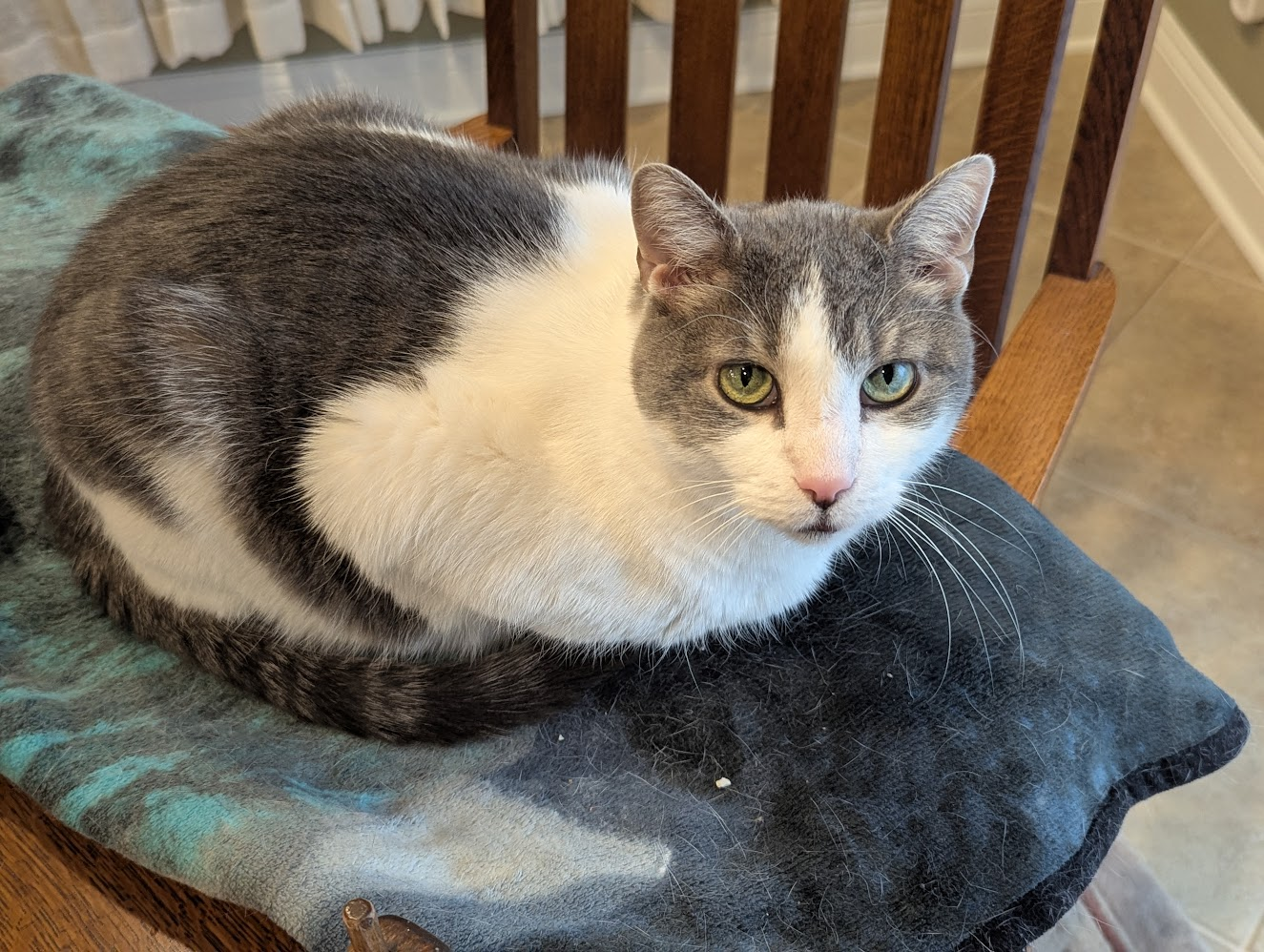
2/17/25 - Very important observation for developing traders: Notice how Shay (see below) was able to find his positive future by giving what he wanted more of. He was isolated in a cage, but when he saw us in a room, he immediately went to us and was extremely loving. It was because he gave love that we were inspired to provide him with a loving home. Developing traders who are struggling reach out and what do they talk about? Their struggles! What they don't share are their lessons learned and their successes (no matter how limited). If you want to learn with and from others, you're talking about forming and becoming part of a team. If you want to team up with others, offer teamwork! Give and give your successes and observations and accomplishments and others will be inspired to share their strengths with you. That is how everyone makes everyone else better. Give and give what you want more of.
Shay was in the animal shelter for quite a while. He could have easily grown lethargic in his small cage and withdrawn from the world. Instead, when opportunity came, he was all in. He persisted and persisted with his back and forth between Margie and me until we had to bring him home. In trading and in life, we can face setback after setback and find ourselves in a situation that seems hopeless. If, like Shay, we can reach out and reach out and find those who can help us move forward, we can achieve our successful future. Shay gave love and gave love and gave love when no one was loving him. And that is what brought him to his forever home. When we are feeling most abandoned and lost, that is when we most need to give and reach out. If, in some small measure, you can be the future you hope to find for yourself, you'll inspire others to join you in that future.
.
Sunday, February 09, 2025
Succeeding at Life

2/13/25 - One thing I've learned from my participation in recruitment/hiring/onboarding at hedge funds is that whatever the trader does to be successful in markets leverages strengths that they have developed previously in their lives outside of markets. Whatever that underlying process/talent/skill set may be, it is something that the trader is good at and that is intrinsically meaningful and rewarding to them. The example I use in my upcoming book, Positive Trading Psychology, is how I gather stories and information from the clients I meet with as a psychologist and figure out themes running through their lives. Only once I understand those themes do I know how I can help them in a way that will make sense to them. Not coincidentally, it's sitting back and observing, observing, observing markets that helps me figure out their themes and frame my trades. Same process. Identify what you've been doing to make you successful in life so far and then figure out how to bring those strengths to markets.
2/12/25 - One incredibly valuable lesson I've learned from my experience with the traders at SMB Capital is that consistency of profitability comes before the achievement of absolute profitability. In other words, the developing trader first becomes consistent in generating good ideas, structuring and sizing positions well, and managing their trades. Only after they have demonstrated consistency in how they trade do they bump up how large they trade. Another way of thinking about this is that process precedes profits. Do things well one trade at a time and you internalize the sound trading that enables you to take more and more risk and earn more and more.
Now imagine applying this framework to your life! Focus on living each day productively and meaningfully in a goal-oriented fashion and, once you've found that consistency, gradually elevate your goals. Thus, achieving small goals every day builds the mindset for eventually tackling larger goals. If we focus on making each day consistently profitable in life's rewards, we build the mindset for tackling greater and greater life visions. For better and for worse, we internalize what we do each day.
2/10/25 - The single most important ingredient of a successful life is regularly doing things that you find to be deeply meaningful. Research in psychology finds that happiness is necessary but not sufficient to produce overall emotional and physical well-being. In addition to doing things that are fun and enjoyable, it is important to engage in purposeful activity that is fulfilling for us. A great question to pose each day is, "What am I going to do today that is so meaningful and fulfilling that it will inspire me and give me positive energy?" For many market participants, it's not solely P/L that provides that emotional fulfillment. Perhaps it's the intellectual challenge of discovering new edges in markets; perhaps it's being part of a trading team and learning from and helping others; perhaps it's continually reviewing and refining performance to become better and better at navigating ups and downs. What about your trading process is meaningful to you?
Of course, when we are engaged in meaningful, energy-producing activities outside of trading, we're best equipped to bring our best psychology to our market activity. Younger people make the mistake of seeking a fun life. Older people make the mistake of seeking a comfortable life. Every day should bring meaningful goals and challenges that push us to become more than we are, even as they pull us to greater and greater energy and engagement in life.
2/9/2025
* Margie and I celebrated our 41st anniversary this weekend. We met at a singles event in Ithaca, NY, during which I had way too much to drink. When I got home, I wanted to sleep in and was concerned that the morning light would wake me up, so the idea came to me to sleep in my walk-in closet. I woke up hung over, stumbling out of my closet. I knew that Margie was special, and I knew that I would have to grow the f*ck up to be in a great relationship with her, especially given that she had three children by her prior marriage. What I couldn't do for myself, I was able to do for her: great relationships inspire us to be more than who we are. We become who and what we love.
* Great traders invest in their careers: they constantly study to find new sources of edge, and they continually work on their game. I have never met a successful trader who copies the work of others. The same can be said of successful artists, scientists, and businesspeople.
* We cannot live energized lives with out of shape bodies. Our emotional and spiritual development draw upon our physical energy.
* Mali teaches us that strength comes from how we compensate for our weaknesses.
* Mia teaches us that persistence pays off, even when you're on death row in rural Kentucky.
* We internalize what we consistently do. We succeed at life when we turn each day into small successes.
.
Sunday, February 02, 2025
What Goes Into An A+ Trading Opportunity?

2/9/25 - Once we identify an A+ opportunity, we've only begun to exploit its potential. By tracking short-term action where buyers/sellers cannot move the market to new highs/lows (the inefficiency pattern mentioned below), we have potential entry points with solid reward relative to risk. If the inefficiency patterns break for some reason, we can exit quickly when the market makes a new relative high/low. Because we're overbought/oversold over multiple time frames, the potential reward is significantly greater than the risk.
Still, this leaves us with two crucial aspects of the trade: *what* we trade and the sizing of our positions. We're looking for instruments that show clear overbought/oversold levels at the multiple time frames and we're looking for instruments that are moving most between these overbought and oversold levels. In other words, we look for what is trading: 1) cleanest and 2) what is moving the most.
With respect to sizing, every subsequent inefficiency (selling that can't move the market to sequential lows; buying that can't move us above our most recent peaks) becomes an opportunity to add to the position. When we hit overbought/oversold levels at the three periods mentioned below, we have opportunities to take profits. What this means in practice is that, early in the unfolding of the opportunity, we're sizing up and, as the pattern is working out and we are moving to overbought/oversold levels on the three time frames, we're taking profits. Position management is every bit as important to profitability as the timing of entries and the selection of trade setups. By taking profits quickly when we hit first levels of overbought/oversold on the adaptive moving average measures and moving our stops accordingly, we generate fresh risk/reward. Too often, traders focus on entries, less on exits, and very little on dynamic trade management and *what* to trade. If profitability were simply a function of the setup, it would be easy to automate the setup pattern and make money consistently. It's how we select opportunities and what we do with them that defines our success.
2/7/25 - Two ideas go into an A+ opportunity in my own trading. The first is a lining up of time frames. As I've shared in the past, following the work of Marcos Lopez de Prado, I construct my charts on event time, not chronological time. These charts utilize open-high-low-close, but the bars represent an amount of volume traded, not units of time. For instance, with the MES contract, I follow three periods, with bars of 5000, 15,000, and 50,000 contracts traded. Each chart then tracks overbought and oversold levels based upon the adaptive moving averages created by John Ehlers. These averages track crossovers of short- and longer-term lines, but the lines adjust their speed based upon how markets are moving at that time. When we have all three event time periods oversold at once or overbought at once, we have a lining up of time frames. Trade opportunities may present themselves based upon overbought/oversold levels of individual adaptive moving averages at a particular event time period, but the A+ opportunities occur when we're stretched at multiple periods.
The second thing I look for once the market is stretched across periods is what I call inefficiency. I use indicators of buying and selling pressure, such as the NYSE TICK, to tell me what traders are doing in real time. When we see buying/selling pressure that cannot move the market higher/lower, that tells us that the buyers/sellers have become exhausted. Their buying/selling is being absorbed by larger market participants.
When we see buying/selling inefficiency in markets that are stretched on multiple time frames, the ingredients are there for major unwinds. I want to take advantage of the buyers/sellers who are trapped. Because a large amount of volume is trapped, as measured by the volume bars, the resulting move is generally significant--not a quick scalp. My experience is that the batting average on these trades when all the variables line up is quite high. In my next post, I'll outline ways of making the most from these A+ opportunities.
The key here is to find a way of understanding market action that makes sense to you and that plays into your information processing and personality strengths. When you trade the unique patterns that reflect your best understanding of markets, you can then achieve unique returns.
2/6/25 - What goes into an A+ trade for one trader is often quite different from what goes into the best trades for others. This is because each of us brings unique talents to markets and varied skills that help us make us of these talents. Studying your best trades over a period of time can help you figure out how you best detect and exploit opportunity. Too often, developing traders are interested in trading and making money and not interested enough in figuring out who they are in markets and what they do well. Those traders have emotional disruptions of their trading, not because they are so emotionally troubled, but because they are pursuing something important to them without drawing upon their greatest strengths. The best way to be calm, focused, and secure in trading is to stay connected to what we do really well. That is what ultimately gives us the energy and enthusiasm to persevere and succeed. What do you see most clearly in markets? What interests you the most in trading? What are you doing well when you're making money? What kind of markets bring you the greatest opportunity? In relationships, we date before we commit. It makes sense to date markets--try out different markets and styles of trading--before figuring out what you will commit yourself to. Premature commitments yield failed marriages--in all areas of life. Next, I'll share what I do best and worst as an illustration of building trading success on what we do most successfully--
From this perspective, One Good Trade includes losing trades that one manages well. One Good Trade also refers to profitable trades that follow one's trading rules. If my above observation is correct, however, trading success also requires awareness of One Great Trade: one's A+ opportunity. It's the relatively few big winning trades that account for the difference between most good traders and the great ones. It's the (all too rare) combination of disciplined risk management and aggressive pursuit of special opportunities that define the great trader.
Having met with many traders over the years, I can confidently say that the great majority don't know--in detail--what goes into One Great Trade. They might have a sense for good opportunities, which they might call A trades, but they haven't truly studied their A+ trades: those few trades in a month or year that account for a large share of total profitability. What goes into an A+ trading opportunity? If you don't study those One Great Trade occasions in detail, replaying them and analyzing them intensively, how can you find the conviction to pursue them with aggressiveness?
I've been studying my own A+ trades and opportunities and will share them in an update to this post. But my unique opportunities are unlikely to be yours. Anything great cannot be copied from someone else, whether it's a painting, musical work, or writing. The odds are good that your A+ opportunities are hiding in plain sight. They are among your standout winners, even though you may not have fully exploited their potential. Much of the time, we become so immersed in solving trading problems and controlling trading emotions that we never fully study our trading strengths.
One Good Trade keeps you in the game and can make you consistently profitable. If you can identify One Great Trade, you'll have a template for success that you can build upon.
More to come.
Further Reading:
.
Sunday, January 26, 2025
Trading as Warfare
1/29/2025 - How can we do a better job of integrating our trading tactics into a broader trading strategy? In the book that will be coming out later this year, Positive Trading Psychology, I collaborate with Jeff Holden at SMB Capital to identify best mentoring practices used in the SMB teams. As research for the book, I sat in on Jeff's mentoring sessions with developing traders and saw first hand how he integrated strategy and tactics. The sessions began with looking at the broad market indexes and by focusing on longer (multi-week and multiday) perspectives. This view included overseas equity indexes as well as the U.S. stock market. This provided a big picture of whether money was flowing into or out of stocks globally and whether money was rotating to some countries from others. The chart review then proceeded to sectors within the U.S. stock market on different time frames again to see if money was flowing in or out of the market or whether funds were rotating capital to some sectors and out of others. Finally, the review focused on the individual stocks "in play" within these strongest and weakest sectors and the tactics for participating in their moves. By the end of the review session, traders had a good sense for what they were trading, why they were trading it, and how they would trade it.
A number of these traders came up with questions during the session and many posed their questions to me in the chat area of the Zoom and later in emails. Almost all of these questions pertained to how they could improve what they traded and how they traded it. Very, very, very few questions were about emotional overreactions to the day's trade and destructive patterns of trading. The reason for this was that the time spent in systematic preparation--understanding what the market, sectors, and stocks were doing; formulating a strategy for what to trade; and elaborating tactics for implementing the strategy--kept them grounded and focused. Solid preparation reduced uncertainty and nurtured a sense of understanding and mastery.
Trading is like warfare. If you stick troops into the field without a clear mission and tactics, they will panic at the first skirmish. The best trading psychology emerges from the best preparation: clearly elaborated strategies and tactics and ongoing practice and review.
1/27/2025 - In the overnight weakness in the US stock market, we can see a reversal of recent strength. This highlights yet another aspect of strategy and tactics in trading: the need to be flexible. Intelligence is not infallible in warfare and in trading and often it can be murky or incomplete. Notice that, in the days leading up to this decline, the SP 500 made a new high, but many averages--and many sector indexes within the SPX--stayed well below their highs. When we see the vast majority of stocks and sectors moving higher or lower, we can anticipate a degree of momentum/trend. When we see breadth waning on an upmove or downmove, that is when we're particularly at risk of reversal. That means that we must have the flexibility to assess new market information, determine whether it's a game-changer, and respond with fresh tactics and perhaps with a revised strategy. We put effort into generating our ideas; equal effort is needed to update those ideas as fresh data come into view--
In trading markets, strategy defines bigger picture opportunity. Tactics implement the strategy on a here-and-now basis. Many of the psychological challenges of short-term traders occur because they operate tactically, without an underlying strategy.
Here's a simple example. I have created a daily database of the percentage of NYSE stocks trading above their various moving averages, from 3-day MA all the way up to 200-day MA. Each day, this produces a momentum curve, a measure of how breadth has behaved over short, medium, and longer terms. The database goes back to 2006, so I can see how breadth behaves in various market conditions. (These data can be found on the Market Charts site).
This is another way in which trading is like warfare. Superior intelligence--more and better information--fuels superior strategies and tactics.
Across the entire database, if we divide the percentage of stocks trading above their 3-day MAs into quartiles (roughly 1150 days for each of the four groups), we find something interesting. Over the next few days, average returns following the strongest breadth quartiles have been significantly weaker than after the weakest breadth quartiles. In other words, on average, three-day periods of broad strength lead to short-term underperformance; three-day periods of broad weakness lead to short-term outperformance. We see mean reversion tendencies over the short term. The exception to this rule occurs when there is a breadth thrust: very high levels of breadth momentum. Then we see strength leading to more strength; weakness yielding further weakness.
The day trader who is unaware of such patterns may see a bullish or bearish setup, but can easily be run over by the mean reversion and momentum tendencies playing out over a multiday period. That leads to frustration, which can further impair trading. The cause of the frustration, however, is not a psychological conflict or weakness; the cause is due to pursuing tactics in the absence of strategy. The same problems affect investors, who trade "catalysts", only to lose sight of multi-week patterns playing out in market breadth.
Trading is like warfare. The difference is that the trader is both a general and a soldier: one who frames strategy and one who implements it. There is always a bigger picture that defines edge and a more immediate picture that guides the execution of the tactics that exploit that edge. Confidence comes from well-grounded strategies, implemented skillfully. .
Sunday, January 19, 2025
What If You Could Only Trade Once Per Day?
1/23/2025 - On Monday, January 27th at 4:30 PM ET, Agnieszka Wood and I will conduct a free hour long "ask me anything" (AMA) session. One thing that will make the session unique is that Agnieszka and I will approach questions from different, complementary angles: how our mindset can improve our trading and how improved trading practices can fuel our mindset. Should be a great opportunity to pick up best practices all the way around! One thing I'll discuss is how bigger picture thinking can improve our short term trading and how honing short term trading skills can help us get the most out of our higher time frame views. Registration will be limited; hope to see you soon!
1/22/2025 - We can approach trading from a bottom-up perspective (watching for real time shifts in buying/selling pressure) as a scalper or from a top-down perspective (watching for backtested patterns and catalysts over longer time horizons) as a swing trader or active investor. One approach is grounded in the talent of fast thinking and acting and pattern recognition. The other approach is grounded in the talent of analysis and bigger picture thinking. Success comes from knowing where your greatest talent lies and then developing the skills to apply that talent consistently. Many seeming psychological challenges of trading stem from the fact that we're not utilizing our greatest talents--
With only one bullet to fire, you would have to make sure the opportunity was outstanding.
What information would you gather to identify the one good daily trade? Knowing this constraint, you'd have to study, study, study the best trades that could have been placed each day and generate a creative plan for exploiting the single best opportunity.
How would you size the daily trade? What would you need to see to add to your position? What would you need to see to take profits? What would stop you out of the daily trade?
If you only traded once per day, what do you think your win percentage would be? How do you think your profitability trading once per day would compare to your current profitability?
What would be your greatest psychological challenge if you only traded once per day? Knowing that you're limited to one trade, what constructive activities would you engage in while the one good trade was setting up?
What if anything more than one best trade per day makes minimal money on average? What if all your time and effort watching screens and trading in and out of the market does not add significant value to your trading? To your life?
This will be an experiment I pursue in 2025. Discoveries come from asking new, different, and difficult questions.
Further Reading:
Expanding Our Trading By Imposing Constraints
.
Sunday, January 12, 2025
How to Achieve Quiet Confidence in Our Trading
1/15/25 - Understanding markets is not just about the big picture macroeconomic trends impacting price action. It's also about identifying the kind of markets we're in: trending/momentum; cycling/mean reverting; or a combination of the two, where cyclical moves occur within trends. The kind of market we're in determines the kinds of trading strategies we employ. Much frustration and loss in trading occur when we impose our strategies on the market, rather than trade the conditions we see. I find that I'm best able to trade market cycles by constructing charts based on volume, not time, and by tracking crosses of adaptive moving averages (moving averages that automatically adjust their parameters based upon identified cyclicality). Very promising trades occur when moving averages are behaving similarly on shorter, medium, and longer time scales. When cycles line up, the result is a sense of understanding that fuels our confidence in trading.
1/14/25 - The below post suggests that our optimal frame of mind when trading is not positive or negative, but focused and open-minded. As a psychologist, when I meet a new person in counseling, my first step is to connect with them and listen, listen, listen. If I stay open-minded and keep listening, the themes in what they are telling me will jump out at me. I don't try to intervene in the person's life until I have a clear thematic understanding of what they are going through. Similarly, I want to connect with the market I'm trading and listen, listen, listen to all going on within and around my market. That requires a focused, quiet mind--and most of all a curious, interested mind. We achieve quiet confidence when we achieve understanding and we achieve understanding by listening and listening for the themes connecting markets and time frames. Our optimal mindset is curious, interested, and focused. If we spend too much time looking for trades, we stop listening to markets and that leads to frustration. How we approach markets shapes our trading psychology, not just the reverse.
So much effort goes into trying to predict what markets will do next. Confidence, however, comes from understanding. When we understand what is going on in markets, the right trades come to us.
In a recent video for SMB Capital, I explained how the perspectives of active investors--such as those managing capital at hedge funds--can benefit short-term traders. This is because portfolio managers don't just look for trades: they identify themes that connect a variety of markets. A good example of this can be found in my recent post, which tracks recent moves in the U.S. dollar, U.S. interest rates, the U.S. and overseas stock markets, and commodities. There are themes underlying these moves (such as the potential impact of tariffs), which show up as relative strength in certain stock market sectors (such as the growth areas of technology) and relative weakness in other sectors (such as interest-rate sensitive shares). When we can step back and see the themes connecting movements among markets, it becomes easier to participate in significant market developments, such as the weakness in stock and bond prices on Friday.
Much of what we call "overtrading" occurs when we don't step back and achieve understanding and instead react to every market move that catches our eye. There can be no quiet confidence when we overtrade and when we are more interested in finding trades than in understanding market behavior. An experienced psychologist knows that people don't have dozens of problems; they typically have just one or two issues that show up in dozens of areas of life. Once we can step back and see the themes connecting our life challenges, we open the door to responding to old challenges in new, constructive ways. So it is in trading. When we stand back from the moment-to-moment ups and downs of markets and perceive the themes driving the trading from large institutional participants, we place ourselves in a fresh position to ride those waves.
Success in markets comes from turning themes into solid risk/reward trades. Confidence comes from seeing a bigger picture and knowing how to turn that into short-term opportunity.
.
Sunday, January 05, 2025
What in the World is Going On

1/7/25 - Just a quick addition to the below post: If you take a look at the popular equity ETFs in U.S. industries on the Barchart site, you can quickly see strength and weakness among sectors of the market. Notice that yesterday was generally seen as a strong day in the market, but strength was focused on technology and communications stocks--two important areas of growth. The value areas, such as consumer staples, were actually down on the day, as were the interest rate sensitive areas, such as utilities and real estate (see below). Trading success hinges on quickly identifying whether we are in trending or rotational markets. Is money flowing in or out of stocks, or is money flowing from certain areas of the market and into others? In the rotational markets especially, what we trade is just as important as when and how we trade. We can work on timing all we want, but if we're trading the wrong things, our returns will be suboptimal at best--
===
This post will summarize what is happening across financial markets and economies--what is sometimes called the "macro" picture--and explain how that understanding can help our short-term trading.
I've begun work with new portfolio management (PM) teams at hedge funds, and I have been impressed by the unique research undertaken by each team. One thing that makes these teams distinctive is that they first seek to understand what in the world is going on and only then do they explore trades that might provide them with good reward relative to risk to exploit this understanding. Because they are driven by intellectual curiosity and the desire to understand, they are not following every tick in the market and they are not going on tilt, trading on FOMO, and experiencing all the common problems we hear about. When PM teams meet with someone like me, it's to expand their understanding, improve their teamwork, and translate conviction about what's happening in the world into portfolios of trades that best leverage their distinctive strengths.
In my upcoming book, Positive Trading Psychology, I explain how a knowledge of short-term trading can help active investors achieve better reward relative to risk for their trades. I also explain how an understanding of macroeconomic fundamentals can help short-term traders identify unique areas of opportunity and align their trades with bigger picture trends. It is when we blend the tactical identification of opportunity (our fast-thinking, pattern recognition skills) with the deeper, strategic thinking that provides us with an understanding of market trends and patterns that we achieve the positive mindset that accompanies a sense of mastery. Optimal trading psychology comes from understanding, and understanding comes from preparation. Notice how the relationship among preparation, mastery, and mindset occurs in every performance field, from sports to chess to professional dance.
OK, so what is going on in the world? Here are a few observations from macro markets, with a shoutout to Barchart.com, which provides a wealth of data (found in the following links) regarding performance across asset classes and regions of the world:
1) The US Dollar is outperforming other currencies: Note the uptrend in DXY since early October. During that same period, note the relative weakness of the Japanese Yen, the Canadian Dollar, and the Australian Dollar, and the relative strength of the US Dollar to the Chinese Yuan.
2) The yield curve has been steepening: Remember how, not so long ago, we were talking about inverted yield curves and forecasts of recession? No longer. Since September, long-term fixed income prices have fallen more than medium-term fixed income prices and both have fallen more than short-term fixed income prices. That means that interest rates are rising as we go out on the curve. Note that high-yield bonds have performed relatively well. We don't seem to be anticipating defaults in the fixed income world.
3) Many commodities have weakened: The commodity index is down since early October, with notable weakness in metals and mining, agribusiness, and the shares of raw materials companies.
4) US stocks have outperformed overseas averages: Note the relative underperformance of European shares since late September and, indeed, in the relative underperformance of non-US stocks in general. Shares in China have held up better than shares in Australia, South Korea, and Brazil.
5) Performance among US stock sectors has been very mixed: We've seen relative strength in NASDAQ shares and Consumer Discretionary stocks. Growth shares have outperformed value stocks lately and small cap shares have recently underperformed the overall market. Note the particular weakness in interest-rate sensitive sectors, such as real estate and utilities, as well as raw materials and healthcare. We hit a peak in stocks making fresh new annual highs on November 6th and, since December 10th, the number of stocks making fresh one month lows have exceeded the number of monthly highs every single day and the number of shares registering three month lows have exceeded the number of three month highs almost every day. Only 6.45% of real estate stocks are trading above their 20-day moving averages as of this past Friday and only 7.14% of raw materials shares. By comparison, despite the recent correction, over 30% of technology stocks are above their 20-day averages.
Conclusion: The bottom line is that performance in financial markets has become narrower and narrower. Rising long-term rates in the US, falling commodities, and weak overseas equity markets speak to the potential impacts of economic policies that seek to place America first. The prospect of broader trade wars and diminished trade due to possible retaliatory tariffs weigh on many segments of equity markets. Trading success has hinged on identifying the relative winners and losers in the emerging financial landscape. Short-term traders should be alert to the patterns of relative strength and weakness.
So far, in the big picture, strength is relatively concentrated in the US (US dollar; US stocks) and, within the US, strength is relatively concentrated in growth segments of the market. A Goldman Sachs report observes that concentration of value among US stocks is at historic highs. They observe that we have only seen similar levels of concentration prior to the Great Depression, at the peak of the dot-com bubble, and during the early 1970s. Right now, themes of relative strength and weakness dominate the macro investing landscape. It will be important to watch the segments of greatest strength to see if this period also turns out to be a bubble that bursts, perhaps as the stagflationary result of tariff wars fueling inflation and restraining growth.
.
Subscribe to:
Posts (Atom)

 Posts
Posts


