Sunday, March 28, 2021

Ask The Trading And Trading Psychology Questions Top On Your Mind

 
It's been a busy few weeks, and I've largely taken a break from social media and educational programs in order to focus on my own trading.  Among the areas I've been working on are:

*  Using the trading psychology of market participants to read intraday and longer-term patterns in the stock market;

*  Refining the use of market cycles for the timing of trades;

*  Refining the use of quant studies to look for market edges;

*  Using relative performance to identify the next market themes in play.

This work was rewarded on Friday with one of my best trading days in a while.  Trading is always a work in progress and that is a big part of what keeps it fascinating and challenging!

If you click the graphic at the top of the post, you'll get the details on a webinar I'll be doing with Futures.io and Morad Askar this coming Wednesday at 4:30 PM EST.  The format of the session will be that participants can bring any trading or trading psychology question for Morad and me to answer.  Participants can ask their questions anonymously and it will be open kimono on my end.  Happy to share my latest work, as well as general ideas re: trading psychology.

The idea is provide free coaching and mentoring to developing traders and allow everyone to learn from each other's questions.  

In order to participate in the live session and ask questions, you'll need to use this link to register:  


Because it's a virtual session, attendance will be limited.  Hope to see you there!!

Brett
.

Friday, March 12, 2021

Tracking Sentiment And Market Impact


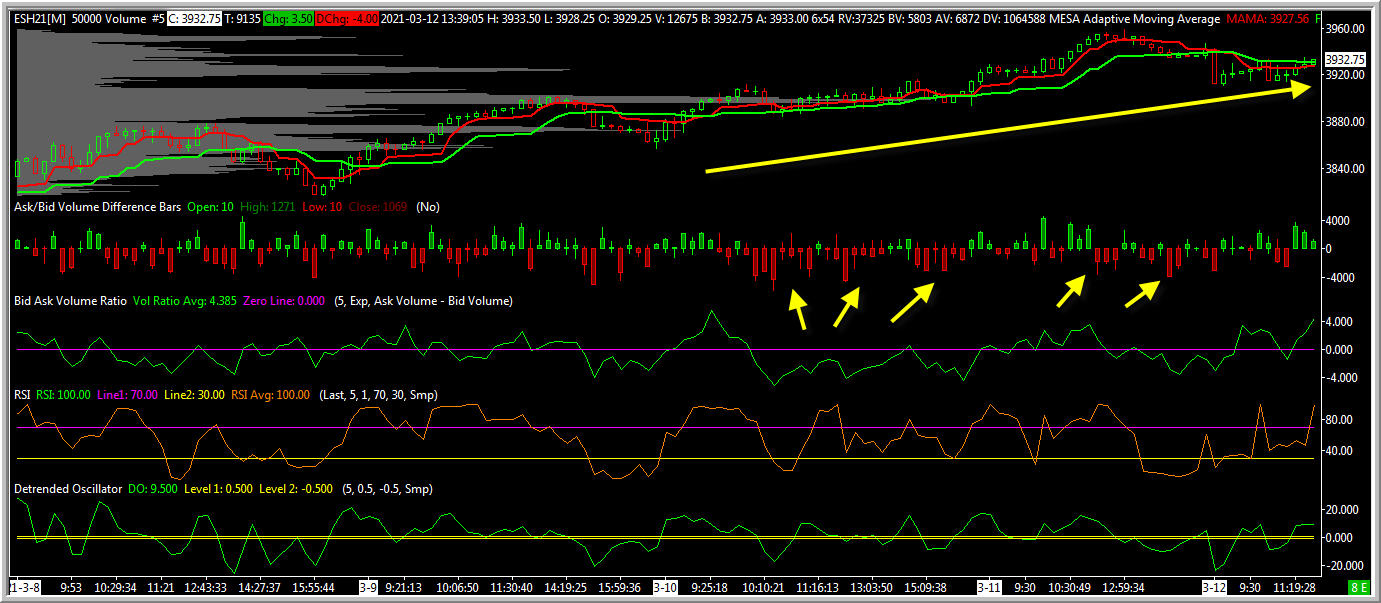
If you click on the chart above, you can see one thing I was tracking in the afternoon of Friday, March 12th.  (Data and chart from Sierra Chart).  In the top panel, we see the futures market for the S&) 500 Index (ES), where each bar represents 50,000 contracts traded.  The second panel shows the proportion of volume during each 50,000 contract period that was transacted at the offer price (green color) vs. the bid price (red color).  What we see with the yellow arrows is that the trend of ES continues higher, but there has been recent hitting of bids during the recent period.  In other words, sellers have been more aggressive lately, but they have been unable to push price meaningfully lower.  That has kept me long the market, with a tilt toward large cap value, which has been outperforming the NASDAQ tech names.  

Knowing the sentiment of the market through tracking which side is more aggressive and then seeing how this is impacting price action provide a helpful perspective on the market.  In this case, it has kept me in my position despite some price pullback and opens the door to my adding to the position should I see fresh lifting of offers taking price higher.

The most recent Three Minute Trading Coach video describes two ways of improving our trading that also improves our trading psychology.  The overarching point is that trading well--and grounding ourselves in market data that we have studied and reviewed so often that we have confidence in their value--is one of the best ways of improving our mindset.  If we are patient enough to wait for those occasions when we truly understand what is going on, that understanding provides us with the security to take proper risk in the idea.  Working on your trading ultimately *is* working on your head.  Understanding the psychology of other market participants is excellent grounding for your own psychology.

Further Resources:


.

Monday, March 08, 2021

Should High Achieving Traders Try To Live A Balanced Life?

 
A developing trader with a real passion for markets recently asked me about the psychological benefits of a "balanced life".  I'm sure he noticed, as I have, that many of the most successful traders put an unusual amount of time and effort into their work.  Is that setting them up for burnout, however, or undue stress during periods of drawdown?

It's an issue that I am intimately familiar with, as I typically wake up quite early in the morning and often work into the evening, including on weekends.  I have multiple work responsibilities--teaching in a medical school, working with traders from different firms, and helping college students who are doing overseas internships--and I have a wonderful family to keep up with.  On top of that, I'm taking several courses and writing a book.  Time is tight.  Sometimes too tight!

Do I have a balanced life?  In one sense, no, if we measure balance in terms of hours per week.  In another sense, my time spent with family, in my marriage, in learning, and at work provide real variety.  Per the quote above, I seek a balance among my passions; I don't balance time.

A large body of research in the field of positive psychology finds that we perform best, feel best, and are physically healthiest when we maximize our well-being.  Psychological well-being comes from doing things that make us happy; doing things that are meaningful to us; doing things that give us energy; and doing things that bring us closer to those that we care about.

We want to be firing on all four of those cylinders frequently every week, preferably every single day.  If we balance our passions in that way, we're most likely to broaden our sources of well-being and make ourselves as fulfilled and productive as possible.  If you're looking to balance your work life, the best place to start is maximizing non-work passions.

I've often pointed out that trading has to fit into our lives; our time can't be hostage to markets.  If all we have in life is trading, we will feel empty, stressed, and depressed when trading isn't paying off.  When we cultivate multiple passions, we always have things in our lives that keep us energized and engaged.  

What in your life sustains you outside of markets?

Further Resources:


.

Saturday, February 27, 2021

Three Ways To Improve Your Trading--And Your Trading Psychology

 
Here are three things you can evaluate right here, right now to help your trading and improve your trading psychology:

1)  Look at how much heat you take on your trades relative to how much they move your way - In other words, examine each trade you place and see how far the position went against you during the life of the trade and how far it went in your favor.  This tells you if you are truly achieving good reward relative to risk in the execution of your ideas.  If you tend to undergo meaningful downside before positions work for you, how might you refine your entries?  Studying what would have been more optimal entry points will help you reduce downside during your trades and that promotes a sense of mastery.  On the other hand, if you tend to take little heat on your trades, are you sizing up positions adequately when you do enter?  Might it make sense to size the entries larger and scale out of positions as they go your way, creating more consistent and larger profitability?  That can help our psychology as well.

2)  Look at the productivity of the time you spend when you are *not* trading - There are many junctures during the trading day and week when opportunity is slim.  Do you use this time to research new ideas, update existing ones, and review performance in detail?  Or do you find yourself staring at screens, worrying about P/L or searching for trades to put on, even if those aren't necessarily in your wheelhouse?  When we are productive in our time outside of trading, we create wins every single day, and that bolsters our mindset.  Using the time unproductively reinforces a sense of self that fails to achieve.

3)  Look at what happens to your positions after you exit them - After you've exited a trade, what tends to happen to your positions?  If you took a profit, did the positions move meaningfully further in your favor?  If you took a loss, did the positions reverse and eventually prove profitable?  Many times we exit positions and leave considerable money on the table.  Might it make sense to exit positions in stages, rather than all at once?  Might it make sense to hold portions of profitable positions longer for further potential gain?  Would it make a difference to hold those portions of positions in the form of options, reducing capital at risk?  Many times we enter for sound reasons and exit for emotional reasons.  Studying and optimizing our exits gives us greater control over our risk, enhancing our sense of efficacy.

The bottom line is that some of the best ways to improve your trading psychology is to improve the mechanics of your trading.  All the positive self-talk and work on mindset cannot substitute for skill and its consistent execution.

Further Resources:


.

Sunday, February 21, 2021

How We Tranceform The Mindscape

 
In The Psychology of Trading, I wrote about "Tranceforming the Mindscape", which was my way of describing how we can cultivate alternate states of consciousness as a way of expanding our ways of thinking, feeling, and behaving.  Although many turn to drugs and alcohol for this purpose, the reality is that there are many disciplines we can learn to live life more intensely.  The right kinds of dance and music can shift our awareness.  Mastering meditation can be another path.  In the recent Trading Coach Video, I describe the use of self-hypnosis as a way of expanding our repertoire.  Especially relevant is the recent Forbes article, which describes the technique of anchoring and how we can employ it to improve performance. 

Suppose you want to be a winning race car driver.  You work on different techniques of driving, different ways of passing cars, different ways of pacing yourself.  All are fine, but you're still driving the same car.  That's the challenge of most traders.  They are looking to improve their psychology, but they're operating with the same brain, the same states of awareness.  Does anyone truly rewire themselves simply by writing notes and goals in journals or casually reviewing charts?

To win, we need to be driving a better car.

In the Radical Renewal blog book, I describe ways of programming our minds for stillness and extreme quiet.  There are ways of radically quieting the mind that enable us to reprogram ourselves and create new connections of thought, feeling, and action.  This "trance-forming" of our mindscapes involves entering very different states of mind and body and then rehearsing desired patterns--and directly experiencing our best selves--in these fresh states.  For instance, I recently wrote about brain wave biofeedback and techniques I'm learning to keep myself in hyper-focused states.  While highly focused, I simply walk myself through the things I want to accomplish in my day or in my trading.  Incredibly, everything I rehearse comes back to me vividly once I return to the focused state.  So, for instance, one of my trading goals is to hold winning positions longer under defined conditions.  Rather than keep myself "disciplined" to achieve this goal, I keep myself focused.  The right trading actions are anchored to the state of high focus.

The fundamental idea behind Radical Renewal is that the world's great spiritual and religious traditions are collections of time-tested methods for transforming ourselves, overcoming our egos, and tapping into our souls.  It is difficult to find such a tradition that does not induce trance states through ceremony, prayer, meditation, and/or dance.  "Tranceforming the mindscape" means that we develop the ability to process the world in enhanced states of focus and awareness and then use this experience to expand our repertoires.  It is through the body that we program the mind; if we operate in a narrow range of mindsets, we will never expand ourselves.  To paraphrase Gurdjieff via Colin Wilson, the fundamental human situation is that we're watching the wrong movie, not realizing that we have been the projectionist all along, that we should be in the control booth.  

Life is too precious to be lived mechanically.


Further Resources:


Friday, February 12, 2021

Learning How To Lose


On the surface, it seems like a strange idea:  We become winners when we learn how to lose.  It's when we can't accept losing that we hold onto trades long after they've gone against us.  It's when we can't accept losing that we play small ball and never pursue meaningful rewards.  It's when we can't accept losing that we become frustrated during drawdowns and lose our focus and discipline.  It's when we can accept losing that the good entry in a trade is never good enough and we miss opportunity.

So many of the challenges of trading psychology are rooted in our inability to lose.

When we can accept--truly accept--that trading is a probabilistic game, that losing is part of those probabilities, and that we can trade well and lose, our egos no longer become attached to our P/L.  If we go to a Vegas casino and bet large when we hold two pair, we can lose when someone around the table comes up with three Kings.  We were right to bet large and, over time, that bet is likely to pay off.  If we can't accept losing, however, we will not just lose but be defeated.  That will prevent us from placing the next solid bet, or it could frustrate us and place us in revenge mode, betting even larger on a poor hand.

Learning how to lose means losing in a planned manner.  It means knowing when our trade has been proven wrong and exiting at a point that we have rehearsed and accepted.  It means sizing our bets so that the probabilities going against us won't take us out of the game.  If we run a 60% win rate with our trades over time--which would be quite good--the reality is that we will lose several times in a row many times during the year if we trade often, simply by random chance.  If we can't accept that kind of losing, can we truly hang in there to win?

Traders work on improving their trading and that is necessary for success.  Working on losing is equally important.  A great topic for a trading review is:  Did I do a good job of losing?  The odds can never work in our favor if we don't fully embrace those odds.

Further Reading:

Radical Renewal - Free blog book on trading and spirituality


.

Friday, February 05, 2021

The Best Way To Develop Trading Expertise


Yesterday I participated in a team meeting at SMB where the members reviewed their performance for January.  It was striking how many of the traders were working with team members to improve their trading, often by trading shared books.  In these shared books, the traders developed ideas jointly and worked through how to trade those ideas.  The performance of the joint books was off the charts, and many of those traders made six figures on the month.

What's going on here?

Consider three levels of learning:

1)  We can attend seminars, listen to podcasts, etc. where experts tell us how to trade;

2)  We can attend classes where experts teach us how to trade;

3)  We can work as an apprentice to experts to involve ourselves in learning.

What I have found is that the first option is good for conveying information, but has little value in terms of developing expertise.  The second option is helpful in terms of describing what to do, but is limited in terms of helping us actually achieve the doing.  The third option involves hands-on role modeling and mentoring and actually provides real time feedback on performance for deliberate practice.

The shared trading acts as a vehicle for mentoring and apprenticeship.  It creates a structure for using skills, getting feedback, and making improvements--every single day.  I see this at hedge funds, and I see it at proprietary trading firms.  Mentoring works.  Single shot seminars and classes inform, but do not build expertise.

Can we develop processes for mentoring ourselves?  In other words, what if we have a wise self that we can tap into as well as a reactive self that makes lots of trading mistakes?  Is there a way we can access this wise self and utilize our own experience as a vehicle for mentoring?  For many traders, this would be a game changer.  I will be developing this theme and providing examples in upcoming posts.

Further Resources:

The Three Minute Trading Coach - Using Checklists to Improve Performance

The Real Way to Develop Expertise

A Quick Checklist for Peak Performance

.

Sunday, January 31, 2021

Lessons From The Recent Trading Craze

 
Aristotle had a good point:  Without a touch of madness, we would all be secure in our consensus thinking and that's not helpful for innovation.  Often, it's the seemingly crazy question that leads to new ideas and fresh ways of tackling old problems.  For a long time, algorithm developers have been able to examine individual transactions, volume, and price levels and estimate how much volume is long and short at various points in the market.  At key points, these programs can push prices beyond a pain point, forcing shorts to cover and longs to scramble from their positions.  Figuring out where buyers can't push prices higher and sellers cannot move markets lower is a durable source of edge, in part because market participants tend to be leveraged and cannot take heat on their positions.  

So along comes a touch of madness saying that this same dynamic could be implemented by large groups of traders aligned in social networks.  Some large market players specialize in short-selling strategies, seeking to profit when individual stocks are overpriced.  They then leverage bets that these high flyers will return to earth.  But what happens when networks of individual traders take the other side of that bet, pushing prices higher than the short sellers can bear?  The result is that overbought stocks become insanely overbought, but over the short time frame the inability to take heat has created yet another trading edge.

You don't have to be a whale to dominate the seas.  Piranha in sufficient numbers can take down the largest creatures.  It just takes the madness of a few lead piranha to see what can be possible.

Ultimately, markets will absorb the participation of trader networks as they have absorbed the participation of computers:  through regulation and oversight.  But I'm not sure the genie gets back in the bottle once unleashed.  Networks are likely to be here for good, introducing elements of madness in politics and finance, sometimes for better, sometime for worse.

The untold story is less dramatic, but perhaps more important.  I have record numbers of traders reaching out to me, interested in learning trading.  They are not simply wanting advice on $GME or $AMC; they truly want to learn how to trade.  The current market turmoil is bringing an entire new generation into markets, and that will shape market activity for years to come.

The opportunities are immense for trading firms dedicated to training new traders, such as the groups I work with at SMB Capital and Kershner Trading.  They are also profound for online trading communities that are truly dedicated to teaching trading and growing a new generation of market participants.  Take a look at Investors Underground, with its trading courses, video library, and real time chatroom for developing traders.  Take a look at Traders4ACause, with its annual programs and networking events.  Take a look at BearBullTraders, a community of mentors and training resources that is in the process of teaming up with TradingSim, developer of a platform where traders can actively practice trading skills.  

As responsible and successful trader development networks take hold, they will change the face of trading psychology.  The emphasis will be less on one-to-one meetings and more on group programs that teach concrete skills specifically tied to trading practices.  Each network will have its own curriculum and its own group of experts to provide that curriculum.  Trading networks will look far less crazy and increasingly look like professional training platforms: next generation vehicles for the development of market participants.

I recently offered a simple three-item checklist that traders can use each day to ensure they are performing at their best.  In a networked trading world, the goal is not for people like me to coach traders.  It's for people like me to provide resources that enable traders to coach themselves.  Once you have your checklist and a robust process for utilizing it, you can take control of your own development.  The goal is not to find the next bright shiny object to chase in the trading world.  The goal is to find within markets your strengths and your interests and learn how to guide your own development, your own heroic path.

Further Resources:


.

Saturday, January 23, 2021

Self-Esteem: Our Relationships Shape Our Relationship With Ourselves

  
Self-esteem is our relationship with ourselves:  how we view ourselves, how we treat ourselves, how we talk with ourselves, what we expect from ourselves, what we desire for ourselves, what we most respect, what we most admire.  Self-esteem is destiny: it determines what we seek, and that determines what we achieve.

Every relationship we have is a mirror, reflecting ourselves, providing an experience of ourselves.  Over time, we absorb what is mirrored to us: we internalize what we experience in relationships.  In positive relationships, we experience ourselves as worthy, capable, and special.  Through positive relationships, we internalize positive experiences of ourselves.

Our relationships are our psychological food.  Emotionally, they are what we absorb.  Just as the right foods nourish our bodies, the right relationships nourish our selves.  The love of parents for a child is internalized as that child's sense of self.  Abuse or neglect in a relationship is internalized as feeling unloved--and unlovable.

There are two simple ways to gauge a relationship.  The first is to share something painful you're going through, some great challenge that you're facing.  If the other person simply wants you for what you can provide them, they will not respond.  They are interested in taking, not giving.  If the other person actually cares about you, they will drop everything and reach out.  A good relationship is a secure shelter in the storm.

The second way to gauge a relationship is just the opposite.  Share something very positive that is happening in your life:  some joy, some success, some source of excitement and enthusiasm.  If the other person shares and cherishes your happiness, you know you have a potential soulmate.  If the other person is threatened by the best within you and does not respond to your joys and achievements, you know there is no true relationship. 

If I am by myself, I can either feel all-one or I can feel alone.  Self-esteem shapes how we experience our own company.  If being on your own feels like being alone, you know you've absorbed the wrong relationship experiences.  

Life is too short to settle and compromise.  When we accept those who resent us and secretly long to hear negative things about us, when we accept those who simply want to use us and cannot reach out to us, we lose pieces of ourselves.  You are living your life story, and you're the hero or heroine of that exciting drama.  Find the right people to share that story with and you'll have the life you truly deserve.

Further Resources:


.

Saturday, January 16, 2021

Can Intensive Practice Produce Trading Expertise?

 
One practice I have noted among successful discretionary traders is their review of price action in markets.  Some have used replay functions on their charting platforms to see patterns unfold in the market, making them more sensitive to the occurrence of these patterns in real time.  Especially among daytraders, I've noticed that their trading is largely based upon visual and numerical information on screens.  What they are looking at amounts to patterns in market behavior, just as physicians look for patterns among symptoms and test results to make diagnoses.  For instance, a trader might observe that prices are breaking out of a narrow range with increased volume and increased lifting of offers on a depth of market screen.  That might be an indication that the market is establishing a new, higher level of value.

Pattern recognition, however, is a trap as well as a gift.  We can identify patterns where nothing meaningful is actually occurring.  Many chart patterns that traders look for have no causal relationship to price movement and ultimately lead to frustrated and unprofitable trading.  Promising patterns in markets are ones that capture an understanding of what is going on between buyers and sellers.

Physicians learn the pattern recognition of diagnosis through repeated experience.  A radiologist may need to look at many, many images in order to detect malignant growths or hairline fractures.  A psychiatrist may need considerable experience to identify when a mood swing is part of a depressive disorder, anxiety disorder, or bipolar disorder.  Case studies and years of training provide the repeated exposure that allow for accurate pattern recognition.

What if a major reason for the failure of developing traders is not a lack of discipline or disruptive emotions, but rather the lack of repeated exposure to meaningful patterns?  Traders review their trading and look over charts, but is this really the same as training oneself to identify patterns in real time?  Would reading books or reviewing medical charts substitute for observing actual patients for doctors building expertise in diagnosis?

I recently had a worthwhile conversation with Al and Kunal, the principals of TradingSim, a platform that allows traders to replay stocks and markets from any recent period of time in order to practice trading skills. Joining us was Andrew, the leader of the BearBulls online trading community.  One of the intriguing topics we explored was the use of a feature-rich trading simulator as a way that independent traders could drill their trading skills.  This strikes me as having tremendous potential, as it potentially provides a level of intensive practice not typically available to individual traders.

I recently suggested that a major component of trading success is the capacity for sustained focus.  What if the right kinds of trading drills become ways of cultivating the capacity for focus, so that we become better pattern recognizers over time?  In that scenario, trading psychology follows from superior training.  Intensive practice may lead to trading expertise, and it also may build the brain states most likely to result in sound trading.

Further Resources:


.

Sunday, January 10, 2021

Why Your Trading Psychology Exercises Don't Work

 
In the most recent Forbes article, I make the case for mastering our trading psychology by literally engaging in brain training. When I refer to brain training, I am not talking about online exercises or apps that walk you through visualizations, breathing exercises, etc.  Rather, I am talking about directly measuring our body's functioning and training ourselves to control those measures through real time biofeedback.

Over the past two weeks, I have conducted focused experiments with heart rate and heart rate variability, electrodermal activity, and brain wave patterns, using the Fitbit Sense and Muse S units that I referenced in the earlier article.

Here are a few observations that were unexpected:

1)  Taking a Break Doesn't Necessarily Break Our Stress - When I feel stressed and take a break, calming myself and deepening my breathing, I succeed in taking my attention from what is troubling me and I feel more settled, but my body has often not recovered. My heart rate remains elevated, my electrodermal activity and heart rate variability still record stress, and my brain waves are not calm.  Simply taking a break and saying nice things to oneself feels good when we've been frustrated, but may not significantly aid performance.

2)  Less Stress Does Not Equal Greater Focus - This has been dramatic in my experiments thus far.  I can remain still, breathe deeply, and engage in calm imagery and that will reduce my heart rate over time.  (It takes longer than most of us allot to trading breaks.)  When I measure my brain waves, however, they do not show that I'm more focused.  Indeed, to achieve high focus readings with the brain waves, what I need to do is concentrate, not relax.  Interestingly, when I do a meditation routine and do it well, it helps my stress measures (i.e., I'm more relaxed), but my brain waves don't register as being in the zone.  A few minutes of a meditative exercise is very different from mastering the discipline of meditation.

3)  A Few Minutes of High Focus Changes Our Psychology - Most of us are familiar with the feeling of being calm and unstressed. That relaxed state can be helpful in winding down from a period of trading.  A highly focused state feels quite different.  When I'm unusually focused (and the brain wave feedback registers such focus), I feel a slight tension in my forehead and I feel distanced from the world around me.  It doesn't feel relaxed, as one might feel after an alcoholic beverage.  It feels quiet and I feel separated from the world, more like an observer than a participant in what is going on.  Perception is different in this mode, clearer and not at all distracted.  I'll have more to say about this in the next Three Minute Trading Coach video, but my sense is that I see markets much better when I'm highly focused than when I am simply stress free.

So what does all this mean?  Perhaps we're managing our trading psychology the wrong way.  Perhaps we're trying to de-stress when we need to be intensely focusing.  Perhaps we are setting up our trading days and processes in ways that increase distraction and actually prevent us from achieving the focus needed to quickly process evolving market patterns.  Our efforts at improving our trading psychology might not work because we're focusing on our feelings rather than strengthening our brains.

Further Resources:


.

Sunday, January 03, 2021

What You Trade Is As Important As How You Trade


Happy 2021 to colleagues and readers!

In this new year, I'll be doing something different with my blog posts and making efforts to link to the work of trading educators and mentors whose work I enjoy and respect.  The goal is to highlight valuable lessons for traders and also to introduce ideas and contributors readers might not be familiar with.

This week's lesson is "what you trade is as important as how you trade".

Here's a straightforward example from my recent coaching experience:

A trader focused day to day on "catalyst" events that would provide directional opportunity.  For instance, he might trade breaking news from a central bank meeting, a data release, or a news headline.  He worked diligently on refining his entries and exits in these trades, hoping to generate quick profits that supplemented his longer-term, thematic macro trades.  Indeed, this focus on how he traded catalysts improved the Sharpe ratio of those trades over time.

During one of our meetings, he briefly noted some frustration that some of the catalyst trades went on to become great trending moves, but only after he had exited his positions.  So, we investigated his recent successful trades and examined which ones went on to become larger opportunities.  What we found was that it wasn't just the move in a single trading instrument in response to the catalyst that made a difference; it was the move across multiple, related instruments.  

A simple example would be a stock that moves higher on an earnings beat.  If the move is idiosyncratic--limited to that stock--it tended to make for a good short-term trading opportunity.  If the relevant sector moved higher on the earnings beat, this was a sign that the news signaled a broader opportunity for an entire industry and would be more likely to be picked up by equity investors.  On those occasions, it made sense to keep a portion of the position on, as long/short investors and trend followers were likely to join the bandwagon.

Another example would be an economic release that leads to a move lower in the U.S. dollar.  If the dollar moves lower across multiple crosses, this might have very different implications than a dollar move that occurs mostly against a single currency.  If the dollar move is accompanied by correlated moves across the interest rate curve, this, too, might suggest that the macro world is interpreting the news in a way that could lead to trending behavior.

The trader I met with thus focused his energy on *what* he traded, not just on the mechanics of entries and exits.  Prioritizing opportunities that displayed a breadth of response to a catalyst, he became more selective and achieved a higher quality of returns that included both short-term opportunistic profits and the profits from the holding of longer positions.

In 2020, if you were trading stocks, the sectors that you focused on made all the difference in your returns.  The growth stocks and IPOs emphasized by Kathy Donnelly, Eve Boboch, and colleagues, for example, have performed phenomenally versus more value-oriented shares.  Once focused on the area of opportunity--the *what* to trade--it then makes sense to refine the *how* to trade.  Indeed, that was the focus of Kathy's recent podcast with Richard Moglen:  how to decide upon exits in these large opportunities.  But as Kathy relates to Richard, the initial focus of their efforts was Eve's focus on finding the next Google--figuring out *what* to be trading.

A different example of focusing on what to trade came in my own trading, as I reviewed the work of Brian Shannon at Alphatrends.  He has pioneered the application of "anchored VWAP" in trading, including the use of multiple volume-weighted average price lines anchored by key market events.  What I found, based on Brian's work, is that when anchored VWAPs at different time frames converge--and when that convergence is occurring across multiple stocks in a sector--that often provided potential breakout opportunities that had real investment implications.  Those breakouts were ones that investors would be more likely to hop on, providing the longer-term potential.  Here the *what* to trade was defined by the intersection of technical criteria and the breadth of the market opportunity.

Finally, I have noted in the past that the unusual success of many traders at SMB Capital can be attributed to a focus on what they trade and not simply on their work on how to trade the opportunities.  An important tool in this regard is "relative volume".  When a stock displays unusually high volume relative to its past, that's an indication it is "in play" and drawing unusual trader and investor interest.  Because volume correlates highly with volatility, such stocks are more likely to display meaningful moves for short-term traders.  Interestingly, many of the best opportunities are found among smaller cap stocks that don't have a large institutional or algorithmic following.  It is easier to read the tape with those stocks, allowing for better identification of when buyers or sellers dominate.  The same trading techniques applied to widely traded vehicles, such as stock index ETFs, would be far less profitable.

Focusing on what to trade means becoming more selective in our trade selection, prioritizing the quality rather than quantity of opportunities.  As for any successful entrepreneur or oil driller, where to seek opportunity makes all the difference.  You can have the greatest drilling equipment in the world, but if you're looking in the wrong spots, all you'll get are dry holes.

Further Resources:

The Three Minute Trading Coach - 30+ short videos to help traders coach themselves

Forbes Articles - A large archive of articles on methods for improving performance

Trading Psychology 2.0 - Book outlining how we can find our best practices and turn those into repeatable processes   
.

Sunday, December 27, 2020

What Distinguishes Professionals From Amateurs

 
I see some traders tackle markets for years and never achieve even basic competence.  Then I work with others that achieve unusual success in their first years.  What makes the difference?  Yes, work ethic and skill/talent sets matter quite a bit, but what increasingly hits me between the eyes is the difference in the learning process between amateurs and developing pros.  Here are two of those differences that make a difference:

1)  Professionals keep score - Can you imagine a weightlifter who doesn't track how much they're lifting, how many reps they're doing, which muscle groups they're working, how much body mass they're adding?  Conversely, consider the golfer who uses sensors and apps to track their golf swings, identifying details of what they're doing right and wrong on various courses and holes.  Pro basketball teams review game film in agonizing detail; amateurs leave the game behind once they leave the court.  In trading, we can easily keep score, with performance stats ranging from how much heat we take on a trade to how much we make and lose for various types of trades.  What amazes me is that, when traders keep score, they learn about strengths and weaknesses in ways that they do not when they just review their weekly or monthly P/L.  As I recently shared in my article on building your personal process, I have been using the Fitbit Sense and MuseS units to track my sleep, exercise, stress levels, focus, and much more.  To my surprise, I might think that I'm calm and focused, but all the data sometimes tell me otherwise!  By constructing daily exercises and keeping score, I'm getting better and better at my own trading psychology.  If a psychologist needs to keep score to improve mindset, the odds are pretty good that most of us could benefit.  :)

A couple of tools for tracking performance and keeping score are TraderVue and Edgewonk.  What I find with the successful developing SMB traders is that how they use such tools makes all the difference.  When the score keeping leads to small, steady, consistent improvements in trading, the result is an amazing improvement in trading consistency.  Once that consistency is achieved, sizing can be increased without undue downside exposure.  The traders that simply track P/L and state global goals ("I need to eliminate my overtrading") simply do not make the detailed improvements that lead to consistency.

2)  Professionals emphasize logistics - An amateur plans a surprise attack on the enemy; a pro works out the details of how troop movements will be hidden, how to deliver timely air support, where to achieve quickest exit from the battle area, etc.  Similarly, amateurs talk about "setups".  Professionals identify precise ways to gauge real time price movement shiftsorder flow and sentiment to achieve superior reward relative to risk.  Professionals have different ways to trade different kinds of markets; amateurs approach the market with a one-size-fits-all mentality.  Tools such as Market Profile (volume traded at each price level and the distribution over time); Delta (volume traded at market offer and bid prices through the day); and anchored Volume-Weighted Average Price enable traders to take good ideas and turn them into great trades.  Brian Shannon's work on tracking opportunity across multiple time frames is an excellent example of how logistics make the difference between a successful tactic and an unsuccessful one.  Mike Bellafiore's work on "playbooks" also illustrates how work on trading logistics can become part of a robust trading process.

There will always be "gurus" who want to tell you that there are easy ways to make money in markets or that success can be found in chart patterns or mindsets.  The simple truth is that if the majority of traders pursued *any* performance field without keeping score and building logistics, they would fail.  Every professional starts as an amateur.  It's how they work on their craft that makes all the difference.

As we count down the wild year of 2020, I would like to wish all readers a happy, healthy, and successful 2021.  With fewer but more in-depth blog posts and Forbes articles and trading coach videos to support the ideas, my hope is to provide traders with the largest repository of free trading psychology materials in the world.  The great traders don't have a passion for trading; they have a deep and sustained passion for self-improvement.  Markets are simply the canvas upon which they paint their masterpiece.

Further Resources:


.      

Sunday, December 20, 2020

How To Sustain A Peak Performance Mindset

 
This week's Three Minute Trading Coach video tackles the topic of "personal process" and what it takes to become more consistent at managing ourselves and keeping ourselves in peak performing condition. So what goes into a personal process?  The most recent Forbes article introduces the idea of "holistic development", in which our self-management pursues multiple areas of growth, creating powerful synergies.  Instead of setting different goals each day and never really working on any areas in a deep, ongoing way, we can turn personal development into a true personal process, where we work on key areas of growth day after day.

The idea here is that we can develop a peak performance mindset the same way we develop peak performance in trading.  Working with traders at SMB Capital, I've been impressed by the pace of trading success among developing traders who consistently keep score in their trading, track what's working and what's not, and make small but steady improvements in what and how they trade. These traders consistently review which trading ideas are working and which aren't; which times of day are most and least profitable; which ways of managing positions are working best; and so much more.  It's in collecting all this information through platforms such as Tradervue that traders can develop by making consistent efforts to do more of what works and change what's not working. 

When we make these steady, successful efforts at improvement, we generate a positive mindset based on growth.  In that peak mindset, we are energized and most likely to see and act upon opportunity.  I recently spoke with a trader who perceived opportunity in the late-day trading when TSLA was added to the S&P 500, but did not act on the opportunity because of fatigue and fear of loss.  When we are in peak performance mode, the sense of impossible becomes a mindset of "I'm possible", helping us take advantage of current opportunities and perceive emerging ones.

The same scorekeeping that works for developing traders can also anchor our personal processes.  In the coming year, I will be working intensively with Fitbit and Muse to collect data on my stress levels, focus, fitness, sleep quality, and much more.  That information will help me tailor eating, sleeping, exercise, work routines, and social activity to maximize positive emotional experience, energy, and productivity.  My hypothesis is that the resulting increased well-being will spill over to a variety of life areas, from trading to personal relationships and professional ones.

Many traders want to work on their psychology by reducing negative emotional experience.  There is an entire horizon of development that they miss by not maximizing their mindsets and creating a peak performance lifestyle.  The process that creates trading success is the same one that fuels life success.  We have the tools available to turn excellence into a lifestyle.

Further Resources:


.

Sunday, December 13, 2020

What Are Your Goals For 2021?

 
I recently offered a Three Minute Trading Coach video on the topic of setting effective trading goals.  Now that we're wrapping up the challenging 2020 year, it's only natural to think about goals for the year to come.  Here are several pitfalls that I'm observing among the traders I'm speaking with:

1)  Exhaustion - A number of traders understandably just want this year to be over with.  After the pandemic, crazy political gyrations, and shifts in market themes, many traders simply want a break.  Indeed, taking time off at the end of the year and renewing energy and focus is itself a worthwhile goal.  The risk, however, is that we so focus on the needs of here and now that we don't formulate powerful visions and goals for the coming year.  Once we've rejuvenated, it's important to perform a thorough review of the year, identify clearly what you did well and what needs improvement, and then set specific plans for growth in 2021.  Perhaps you want to expand the opportunities that you pursue in markets; perhaps you want to refine your network of colleagues to generate better discussions and ideas; perhaps you want to grow your risk-taking:  defining specific goals that excite and scare you will provide you with energy to tackle the new year.  The right goals and goal-setting *gives* energy.

2)  Setting Narrow P/L Goals - While 2020 was a difficult year for many people personally, it in fact has been a profitable year for many traders, especially shorter-term traders that benefit from expanded volatility and the speculative flows that have entered the stock market.  I'm working with quite a few traders who have had record years in 2020 and phenomenal monthly returns in November, as SMB recently shared.  It is only competitive human nature to want to build upon such performance and define even more lofty performance goals.  This can be a trap, however.  We don't know what the market environment for 2021 will be.  Could we have known in December, 2019 what 2020 would bring?  If we increase our risk-taking in the wrong environment, we could expose ourselves to quite a setback.  This is why setting process goals is more important than setting absolute P/L goals.  (See the upcoming Three Minute Trading Coach video on setting process goals). 

3)  Setting Goals Without Setting Up Plans and Procedures - As the saying goes, a goal without a plan is merely a wish.  I see many traders setting lofty goals--and then providing no detail about how, specifically, they will pursue those goals.  Here's an important principle:  if you are really serious about your goals, you are doing something *every day* to pursue those goals.  If our goals aren't alive daily, then they are nothing more than good intentions.  If your goals are worth pursuing, they should be alive and active every single day.  That is true for your personal goals just as much as your trading goals.  Many traders are great at setting goals and not so great and keeping those alive day to day.  It's the daily work on goals that helps us internalize new attitudes, behaviors, and skills.

One more observation, this also based on my observation of the traders at SMBI'm seeing huge growth in trading skills, experience, and profits when the right traders team up with one another.  When traders with different skills and perspectives but similar trading styles share ideas, everyone makes everyone else better.  Proof of that has been that some of these team efforts have led to joint trading books among the SMB traders, where the positions come from the independent thinking of two or more collaborating traders.  When multiple smart people who do good research come up with the same idea independently, the odds of them all being wrong are pretty small.  Those joint books have been phenomenally consistent and profitable.  In 2021, you might ask the question:  Who can I team up with to make them better and to make me better?  Great things can happen when we approach trading as a team sport!            

Further Resources:


.