Thursday, September 27, 2018

Webinar To Improve Your Trading Performance

I'm pleased to announce a free webinar hosted by Journalytix on the topic of "Taking Your Journals--And Your Performance--To The Next Level".  The session will be held at 4:30 PM EST on Monday, October 1st.  I like what the Journalytix folks have done in creating a next-generation journaling tool.  One app connects your daily journal with your key trading statistics, news feed, and event calendar--and it all updates in real time via your data feed.

The Monday presentation will focus on how you can use journals and trading stats to more clearly define where you do and don't have edges in your trading.  One observation I've made with developing traders is that they will trade multiple patterns/setups and will assume that these have an edge.  When they break down their profitability as a function of the strategy traded, however, it often is the case that most of their profits are coming from one or two key types of trading.

By using trading stats as an objective performance measure and, from the numbers, defining goals to work on each day/week/month, traders can greatly accelerate their progress.  With traders I observe first-hand, for instance, at SMB, I notice distinct improvement among those who religiously keep their stats and generate monthly goals.  We really can take control of the pace of our trading progress.

I look forward to sharing best journaling practices with you and responding to your questions on Monday.  Thanks!

Brett  
.

Monday, September 24, 2018

Yellow Caution Lights for the Current Market

As we all know, the stock market has been on a tear, recently rising to all time highs.  This reflects overall strength in the economy as well as a favorable yield status for the U.S. dollar.  

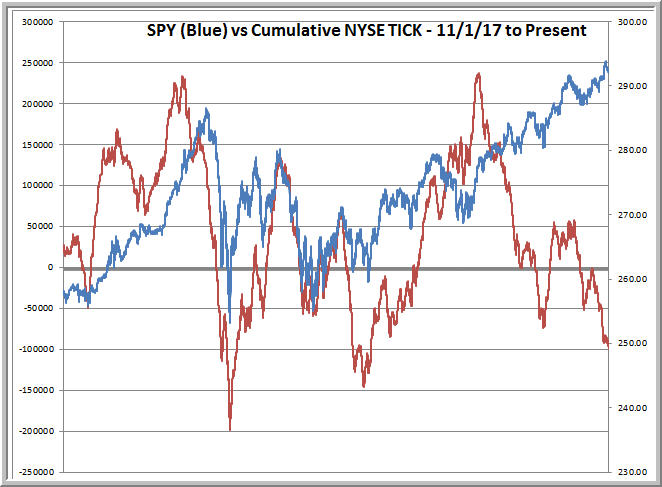
As we have made these recent highs several of the measures of strength that I track have lagged.  I refer to this as a yellow light, rather than an outright red one, if for no other reason that these divergences can persist for quite a while before they turn into significant price weakness.  My general experience has been that, the longer the divergences, the more pronounced the subsequent market decline.  This was certainly the case in 2000 and 2008, where market rises became increasingly selective until the overall market dropped.

Above is a chart that tracks five minute closing values of SPY (blue) versus a cumulative line of upticks versus downticks among NYSE stocks.  (See this post for background).  When we have more stocks trading on upticks, that reflects underlying broad buying strength and vice versa.  Note how the cumulative TICK has been declining now for a while.  This reflects relative weakness among the smallest of the NYSE universe.

We see this relative weakness in the recent underperformance of the NASDAQ and Russell indexes as we made the recent highs in SPX.  Many sectors within the SPX also failed to make new highs for the year, including XLF, XLE, and XLB.  Even more pronounced has been the relative weakness of overseas equity markets, many of which have been in downtrends since January.  See, for example, EEM and EFA.

Quite simply, stock market strength around the world has waned since January and has begun to wane in the U.S.  As a result, the market rally has become increasingly narrow.  Indeed, in the last 13 trading sessions, only 4 have seen more stocks across all indexes making new one-month highs versus fresh one-month lows.  

As I've mentioned in the past, a rising tide lifts all boats.  When boats aren't rising, it's worth questioning the tide.  Updating market strength and weakness is a way of staying flexible in our expectations and being prepared for multiple market scenarios.

Further Reading:


.

Friday, September 21, 2018

Can Artificial Intelligence Make Us Smarter Traders?

There are some who would have you believe that trading is 80+% a function of your psychology.  All you need to do is sustain your mindset and discipline and remove your emotional blocks and you, too, can find the success of Market Wizards.

As a psychologist, a psychologist who has worked full-time with traders on trading floors, a psychologist who has consulted to trading firms across different markets and strategies, and as one who has traded himself for decades, I can assure you that there is a helluva lot more to success in markets than maintaining the right psychology.

A good way to put it is that the wrong psychology can derail anyone, but the right psychology does not substitute for insight, skill, and experience.  Psychology is necessary for success in any performance field--from athletics to trading--but it is not sufficient.

One of the most powerful observations I've encountered in my work with traders and portfolio managers is that cognitive skills and development account for as much success in markets as personality variables.  Superior traders have superior information processing skills.  Show me a good trader, and I will show you someone who--in some way--processes information more effectively and uniquely than his or her less successful counterparts.

I was part of a meeting recently in which a money management firm discussed the idea of requiring programming knowledge from all new hires.  Years ago, that could never have been a topic for discussion.  Now it is a serious proposal.

It makes sense.  When I look at the traders who have been particularly successful over the past couple of years, the majority are either entirely algorithmic or manage capital with a hybrid, "man-machine" interface.  Many make discretionary decisions--aided by signals generated by the machines.

Quite simply, machines--used properly--can process more information, more quickly than we can.  They can find patterns in multidimensional space that evade our naked eyes--and they can ensure that these patterns are not merely curve-fit.

It's not that artificial intelligence (AI) necessarily succeeds by giving us better trades.  It is valuable in giving us more hypotheses to consider in framing trade ideas.  It identifies patterns that have set up in the most recent past so that we can make an informed judgment as to the potential for those patterns continuing into the immediate future.  It vastly expands our cognitive bandwidth.  For that reason, AI can help us more quickly adjust to shifting patterns in the instruments and markets that we trade.

On Saturday, October 20th, I'll be in San Diego with the folks at Trade Ideas and several experienced market participants to discuss the potential for partnering with machines for better trading.  We'll take a look at trading processes, as well as trading psychology, and how those can make the most of increased information bandwidth.  The automobile greatly expanded our travel capacity relative to the horse-and-buggy.  So, too, in the machine age, can we greatly enhance our decision making with a superior flow of supporting information.

Further Reading:  


.

Tuesday, September 18, 2018

The Power of Quiet Trading

Think of your mind as a finely calibrated instrument that can detect subtle patterns in markets--and in ourselves.  In order for this wonderful instrument to function properly, it requires no interference whatsoever.  If you place electrodes on a person's head to detect brain waves, the slightest movement of the head can throw the readings off.  Similarly, when our minds encounter interference, they no longer can read the subtle cues of conversations--or the subtle patterns of price behavior.

Perhaps the greatest trading psychology flaw one can have is the tendency to experience quiet as emptiness.  Instead of experiencing quiet as peace, people can experience it as boredom or as a void.  So they rush to fill their voids with self-chatter and aimless action.  Just watch how quickly we turn to our cell phones when a quiet moment occurs.  All that activity trains us in a sense: it trains us to be unable to make full use of our finely calibrated instrument.

The most recent Forbes post examines research relevant to the quieting of our minds.  One line of research reaches an astounding conclusion:  that it is in the quieting of our egos that we gain access to our greatest strengths.  I encourage you to check out the post and the research links.  If this line of thought is correct, then all the trading patterns/setups and all the self-help techniques designed to instill discipline and remove our blocks are of limited value.  If we are not in the right (flow) state to detect subtle patterns, we quite literally will end up trading noise.

.

Thursday, September 13, 2018

The Right Way to Trade With Confidence

Here's an idea I've been discussing with a few of the traders at SMB who are increasing their confidence--and their size--in many of their trades:

When you have *real* confidence in your trading, you're not threatened by the possibility of being wrong.  All of us are fallible, and if we are secure with who we are, we can accept that.  True confidence means we have the inner strength to deal with setbacks as well as successes.

When we have big confidence in a trade, that is when we want to double down on our planning for the possibility of being wrong.  Too often, traders become confident in an idea and stop looking and planning for alternate possibilities.  We want to use confidence to trigger our awareness of fallibility, so that we are aggressive in the trade AND aggressive in planning an exit if the trade doesn't work out.

The holy grail is to have conviction *and* open-mindedness.  We can size up a trade at the same time that we intensively review our exit strategy.  Aggressive and nimble...just like the sniper.

Further Reading:


.

Saturday, September 08, 2018

Six Characteristics of Successful Traders

I've seen traders succeed in very different markets, over very different time frames, and with very different strategies.  Here are common elements I've noticed among the most successful traders:

1)  Capacity for Sustained Focus - Quite simply, the successful ones process more information--and sustain the search for unique information--better than their peers.  This enables them to see what others do not;

2)  Originality and Creativity - I have never met a successful trader who traded in the ways that trading texts describe.  There is always something unique to the successful trader, and very often it's looking at unique information or looking at common information in unique ways;

3)  Learning From Mentors - There may be completely self-taught genius traders, but the best that I have met have learned from other successful traders.  Indeed, it's common for the great trader to have multiple role models and synthesize lessons from each;

4)  Emotional Resilience - Some traders bounce back from losses and setbacks better than others.  The successful ones actively learn from the setbacks--and then move on.  The less successful ones fail to learn from their experience and often fail to move on;

5)  Attention to Detail - In football, it's often the blocking and tackling that ultimately wins the game.  In basketball, it's running the plays and the defense.  Less successful traders focus exclusively on "setups" to get into trades.  Successful traders develop rules and processes for sizing and managing positions to maximize reward relative to risk.

6)  Always Working on their Game - As Merritt Black at SMB Futures recently noted, the intensity and consistency of the review process is very positively correlated with success.  Just as in sports, the successful traders review markets, review their trading.  They are studying "game film" to prepare for the next contest.  They aren't focused on getting rich; they're focused on getting better.

Quite simply, the best traders start with distinctive strengths and then cultivate those through rigorous tracking of performance and learning.  There is a winning process long before there are winning outcomes.

Further Reading:


.

Wednesday, September 05, 2018

The Psychology of Trading Without the Ego

A surprising amount of poor trading comes from trading our egos, not from actually trading markets.

When we focus on predicting market moves and trading our views with conviction, trading rapidly becomes a game of the ego.

When we declare that we have a certain trading "style" and we wait for market conditions to accommodate our style, trading becomes ego-based.

When we obsessively watch screens and focus on each move of P/L, trading turns into an ego game.

We can use every technique under the sun to instill discipline and overcome emotions, but if we pursue trading through the ego, we will be vulnerable.

An analogy I've used in my books is the good dancer on a dance floor.  The good dancer doesn't just dance his or her style regardless of the music playing.  The good dancer does not start dancing ahead of the music, anticipating the next tune.  The good dancer waits for the music to start, catches the beat and tone, and dances accordingly.

In my recent trading, I've been taking ego out of the picture.  I examine a stable lookback period in the recent market and identify two things:

1)  Has there been a dominant trend over that period?
2)  Have there been one or more dominant cycles over that period?

If I can detect no clear trend or cycles, I don't trade.

If there is no trend, but a dominant cycle, I trade the hypothesis that this cycle will continue into the immediate future unless I see clear changes in market volume, volatility, news events, etc.  That has me buying prospective cycle lows and selling highs.  In that regime, I look like a value trader.

If there is a distinct trend, but no clear cycle, I use the first pullbacks/bounces in the NYSE TICK to enter and ride the trend, again unless I see clear evidence of changes in the market's trading.  In that regime, I look like a momentum investor.

If there is a distinct trend *and* one or more dominant cycles, then I am using the cycles to guide entries and exits in the direction of the trend.  In that regime, my execution is counter-trend (value), but the overall idea is trend-based (momentum).

We suffer when we expect markets to trade the way *we* want them to trade.  There are valuable tools that help us identify cycles and trends.  That enables us to enjoy the market's dance music--and profit from it.

Further Reading:


.

Monday, September 03, 2018

Becoming Truly Accountable For Our Trading Account

We have trading accounts, but how truly accountable are we for those?

What percentage of us routinely keeps informative data on our trading results?

What percentage of those traders keep regular journals to turn the trading data into actual goals and plans?

What percentage of those traders then tracks their goals and plans and holds themselves accountable them going forward?

Put it this way:  If you pursued greatness in any professional sport, how likely would it be to find success if you worked as hard at that sport as you currently do at your trading?

Could it be that the majority of traders fail to find success, not because they trade the wrong "setups" and styles, but because they pursue performance in ways that could not work in any performance field?  

In an excellent post, Bry Gomez from the Caylum Trading Institute points to a study from the American Society for Training and Development (ASTD) in which the probability of reaching a goal was studied as a function of the level of accountability for that goal.  Simply formulating a goal led to a probability of success of 10%.  Having a concrete plan for reaching the goal raised the odds of attaining the goal to 50%.  Having a specific person to whom you are accountable for the goal--and a specific time set to review performance with that person--led to an achievement rate of 95%.

In other words, it's not simply about having good intentions or even having good goals.  It's about leveraging the power of human relationships to become fully accountable for achieving those goals.  Creating daily report cards of performance and sharing those with peers becomes a best practice that can greatly improve performance, as Mike Bellafiore has observed in the development of traders.

We find our potential when we make life a team sport.

Further Reading:


.

Wednesday, August 29, 2018

Tapping Our Inner Resources

In this post, allow me to pose a few questions that strike me as terribly important:


  • What if the depth and breadth of our learning can be magnified many times over by maintaining optimal mindstates?
  • What if our performance--in trading and in life more broadly--could be expanded many times over by sustaining optimal well-being?
  • What if the normal human mindstate is itself pathological and suboptimal, far from the potential of joy, fulfillment, and energy that we're capable of?
  • What if the ways in which we approach each day, designed to get tasks done, are some of the very ways in which we sustain our suboptimal mindstates?
  • What if the usual ways we think about trading psychology are simply shufflings of deck chairs on the Titanic and not ways that can bring about positive transformation of learning and performance?
My most recent Forbes post expands on these questions and offers one technique for maximizing our experience--and our performance.  The important implication is that, to maximize our trading, we need to optimally develop ourselves.  Expanding our experience is like providing our brains with faster, more powerful processors.  The problem is not that we fail to live up to our dreams, but that we dream too feebly and hence never truly awaken to turn dreams into visions and realities.

In coming posts, I will address powerful strategies for expanding our selves as a gateway to making the most of what we pursue in relationships, in careers, and in markets.

Further Reading:

.

Friday, August 24, 2018

A Powerful Strategy For Feeding Your Head--And Your Trading Results

Mike Bellafiore at SMB recently wrote about the value of expanding your trading network as a way to accelerate learning and performance.  When traders team up and share ideas and review performance, they turn learning into a social process, which can become enjoyable and motivating in itself.  Most importantly, teaming up increases our sources of learning.  If I take away one valuable lesson from my trading each week, that compounds impressively over the course of a year.  If I take away multiple lessons from colleagues each week, I'm now on an exponential path of growth.

I notice a promising mentoring group for day traders that has formed recently:  My Investing Club.  Another with a long history of success is Investors Underground.  Hedge fund managers have a long history of networking over dinners and drinks, sharing ideas and performance improvements.  What Mike is describing takes networking to another level, where traders become an active, ongoing part of each other's processes.  That occurs regularly on the NYC trading floor and has been an important source of learning and growth for developing traders.

I would like to suggest a deeper reason why this networking works, and it's related to the Sweller quote above.  When we team with others, we gain access to their modes of information processing.  Each of us processes information in different ways, with different strengths.  I may be excellent at processing market information analytically, but I can benefit from others who are well connected and sensitive to shifts in investor/trader sentiment.  Perhaps I'm good at pattern recognition and reading short-term market behavior.  I might benefit from another trader who is excellent at identifying bigger picture market themes.

When we network with others, we process information actively and we typically do so via multiple modalities.  That leads not only to broader learning, but a deeper processing of the material we learn.

This works because it takes advantage of an evolutionary dynamic.  We create many variations when we look at markets in multiple ways through multiple lenses.  We can look at many markets and their interconnection; we can analyze markets quantitatively; we can look for repeating patterns in markets; we can look at the same markets over varying time frames.  All of this expands the number of hypotheses we generate and sets us up to critically sift through these hypotheses, resulting in a greater likelihood of one good idea coming to mind.  By looking at more things in more ways, we activate a kind of intellectual natural selection that results in the few great ideas, the few great trades that can make our week, our month, our year.

One implication of this line of reasoning is that, as traders, we can do a much better job of networking with ourselves.  This means tapping into *our* variety of modes of processing and actively engaging market information in multiple ways:  seeing it, talking it aloud, writing it, studying it.  Networking works, because it literally feeds our brains, creating better cognitive networks.  An underappreciated source of trader failure is impoverished information processing.  In so many areas of life, feeding our heads can feed our bottom lines.

Further Reading:


.

Monday, August 20, 2018

Failing With Enthusiasm

Thanks to a savvy performance/trading coach for forwarding an excellent NY Times article on "Talking About Failure".  

Talk about our failures?  For most of us, that's the *last* thing we feel like doing!

The idea makes sense, however.  Not only does talking about our failed ideas and failed trades help us put them in perspective; it also enables us to accept them, learn from them, and put them into perspective.

One exercise I strongly suggest to developing traders is the following:

On your flat or down days/weeks, reach out to other, similar traders who made money on the day/week and learn what they did and how they did it.  Let them talk about their success and see what you can take away as ideas, learning lessons, and goals going forward.  Having one or more trading "buddies" who can openly talk about mistakes and successes helps everyone cement what they did right and learn from what didn't go right.

And if you have no trading buddies?

It's worth reviewing your trading and looking for the plausible opportunities you may have missed.  In other words, if you had been trading your way, at your best, what might you have done differently?  In that situation, you are looking to the ideal trader within you to act as your "trading buddy".  By openly facing your "failure" and using it to prod your ideal trader, you turn setback into learning and opportunity.

The psychology of having flat or down periods is determined by whether you view them as setbacks and defeats versus inspirations, prods, and opportunities for growth.  Churchill had it right:  it's all about failing enthusiastically.

Further Reading:


.

Thursday, August 16, 2018

Changing How We See The World

One of the most important findings in psychology is that people make important changes in their lives when they are in the midst of deep emotional experience.  Simply talking with a coach, counselor, or therapist doesn't in itself lead to profound change.  Rather, it's when we experience things strongly that our existing views of the world are shaken up.  That shake up opens us to new ways to view ourselves, others, markets, and the future.

This is one of the reasons important change can occur when people "hit bottom".  It's when everything has gone wrong and we're in despair that we're willing to make a complete overhaul in what we do.  Therapists refer to this as "corrective emotional experiences."

But it's not just negative experience and setbacks that can help us see and do things differently.  Sometimes powerful positive experiences have the same impact.  One example is the experience of awe:  when we are so inspired by something positive that it becomes a part of us and changes our perspectives going forward.  In a new article, I describe recent research into awe and how experiences of awe literally renew our energy and help us become more successful.

A theme I have never heard expressed in conventional trading psychology is that markets--and participation in markets--can become sources of awe.  That is, they can be awe-inspiring.  When we perceive the vast complexity of markets and so immerse ourselves that we perceive a meaningful pattern, it's as if we're catching a glimpse of the universe.  It's not an ego thing at all, strutting about and proclaiming your "conviction" in an idea.  Rather, it's standing back and absorbing all that is happening and allowing ideas and themes to come to you.

Trading with your ego ultimately depletes our energy, as we take too many P/L dings.  Trading with a sense of openness and awe can give us energy.  It can be inspiring.  And that inspiration and awe can help us change how we see the world--it becomes a *positive* corrective emotional experience.  Many traders become frustrated with markets and fight what is happening.  How different it is to experience markets as awe-some!

Further Reading:


.

Saturday, August 11, 2018

From Discipline To Professionalism In Trading

In sports, as in trading, performance often begins as an ego-driven activity.  The boxer is all about knockouts; the basketball player focuses on scoring; the golfer looks to ace each hole.  The novice trader wants to make money, and so trades, trades, and overtrades.  This ego focus is not entirely negative; it's a big part of the initial attraction to the performance arena.  But it is not enough.  When we perform out of ego motivations our personal needs overwhelm the requirements of each performance situation.

Many thanks to Mark Meadows and the Top Step Trader team for posting my recent webinar on trading performance.  One of the key points that I make in that session is that a passion for trading is actually a predictor of failure.  That is because the need to trade comes from that ego place where we need to prove ourselves right and need to make money.

More predictive of success is a passion for markets themselves--and especially the passion to understand what is going on in markets.  When we prioritize understanding, the focus shifts from ourselves to what is happening in front of us.  Sometimes not much is happening.  Good trading in those situations can mean not trading.  Mike Bellafiore recently made this point when describing the development of a trader who developed rules for when to not trade.  Discipline--rule following--takes the place of ego:  it's not about trading, but about trading successfully.

Across performance activities we can see that disciplined performance is a necessary phase of development.  The basketball or football player learns to follow a game plan, not just do what they feel like doing.  The poker player learns to fold when the cards aren't right.  It's common for developing psychologists to learn their craft from manuals that are research-validated and that give them a game plan for helping people with various problems.  Discipline is all about sublimating the ego to sound rules and principles.

Later phases of development find that disciplined rule-following turns into positive habit patterns.  Calling the right plays, making the right moves, becomes second nature.  Through repetition, the rules are internalized.  Discipline is no longer needed to do the right thing.  In this later phase of expertise, we see professionals able to read unique situations and make conscious decisions to veer from rules or modify them to the situation.  Instead of following the therapy manual, a sensitive therapist may reach out to a distraught client and offer support.  Instead of backing off trading in the afternoon hours, the index trader recognizes that relative volume has picked up and finds a great place to go short when buyers can't retrace much of the morning's losses.  A football quarterback learns when to call an audible; a poker player learns when to bluff.

That is what professionalism is all about:  Having so much experience that you not only follow good rules and processes, but you know how to adapt to unique situations as they present themselves.  It takes discipline to become a good trader; it takes expertise to know when to veer from that discipline.  It's all about putting our own needs on a back burner and becoming ever more sensitive to what we are trading.

Further Reading:


.

Thursday, August 09, 2018

Trading With Patience

You've no doubt noticed that many markets have slowed down with the summer trade, creating narrow daily ranges and little follow-through on directional moves.  The word I most often encounter in trading journals is "patience".  In slower markets, there may only be occasional opportunities worth pursuing.  That means that a good, disciplined trader is often not trading.

What happens during these patient periods--the times of *not* trading--plays a huge role in trading success and failure.  The successful traders I work with use the down time to work on generating new ideas,building new analytical tools, and reviewing their performance.  The less successful traders cannot abide patience and turn trading into overtrading.  They have to have something to do and so they trade, even when an edge is not apparent.

The best traders turn the patient periods into alternative forms of stimulation.

The worst traders experience patience as boredom and find something to trade.

With the VIX below 11 and my "true volatility" measure (movement per unit of volume) at multi-month lows, I'm finding a lot of movement within ranges and then false breakouts from those ranges.  This makes trading very difficult for a momentum style.  A value-based style--buying short-term oversold and selling overbought conditions that break out of a range--has worked much better--especially when directional moves of the index are not accompanied by similar moves across major sectors.  Buying strength and selling weakness on average fail in the slower environment.

In a future post, I'll be reviewing Larry Connors' forthcoming book Buy the Fear, Sell the Greed.  It's an unusually practical trading book, with each chapter describing a specific source of edge and a backtested way of implementing that edge.  One of his tools is a short-term variation of the RSI measure originally developed by Wells Wilder.  During slow market times, I've been experimenting with the measure to exploit the behavioral biases Larry discusses in the book.  Such research is a great way to turn patient times into productive ones.  

Years ago I did an experiment where I showed people a chart and asked them to predict where the market would go from there.  The charts were identical, but half of the subjects saw a chart with a nice green up bar as the most recent bar and the other half of subjects saw the last bar as a good red, down bar.  Not surprisingly, those seeing the most recent green bar expected the market to rise and vice versa.

It's a great example of recency bias.  We overweight recent experience.  In slow, low volatility markets, there is a worthwhile edge in fading that bias.  That's a great lesson I learned during my patient period of not trading:  markets don't have to trend to provide opportunity.

Further Reading:


.

Sunday, August 05, 2018

Trading With Energy

One thing I've noticed among traders is that success breeds optimism and energy and optimism and energy breed success.  It's not difficult to walk onto a trading floor and see who is active, interactive, and inquisitive and who is glumly staring at screens and pacing the floor.

I've written in the past about the ratio of activities that give energy to activities that drain our energy and why it's so important to have a positive balance.  It is very difficult to sustain effort--whether it's concentration in following markets or researching trade ideas--without feeling energized.  This is why quantity and quality of sleep are so important to performance; it's why being in good physical shape is helpful.  It's also why clinging to moment to moment, day to day P/L can be so deadly, draining us of willpower resources.

In a recent article, I set out three keys to thriving in any work we perform, including trading.  The common element among these is positive energy.  When we say something has expired, we mean it is no longer fresh, no longer potent.  When we say we are inspired, we mean that we have gained vitality.  There is a world of difference between expired traders and inspired ones.

So here's a quick self-assessment to identify if you are trading with energy:

1)  Does your morning routine give you energy or rob you of vitality?

2)  Do your conversations and interactions with other traders distract you and interfere with your best trading, or do they inform and inspire your best trading?

3)  When you research trading ideas, do you feel inspired and energized?

4)  Do your trading reviews lead you to constructive, energy-giving goals or do they discourage you?

5)  Does your self-talk move you forward and motivate you, or does it discourage you?

If working for someone who managed you the way you manage yourself would lead you to quit your job, you know you have a problem.  All of us are managers of our lives and careers, and--for better or for worse--we are coaches to our own trading.

Is your self-coaching giving you energy or is it holding you back from your best performance?

Further Reading:


.

Tuesday, July 31, 2018

The Importance Of Your Self-Talk During Trading

What goes through your mind during trading hours?

How do you talk to yourself?

All of us coach ourselves via self-talk?  What kind of coach are you?

I recently placed a trade looking for a market bounce.  The bounce was feeble and we began to sell off.  I said to myself, "If the bulls are going to be in control, this shouldn't be happening."  I quickly hit out of my position and reversed it.  The small loss on the long position was more than exceeded by the gain on the sale.

The trade was only possible because I had rehearsed an alternate scenario during my preparation of what to do if the market could not hold key upside levels.  Through that alternate scenario, I was able to react to the market weakness without shock or surprise.  It didn't even feel like a losing trade.  It felt like, "OK, it's time for Scenario B."  

Notice that the self-talk was not about being wrong.  It was not frustrated; it was not discouraged.  A well-thought out trade that doesn't work can provide useful information.  It's tuition for some useful learning.

So it is throughout life.  It's always important to have a Scenario B, and view setbacks as learning lessons.  That means taking the ego out of the trade and viewing everything as information.  It isn't about positive thinking or negative thinking.  It's recognizing that it's not about you.  It's amazing how we can trade with peace of mind when we are market focused and not self-focused.

Further Reading:


.

Friday, July 27, 2018

Finding Our Fulfillment

The last blog post emphasized the importance of trading with a sense of inner peace.  That peace comes from taking the ego out of what we are doing.

But there is one other key component to inner peace:  fulfillment.

One of the important distinctions that we find in the research on positive psychology is the distinction between happiness and fulfillment.  Happiness comes from doing things that are fun.  Fulfillment comes from doing things that speak to our values.  The research suggests that these are relatively independent dimensions.  Sometimes doing meaningful things is not a lot of fun in the here and now.  Many things that are fun may not be meaningful.

Quite a few life problems occur when we pursue fun without pursuing fulfillment.  Then our success ends up, in the larger picture, feeling like a failure.

Trading problems occur when we pursue trading as a source of fun and stimulation rather than as a career that can provide fulfillment.  The overfocus on P/L is typically a focus on seeking happiness and avoiding unhappiness.  It's in developing, following, and refining good processes that we can find fulfillment.  

When we have plenty of sources of enjoyment in our lives outside trading, we don't need trading for entertainment and stimulation value.  Many, many trading problems occur because we're trying to get personal needs met through markets.  Markets can't always be fun, and they don't always generate fulfillment.  Working on having a positive life--one that is happy, stimulating, and fulfilling--is a great way of taking the emotional burden off our trading and allowing us to deal with opportunity (or lack of opportunity) as objectively as possible.

Further Reading:


.

Tuesday, July 24, 2018

Finding Your Peace, Finding Your Success

I'm writing this from the Chicago Traders Expo a couple of hours before my presentation.  One of the topics I'll be covering in my talk is developing ourselves spiritually as a way of furthering our life success--in relationships, in trading, and in careers.

Indeed, my next book will be on the topic of renewing our lives through cultivating our spiritual development.  That book is being written on a blog platform, which means it will be totally multimedia, totally accessible anywhere in the world where there is an online connection, and totally free.  Best of all, the book will enable readers to make comments and share ideas and experiences, which then become part of the book--along with my responses!  That way, the book becomes a dynamic entity:  it will be continually revised and expanded.

The book format is a nice example of what entrepreneurs have always known:  opportunity comes from doing new things--and old things in new ways.

In the ego mode, I want to write a best seller, make lots of royalties, and become a constant figure on the talk circuit.  Good enough is not good enough:  I want more.  In the spiritual mode, we find what most speaks to us.  Getting to that spiritual mode requires finding our peace and letting opportunity present itself to us.

As I will be discussing at the Expo, so much of trading psychology boils down to getting ego out of the way, finding an inner peace and quiet, and processing markets with an open, receptive mind.  I know from my own trading how easy it is to latch onto *my* view of the market and impose that view with a trade, only to have the market show me otherwise.  Looking back, I can only shake my head at how the market's behavior made perfect sense--but I was blinded to that sense.

It's great to have a passion for trading, to work hard at trading, and to follow markets intensively.  But all too often, those activities are ego-driven.  Everything becomes about P/L.  Market ups and downs become our ups and downs.

We'll never find our peace by succeeding at trading.  Succeeding at trading requires finding our peace, because that's the only way we'll be sufficiently open-minded to truly understand what markets are doing.  Finding fulfillment in our lives outside of trading is a wonderful path toward bringing peace to our trading.

Further Reading:


Sunday, July 22, 2018

Where Are Edges To Be Found In The Current Stock Market?

I decided to take a stroll through my database and update views on where opportunity in the stock market has been residing since 2016.  That provides a lookback period long enough to detect meaningful patterns and recent enough to be relevant to current market conditions.  Here a few observations:

*  Sentiment matters:  When the equity put/call ratio has been in its highest quartile, the next ten day return in SPY has been +.96%.  That is almost four times the return when the ratio has been in its lowest quartile, +.25%.

*  Overbought/Oversold matters:  Let's consider the percentage of stocks in the Standard and Poor's 500 Index that have been above their 200 day moving average.  When that percentage has been in its lowest quartile, the next ten days in SPY have averaged a gain of +1.32%.  When the percentage has been in its highest quartile, the next ten days in SPY have averaged a loss of -.04%. (Data from the Index Indicators site).

*  Volatility matters:  When VIX has been in its lowest quartile, the next ten days in SPY have averaged a gain of +.69%.  When VIX has been in its highest quartile, the next ten days in SPY have averaged a gain of +1.02%.  When VIX has been in its middle two quartiles, the next ten days in SPY have averaged a gain of +.39%.

*  Context matters:  When the percentage of stocks above their five-day moving averages is low and the percentage above their 100-day averages is also low, the next ten days in SPY average a gain of 1.00%.  When the percentage of stocks above their five-day moving averages is low and the percentage above their 100-day averages is high, the next ten days in SPY average a gain of +.38%.

Now these are observations only; they no doubt overlap to some degree and I don't pretend that, by themselves, they provide systematic trading ideas.  What is needed is some framework for accounting for these observations.  My straightforward framework is as follows:  the market has been largely trending higher (note how rarely we see negative average returns) and, within that trend, there have been meaningful cycles of 10-20 day duration that capture extremes of volatility, sentiment, and directional movement.

What this means is that traders with a habitually bearish bias have tended to underperform the opportunity set, and traders with a short-term time horizon (holding periods of intraday or swing periods) have also underperformed the opportunity set.  My sense is that a great number of market participants are overleveraged:  they have small account sizes relative to the returns they want/need to generate.  This leads them to take good-sized positions relative to the amount they can afford to lose, which inevitably leads them to manage their positions on shorter and less optimal time frames.  In actual practice, many traders simply don't have the ability to take heat on holding periods of even 10-20 days, even though they may pride themselves on trading "macro" ideas.

My experience is also that traders are very keen to look for trends and trade directional momentum and lack the tools and frameworks to think about cycles and directional reversals.

In short, there do seem to be edges in the marketplace, but they're not found by doing what the crowd is doing.  The key is not playing the game better, but figuring out the right game to be playing.

Further Reading:  


.

Thursday, July 19, 2018

A Subtle Strategy for Becoming a Better Trader

If there is one common element I've observed among very successful traders it's that they have superior personal networks.  They cultivate sources of information; they take on role models; they hang out with people they admire.  In all, they spend time with people who make them better.

This can become our online strategy as well.  We can become caught up in noise and bickering online--or we can surround ourselves with inspiration and information.

But how do we know where the great sources of online information can be found?

One simple but effective strategy is to find the people who post ideas online and do so with a passion.  They post regularly, and they post over periods of years.  They do so because the ideas speak to them.  Their passion has become a purpose--and very often it anchors their profession.

Once you find a few such sites, you can then see who those people link to and whose work *they* admire.  The odds are good that purposeful, passionate people hang out with--and link to--others of their kind.  Before you know it, you can develop a network simply by following the links of those who post with purpose.

What an amazing resource hidden amidst the noise.

Here is my recent article, highlighting four of my favorite purposeful online participants.  Follow their links and you'll learn a great deal.

And if you have your own favorite online participants, feel free to email me with their links and I can add those links to future posts.  It's a great way to build each other's networks and support people doing great work.

Further Reading:


.