I've spent a chunk of time this morning reading what's out there in social media regarding trading, trading psychology, and trading methods. A lot of sites, a lot of tweets. A lot of what I read boils down to, "Once you've found your edge, stay consistent in your mental/emotional state and in your trading practices." Why is it that so many professional money managers (not to mention individual traders) fail to meet performance expectations? I would argue that the reason is that they have followed their own advice. They found their edge, they stayed consistent with it, and they have been left behind as markets have changed. In other words, traders have failed because there is much, much more to trading psychology than maintaining emotional control and following routines. Successful traders and trading firms create and innovate--just like any successful business. They operate in a dynamic environment and they find ways to adapt and exploit *new* sources of edge as the marketplace evolves. The Achilles heel of trading psychology is that it emphasizes the process of trading and not the process of generating fresh ideas worth trading.
Creativity and innovation begin by looking at new information, questioning old assumptions, and using the new information to explore alternate assumptions. Here's an example from my recent trading: What if backtesting a historical set of data is *not* the best way of determining the odds of a market moving from point A to point B? What if a better predictor is the recent behavior of market participants at points A and B? The new data consists of very short-term readings of the upticks and downticks occurring among all exchange-listed stocks throughout the day. (Available via e-Signal). Instead of arraying the uptick/downtick data by time, we array it by price level: we look at each price and how much net upticking/downticking has occurred at that price. (Note that this is similar to arraying volume by price in a Market Profile). What we find is that there are certain price levels and ranges at which buying (upticking) and selling (downticking) has been dominant. Perhaps these price levels/ranges represent where the inventory lies in markets. Perhaps the odds of moving through a given price/range is a function of that inventory. Maybe yes, maybe no; I have an open mind. What I do know is that this is a different way of looking at markets and modeling forward returns. I don't know if any given innovation will yield an edge, but I am convinced that the failure to innovate will allow any possible pre-existing edge to erode. Looking at new information. Questioning old assumptions. Asking new questions. Viewing markets from different angles. These lie at the heart of what I call Trading Psychology 2.0. The challenge isn't simply to succeed, but to sustain success. Further Reading: Creativity is the New Discipline
.
The recent Brexit trade and its volatility has given us an opportunity to explore an important and neglected topic in trading psychology: time. Here's a useful distinction between novice and expert performers: Under pressure, the novice feels threat and speeds up. Heart rate, galvanic skin response, muscle tension--all increase under pressure for the novice. The expert performer has trained under pressure. Under pressure, the expert slows down and focuses. Put novices behind a rifle and the odds are good that when the target appears, they will speed their breathing, start to shake, and miss the shot. Put an expert sniper behind the rifle and breathing slows, all movement stops, and the aim is true. As a psychologist, I've experienced the same thing. During my beginning years, I felt panic if a client I worked with reported thoughts and feelings of suicide. Later, crisis talk made me hyperfocused. I hung on every word. I became more deliberate in my responses, more attuned to the person I was speaking with. So it is with mountain climbers, professional athletes, and elite military units. They replace fight or flight with focus and freedom--the freedom to stay in control over a situation and not allow it to control them.
OK, so what does all this have to do with the Brexit trade?
As part of my trading, I have a short-term system that provides entry and exit execution guidance. The system adjusts entry and exit points for the market's volatility. During Friday's trade, the volatility unit risked by the system was about three times the size of the volatility unit from the first week of June. The same exact setup now could make or lose three times as much as recently. It was no different from tripling trading size all at once. But it wasn't just volatility that changed. Time itself changed! The system works from event bars, not chronological bars. Each bar represents a number of ticks in the market, not a number of minutes or hours. For all of Friday, we printed almost 200 bars. For the first Friday in June, we printed nearly 60 bars.
The novice is calibrated to the chronological clock and thinks in terms of standard trade sizing. As a result, each trade is far more risky. Under those conditions, market volatility begets emotional volatility and either the fight of reactive trading or the flight of the deer in headlights. Calibrated to the market clock and adjusting trade sizing for volatility, the trade opportunities are the same--there are only more of them in a given trading session. A crisis session for a psychologist is an entire therapy compressed into one meeting; it is what you do all along, only compressed. That compression is a catalyst for focus, because each time unit carries greater meaning and significance. The novice trader cannot adapt to changes in the market's clock. Movement slows, the VIX falls to 12, and boredom sets in--the need to trade. Movement picks up, the VIX nears 30, and excitement sets in--the fight and flight. Once you define time in terms of market movement, the switch from slow markets to fast ones is like the change on a dance floor from a slow tune to a fast one. There are times for slower and faster dancing...our job is to adapt to the market's music--not dance a given way regardless of the music that's playing.
So we're walking in the old section of Bergen, Norway (Bryggen) and come across a Mexican restaurant advertising its food in a unique manner. From the looks of it, the sign was bringing people in.
Whether it's in marketing or in trading markets, uniqueness counts for a lot. It's not always easy to predict who will make money as a trader, but it's not hard to predict who won't. The ones who won't succeed are the ones who are like all the others. They look at the same things and trade the same ideas. I've worked in many trading firms, from prop shops to hedge funds. Across settings, the correlation of returns among traders is disconcertingly high. When given the freedom to make their own decisions, many traders decide to abdicate critical thought and follow others.
In general, uniqueness is expressed in two ways: by looking at new and different information and by assembling information in new and different ways. When I replaced time on the X-axis of my charts with event time, I redefined market data and could then view the data in a fresh manner. For example, the volatility of volume-based bars is quite different from the realized and implied volatilities that we normally track; the cycles that appear in event time are wholly different from what we can see in chronological time.
Of course, being unique does not guarantee being successful; it's simply a way of generating more and different hypotheses. Some of these will fall flat; others will bear fruit. Being a trader is not so different from being an inventor. The great find often follows scores of disappointments. If you can't look at new possibilities and keep innovating, however, the successful invention will never follow.
I recently wrote about strategies for constructively dealing with difficult markets. Our natural tendencies lead us to shut down when the world becomes less certain and when drawdowns extend. That, however, is when we most need to be open minded and expand our horizons. So here is a simple self-assessment: 1) What information are you looking at that others are not considering? 2) What ways of assembling information are you employing that are different from what others are doing? If I were a rational, prospective investor looking to back emerging talent, what could you show me that would convince me that you're truly doing something that is different and promising? If you can't sell a prospective investor on what you're doing, perhaps you shouldn't be buying into it yourself.
I'd like to advance a principle: The values and emotional/behavioral patterns that we enact in our trading inevitably reflect those we live outside of our trading. Who we are as a trader never strays too far from who we are as people. In that sense, there is no such thing as trading psychology. There is only psychology; we cannot sustain patterns in our trading if we do not live and reinforce them in our daily lives. We recently returned from a trip to Norway, trekking mountains and fjords. Every year we take at least one vacation that places us outside our daily routines and expands our cultural and environmental horizons. That's also time that we spend together apart from the routines of daily life. On a smaller scale, we use weekends to find new things to do and places to go. Sharing new experiences keeps a relationship new; it also keeps one from becoming too wrapped up in day to day work and markets. This emphasis on life perspective has been key to keeping a level head in trading. It is difficult to overtrade when you're seeing the larger picture of your personal and trading development. Similarly, adopting four rescue cats and being involved in the lives of our five children keeps us in a mode of servant leadership. It's tough to get overconfident in markets and trade with your ego when you spend a good portion of the day helping others. I was recently driving on a highway and the road split into two sections, each going the same way. The left fork was a single lane labeled express; the right fork was a double lane labeled local. My trip was several hours in duration but I immediately took the local option. My instantaneous reasoning was that if the single lane became blocked by an accident or car breakdown, traffic would be trapped--potentially for hours. If the double lane saw an accident or breakdown, there was a fighting chance of getting by in one of the other lanes. In short, I quickly made my decision based upon the management of downside (tail) risk. What this tells us is that, not only does our daily psychology become our trading psychology, but our trading psychology has a way of filtering into our daily lives. Trading teaches us lessons about risk, reward, discipline, and flexibility and those become life lessons. We trade with the psychology that we cultivate outside of market hours. Who we are as traders helps shape who we are as people. There is no trading psychology, only psychology. So what does that mean? If there's a pattern you'd like to change in your trading, figure out how that pattern is playing out in your personal life and make that the focus of your change efforts. In other words, your goal should be to be the person outside of trading hours that you'd like to be in your trading. Life thus becomes a practice ground for trading, just as the reverse is the case. Becoming a better trader is no different from becoming a better person. Well, Mali just walked into the room when she heard my music playing; she only seems to walk in when the romantic tunes are playing...Next in my queue is an email offering a partnership in a money-making opportunity to pitch trading psychology videos. Think I'll spend some partnership time with the little girl instead... Further Reading: The Ultimate Value of Trading
.
Trading is a performance field, no less than athletics or the performing arts. What you see in any performance field is a dedication to practice among successful professionals. Indeed, from chess to Olympic wrestling to Broadway acting, there is no performance field I'm aware of where there is not a high ratio of time spent practicing to time spent performing among elite performers. So the relevant questions become: How much time do you spend practicing, and how do you structure your practice? The time you spend trading is NOT time spent practicing unless you have structured processes for reviewing your trading, systematically identifying what you've done right and wrong, and making efforts at improvement. As Bob Knight has observed, most of us have the will to win. What succeeds is the will to prepare to win. Practice begins with breaking performance down into component parts and keeping score with respect to all of those. The most basic components of trading are: 1) Generating ideas - How you define and employ a genuine edge in markets;
2) Implementing ideas - How you actually trade the ideas you generate, including your sizing, risk management, entries, and exits; 3) Self management - How you maximize your state of mind and body for optimal decision-making. Each of these areas can themselves be broken down into subcomponents, so that you're drilling down to the level of best practices: what you do in each area that is most responsible for your success. Such a list can anchor daily/weekly score cards that allow you to evaluate yourself in real time, identify areas for improvement, set goals, and make corrective actions. If you are not continuously keeping score and taking concrete action on the scores you receive, you can't be continuously learning and improving. Writing in a journal is a great first step, but ultimately matters little if the journal entries don't guide concrete goal setting and efforts at improvement.
It boils down to this: Are you doing things today that you will thank yourself for later? Successful traders don't have a passion for trading--that just leads to overtrading. Successful traders have a passion for self-improvement. They are motivated to be more tomorrow than they are today.
Landry's quote is a great one. What it really says is that reaching our potential means that we have to face uncomfortable truths. If what made us comfortable was what made us great, everyone would be a super achiever. Sadly, that's not the case. I recently gave a talk to a group of traders and interrupted the presentation to ask each person to tell the group the most exciting idea they had come across recently and how they were incorporating that idea into their trading. The silence was deafening. When a few ideas did come out, they were very general ideas about performance--nothing specific to markets. That told me everything I needed to know. These were market participants who were not hearing what they didn't want to hear and seeing what they didn't want to see. They were in their comfort zones. They were static. They were in the process of being left behind by evolving markets. I'm writing from Oslo, Norway. I woke up last night with an unsettling thought. What if the entire narrative approach to markets--turning data (fundamental, geopolitical, technical) into a directional, narrative thesis for trading--no longer works? It's not just that markets respond to different narratives. It's that markets have become sufficiently complex that simple narratives cannot capture the significant patterns that are present. For example, we can predict the likelihood that a fuzzy camera image of a person actually *is* that person, but narratives have nothing to do with the predictive process. This kind of thing happens whenever we travel to remote locations. Getting away from routine helps stimulate new thoughts, often uncomfortable ones. I have no f***ing clue as to whether the death-of-narrative idea holds water, but I'm quite sure I'll dig up a platform for investigating complexity in market behavior and see if there are patterns outside of simple interactions of variables amenable to storytelling. I've described the coaching process as comforting the afflicted and afflicting the comfortable. Both push us outside the states we're in to see different realities. The most successful traders have internalized that coaching that process. Coaching is not merely something they hire; it's something they actively do. Seeing new things, asking new questions, learning new skills--pushing, pushing to be more than you are at present. That's the essence of a true competitor. Further Reading: Every Great Trader is a Player-Coach
.
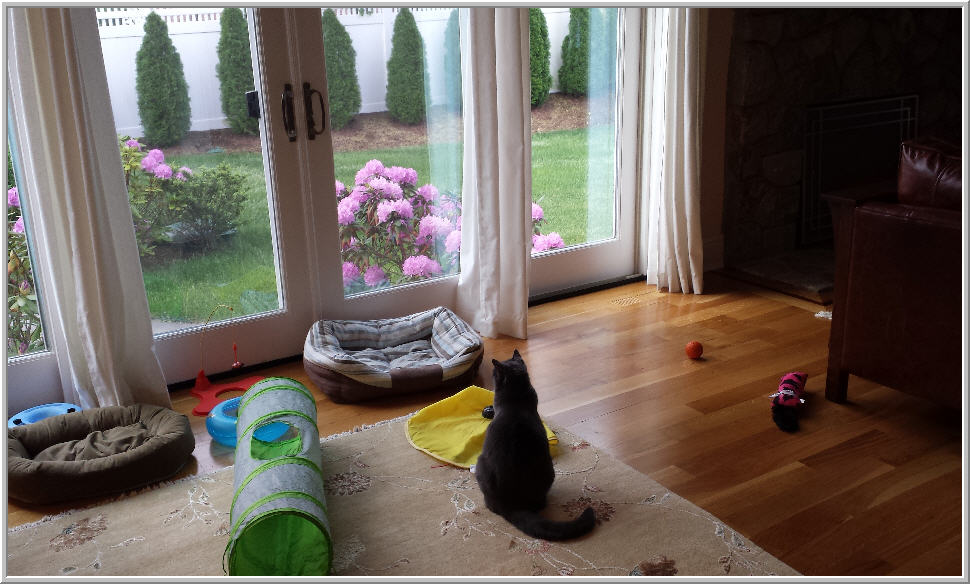
Mia Bella is the gray cat we rescued from a high kill shelter in Kentucky in 2014. She has become a very special part of our home. Unfortunately, a week or so ago, I began to notice changes in her behavior. Her energy level decreased; her eating declined. We brought her to the vet and it turned out that she was running a persistent low-grade fever, most likely the result of an infection. As of this writing, her condition is improving. What was striking in Mia's situation was that, as her fever set in and her energy level decreased, the most distinctive aspects of her personality began to drop away. A very social cat who loves to play with the other cats in the home, Mia increasingly chose to isolate herself. Her affectionate attachment to us, most observable when she would follow me to the basement in the morning and share in my early routine, similarly waned. She stopped going into the basement. More subtly, she stopped behaving in the little ways we had come to love, from telling us that she wanted food to looking out the sliding glass door to watch the animals in our yard. In a sense, Mia had stopped being Mia. That's what alerted us to need to seek a vet. But there's an important principle here: Our greatest strengths--what make us distinctive as people, as spouses, as traders--are dependent upon our energy level. When we lose energy, it is as if we descend that hierarchy of needs described by Maslow and hoard our remaining energy for basic activities such as sleeping, eating, and staying alert. Mia no longer had energy for her curiosity--her looking out the window, her seeking out the other cats. Even going up and down stairs was a chore. The Mia Principle--the expression of our strengths is a function of our energy level--is vitally important to anyone operating in a performance field such as trading. Our cognitive strengths, our ability to detect patterns in real time, our ability to dig beneath the surface of information to generate ideas, require a high degree of clarity and alertness. Our personality strengths, from our ability to engage meaningfully in relationships to our ability to rebound from setbacks, require sufficient energy to sustain constructive efforts. The Mia Principle helps explain many performance slumps. We fall short of our goals and become discouraged. We work harder to succeed, only to become increasingly overloaded and overworked. Each new effort drains us of further energy, ensuring that successive attempts at success become increasingly inefficient. When we are in performance drawdowns, we're typically in energy drawdowns. What we need is inspiration, not further drains on our energy level no matter how well intentioned. Ironically it is the most achievement-oriented of us, the most persistent and driven, that are most likely to fall into the energy trap. If Mia's experience holds true for us, our greatest performance hurdle is that we spend far too little time in states of inspiration. When we have fewer activities that give us energy than require energy, we gradually power down. At such times, the lower power drains our strengths. Like Mia, we continue to sleep, eat, and take care of life's basics, but what suffers is what most makes us who we are. We lose our strengths, our greatest competencies and life visions, when we lose our energy. What if our trading performance doesn't require umpteen efforts at discipline, but rather a consistent connection to our greatest energy sources? We struggle to adapt to markets, but we're never likely to succeed if our struggles drain us of the vital resources that make us who we are.
Many trading challenges are embedded in the language we use to describe markets. Among the most common things I hear from traders is that markets are difficult to trade because they are "choppy" and "noisy". What, precisely, does this mean? A clue to the meaning is that we never hear the opposite. When was the last time you ever observed a trader high-fiving because markets were "smooth" and "predictable"? When have you heard someone making money attribute profits to market "noise"? Yet another clue to the meaning is that very few traders actually measure market choppiness/noise. It's not that noise and signal are part of an explicit trading framework; rather choppiness is used as a reason to either explain losses or to not trade at all. From that perspective, a choppy market is one that cannot be successfully traded. It's the market equivalent of playing in a casino where the game is severely rigged against the gambler. Perhaps that is why so many conversations that start on the topic of market chop veer onto the topic of "algos" and their "manipulation" of markets. As Wittgenstein observes, language captures our limits and our possibilities. If our language describes people of a certain race or ethnicity as inferior people, we will sustain all sorts of behavioral biases against those people. If we feel a need to trade to make a living and our language construes markets as impossibly noisy, frustration is the inevitable result. The trader who bemoans choppy markets is really conveying the meaning, "I find this market untradable and frustrating". The problem with such language is that it leads to no possible solution. If I regard a class of people as worthless, I have basically blocked any potential positive interactions. If I view markets as filled with noise, I block any efforts to identify signal.
The traders I see making money are employing language differently to make sense of frequently-changing markets. For example, several traders I know are trading shorter-term strategies and longer-term strategies and adjusting the weighting of those based upon how markets are moving. A good example was yesterday's trade in the ES futures. We had early selling off the weak jobs number, but many sectors of the market displayed buying interest. The advance-decline line was unusually strong, given the decline in the average, and we never hit a selling extreme of -800 or less in the NYSE TICK measure. This was a useful tell that the selling was part of sector rotation, not part of a general bear/risk-off move. Recognizing this made it much easier to take profits on short positions early in the day and not get whipsawed by the afternoon strength.
A more radical language shift is to break markets down into cycles and trends and identify when each mode is dominant. This leads to mean reverting trades in cyclical regimes and momentum trades in trending ones. Note here the conceptual shift: noisy markets are defined as cyclical ones. That leads to a potentially constructive direction: identifying whether there is a dominant cycle that can be expected to continue into the immediate future. An adaptive trader trades the market conditions that exist, not any preferred regime across the board.
My own trading has proceeded with a yet more radical shift. I start with the idea that *only* cycles exist in financial markets. What appear as momentum/trend and value/mean reverting periods are simply different phases of cycles that exist at varying frequencies. It is the interplay of these longer and shorter duration cycles that creates the complexity of movement within markets. When cycles at shorter and longer frequencies are in mean reverting mode concurrently, markets will look choppy. When multiple cycles are aligned in up or down phases, markets will look trending. It's all one elephant and we're the blind men feeling various parts of the animal and trying to figure out what it looks like. A natural consequence of adopting the language of cycles is that it naturally leads to an attitude of "this too shall pass." Indeed, if we think of multiple cycles aligning in a mean-reverting mode, that suggests that multiple cycles may be peaking or cresting. In such a case, the periods of greatest choppiness would tend to precede the periods of greatest opportunity. Language frames our problems and language frames our opportunity set. I strongly suspect there are no markets devoid of opportunity; only impoverished mindsets. Further Reading: The Dynamics of Market Cycles
.
Above we can see a chart of SPY (blue line) from 2014 to the present. The red line represents what I refer to as Institutional Participation. It is a measure of total upticks and downticks among all NYSE stocks each trading day. Going back to 2012, if we divide daily institutional participation into quartiles, we find significant relationships. Specifically, when participation is in its highest quartile, the next ten days in SPY average a gain of +1.72%. When participation has been in its lowest quartile, the next ten days in SPY have averaged a loss of -.28%. Let's think about why this might be. Suppose we measure institutional participation each minute of the trading day. To achieve a high reading, we would have to see a great deal of upticking or a great deal of downticking at that time. In other words, there would have to be broad-based buying or selling among shares--a surge of demand or supply. Such surges are most likely to come from institutions deploying a great deal of capital, buying/selling stocks overall as an asset class, not just accumulating/distributing shares in a particular name or two. The broad accumulation of stocks is associated with momentum--a continuation of price strength. The broad distribution of stocks is associated with value--the reversal of price weakness. When there is little institutional participation, neither momentum nor value motivations to own shares is present. Returns are subnormal. One of the greatest mistakes I see traders make is focusing on "fundamental" reasons for short-term stock market movement. This leads to frustration, as many market moves seemingly "make no sense". Fundamentals are very relevant to investing, less so to trading. Trading is about gauging market flows, and flows are not best measured by chart patterns or earnings levels. In gauging the buying and selling behavior of institutional participants, we can assess whether flows are waxing or waning--which tells us if momentum or value are likely to be drivers of future price action.
One of the most common emotional challenges faced by traders is frustration. Frustration can cause us to lose our focus. It can lead us to make rash, impulsive decisions. Little wonder that traders hope to trade in a zen mode, completely emotion free. As long as we care about trading outcomes, however, there can be no emotion-free trading. Nor would freedom from emotion be desirable for traders. The emotional processing of events that can lead to frustration is also what gives us our *feel* for markets. One successful trader I've known for a while uses his emotional reactions to provide him with insight on how other market participants might be feeling in a given situation. For him, emotions are information. Frustration can also be a motivator. It occurs when we are blocked in our pursuit of goals. When we channel frustration to better understand and overcome obstacles, we've turned frustration into a positive and essential part of success. Indeed, I would argue that frustration is not a problem for traders and, in fact, is an inevitable trading outcome at times. The problem is what we can call secondary frustration: our frustration with being frustrated. In other words, it's when we make it not OK to feel normal frustration--when we become threatened by frustration and try to push it away--that we're most likely to let it get the better of us. Fully accepting and experiencing a feeling defuses its power and intensity. When we hold ourselves to an unrealistic zen ideal and fail to accept frustration, our feelings redouble: we're now frustrated *and* we're frustrated with being frustrated. Secondary anxiety is a big part of what keeps panic attacks going. When people become afraid of normal stress and nervousness, their anxiety redoubles. Interestingly, it's the calm acceptance of anxiety that gets us past fear. The same is true for frustration and many seemingly negative emotions. Making ourselves conscious of them and becoming their observer enables us to separate ourselves from what we're feeling and gain control over our state. Identifying with our feelings is the surest way of allowing them to control us. The emotionally intelligent trader can prepare for frustration, fear, greed, and other seemingly disruptive states. By anticipating them, rehearsing our response to them, and channeling their energy constructively, we turn our experience into a powerful trading asset. Further Reading: The Basic Cause of Emotional Problems in Trading
.
If you click on the graphical display above, you'll see the results of a very simple demonstration using heart rate variability biofeedback. (I used the Heart Math Freeze Framer biofeedback system for the demonstration; the newer version is called em-Wave.) In the demonstration, I first attempted to enter and stay "in the zone" by regulating my breathing and sustaining focused concentration. Notice the regular sine-wave rhythms in the top display. The finger sensor to the biofeedback unit is picking up a high degree of "coherence" in the variability of my heart beats. This coherence has been associated with greater emotional well being, improved cognitive performance, and enhanced access to intuition. The bottom left display shows that I am functioning "in the zone" during this period of coherence. Over that period, almost all my scores fall into the green (high) coherence category (bottom right frame). When hooked to the unit, you can see your rhythms, whether you're in the zone, and whether you're scoring in the green area. All of these give you instantaneous feedback to let you know if your self-control efforts are succeeding. Notice the change in my rhythms (top panel) about midway through the demonstration. At that point, I began talking aloud about financial markets in a stream of consciousness fashion. I was *not* talking about anything stressful, but notice that simply taking my mind off the self-control efforts was sufficient to get me out of the zone (bottom left panel) and put my readings in the red zone. This is very important, because it suggests that it doesn't take frustrations and losing trades to nudge us out of our zones. Our normal daily routines take us out of our optimal states of consciousness. Once we begin talking, walking, watching screens, etc., we are no longer in that heightened state of focus and self-control that represents our performance zone. You can see that I was in the zone from the very beginning of the demonstration. It takes me little time to get into the zone, because of years of practice. Note, however, that even this practice was not sufficient to keep me from leaving the zone once I went into the talk-aloud mode. Where the practice has helped is in returning to the zone once I find myself distracted, frustrated, etc. That is useful, but it doesn't address the more basic problem: our daily work routines are incompatible with our optimal performance zone.
If this is the case, taking trading breaks and preceding work days with meditation are helpful, but the real challenge is sustaining the zone while we are making decisions in financial markets. This would require a very different work routine: one in which we are minimally distracted, minimally active, and highly self-controlled in our breathing and focus. Online chat? Switching from screen to screen to see what is moving? Little to none of what we usually do when we're trading keep us in a zone and indeed take us out of our ideal state. Nor would writing in journals or talking with trading coaches help the situation. Only a change in our trading process and training to sustain the zone in real time would enable us to make decisions from an optimal state. This is truly a frontier of trading psychology. Further Reading: Heart Rate Variability and Self Control in Trading
.
We've all heard about performing "in the zone", that state of being in which we are so absorbed in our activity that we lose self-awareness and awareness of things around us. This has been called the flow state, and it's been linked to creativity and emotional well-being. When we perform in the zone, we operate in a different state of mind and body--an altered state of consciousness. We enter that state as the result of intense, sustained concentration fueled by deep interest. Therein lies the challenge for traders. What we do to stay in our comfort zones keeps us out of the performance zone. We cannot stay in our usual states of mind and hope to be unusually focused and in flow. Our normal states of mind are not optimal states of mind: we are too distracted, too self-focused, too broadly aware to be deeply aware. To be sure, those normal states of mind are useful for normal living. Broad awareness and high sensitivity to events around us can be useful when we're driving a car or navigating party conversations. Normal life does not call for immersion and optimal performance, and normal life becomes our norm--what becomes our comfort zone. We prepare for trading by studying market patterns, and we prepare for trading by writing in journals, creating our plans, and anticipating market scenarios. Rarely, however, do we prepare for trading by preparing our state of awareness. If we don't train ourselves to sustain flow states in our preparation, can we really expect to access them in the heat of market activity? In coming weeks, I will be revisiting biofeedback as a training tool for preparing the day's trading. The idea is to train ourselves to sustain focused awareness during our market preparation so that we are more likely to achieve that focus during the day's activity. It may be the case that brain training is the best psychological training of all, enabling us to operate in the zone more consistently and for longer periods of time. More to come re: this project. Further Reading: Three Uses for Biofeedback in Trading
.
Markets move higher, markets move lower. The question worth continually posing is, "Is the market getting stronger or weaker?" This is a meaningful question because a market that moves higher can be getting weaker and a market that moves lower can be getting stronger. Perhaps momentum is waning. Perhaps fewer shares are participating in the move. Very, very often markets will get weaker before they put in a top and will get stronger before a bottom is in place. Is the dollar index moving lower? How many dollar crosses are actually participating in that move? Are stocks moving higher? How many sectors are driving the move? Oil is moving higher. Are we seeing a growing number of contracts trading at offer vs. bid price, or are we seeing size starting to hit bids?
Long before the tree falls, the trunk has weakened. Sports teams build rosters before the wins show up on the scorecard. A political candidate loses support with a couple of constituencies before losing the election. We look beneath the surface of events to gauge possible directions and outcomes.
Perhaps we seek a long-term romantic relationship. We are attracted to a person's looks and demeanor, but ultimately we look beneath the surface to determine if the fit is there. Do they share our values? Are they caring, responsible people? Do they complement my strengths or merely compliment them? What looks attractive is not necessarily a good relationship; what doesn't initially grab us can dazzle us with beauty as we look more deeply.
Too often we focus on price action alone, failing to look beneath the surface. Stocks in the U.S. are making new highs, but across the globe buying is failing to generate new highs. We're making new lows on concerns of economic weakness, but commodities are no longer making fresh lows. When we deepen and broaden our perception, we see what isn't immediately apparent. The quarterback who sees the entire field is more likely to make the right decision than the quarterback with tunnel vision. When we plan a trade and ground ourselves in that plan, we can unwittingly create tunnel vision. When we develop conviction in a view, we can blind ourselves to fresh evidence that contradicts that view. Having multiple lenses by which we can view strength and weakness allows perception to stay fresh. Below we see a moving average-based measure of breadth among the FTSE 100 stocks. (Raw data from Index Indicators). We can see when breadth strength leads to higher and lower prices and vice versa. We can see most recently that buying activity has barely moved shares higher--a distinct change from action since February. That same shift can be observed among DAX 30 shares and SPX 500 stocks. But only if we take the time to step back and look at markets afresh, from multiple perspectives.
Consider the above quote. Note that it is *not* saying that the future belongs to those who believe in their dreams. Rather, the future belongs to those who tap into the beauty of their dreams. When something is beautiful, we are inspired by it; we're raised to a new level of awareness and feeling. I recall seeing breathtaking icescapes on a boat trip through the Alaskan glacier region; I think of marveling at the beauty of my child as a baby; I love immersing myself in the beauty of music. Beauty is transformative, taking the normal and making it extraordinary. Dreams without beauty are tasks. They lose their power to motivate. Think of procrastinators: they may very well have dreams, but there is no beauty. Adding something to a to-do list is the surest sign that the activity lacks beauty. No one needs a calendar reminder to ogle their baby, gaze at an icescape, or enjoy a finely crafted work of music. A great way to kill the soul is to start the day with chores--the knocking of items off a to-do list. When we start a day without beauty, we live the day without inspiration. And then we wonder why we don't generate brilliant ideas or see beneath the surface of market activity. Perception and reasoning become rote when we no longer tap into the beauty of our dreams. A wise rabbi pointed out to me that observant Jews recite a prayer called the Shema twice daily: in the morning and evening. But the prayer is no mere recitation; it is meant to be a deeply felt emotional connection to the divine. In order to achieve that deeply felt state, there are warm-up prayers, as it were, that evoke inspirational imagery. The deep appreciation of beauty cannot be turned on and off like a light switch. It needs to be cultivated, evoked. So it is in many faiths. We fast before a major religious event; we hear music and sing at a wedding ceremony. We evoke beauty, because that is what connects us to the power of our deepest beliefs and aspirations.
We often will start a day with physical exercise, recognizing that energizing the body can help energize our day. Rarely, however, will we perform emotional exercise and cultivate the states in which we have greatest drive and resilience. It's great to set goals and organize our day. Unless we connect to the beauty of our dreams, however, we'll be like cars operating on half its engine cylinders. There's a world of difference between setting goals in a journal and immersing ourselves in the beauty of our dreams. Further Reading: Achieving Our Trading Dreams
.
A successful developing trader recently wrote to me about a psychological obstacle in his trading. I'll quote him, so that you can appreciate the problem as he is experiencing it: "What is the biggest challenge I face after gaining a solid technical knowledge and skill base? I think it's frustration. Most often: 1) frustration of not being able to explain to myself what's going on with the market's price action at a given time; 2) frustration driven by understanding what's going on in the market, but not being able to make an execution because of poor risk/reward and/or absence of proper setup to enter; 3) frustration after making a dumb mistake and/or acting wrong while not in 100% mental shape. Based on the 3 points above, it seems that part of myself is acting as a perfectionist...while another part of me does not have the confidence that will allow me to be more flawless and move to the next level... I have developed decent self-observation and can relatively quickly determine when I am not 100%. You know: the tension, the accelerated breathing...that feeling in the stomach...Although I realize in real time that something is off, that same feeling makes me uncomfortable and is also harming my concentration...Let me add that I do not always feel that way when some of the triggers occur, so I would NOT describe it as a critical and uncontrolled situation. But, yes, it is a barrier I am struggling with..." This situation will be familiar to many active traders: frustration intrudes during the trading process and threatens to interfere with our best decision-making. As the perceptive reader notices, this can even occur when we are relatively self-aware and in touch with that frustration. How can we move past frustration? The key is recognizing that frustration occurs when we have a need and that need is thwarted. If we eliminate or change the need, the frustration melts away. If I'm a perfectionist, I create many artificial needs. Perhaps I feel a need to be 10 minutes early for every appointment on my calendar. That will create frustration when I am caught in traffic. If I can accept that I will be just on time or even a bit late once in a while, the traffic is no fun, but it's also no threat. Frustration is a function of expectation--and perfectionism creates excessive expectations. So what is our trader's need? It's the need to trade, the need to make money. If the market isn't making sense, there's no trade to put on and no money to be made. If the setup isn't there, the trade isn't there and neither are the profits. If a bad trade is placed, the fruits of a good trade are erased and there go profits. That same dynamic can also make it difficult to step away from screens, even though the trader recognizes in real time the signs of frustration. It's not OK to miss opportunity.
Our trader recognizes that there are occasions in which he finds himself thwarted but is not dominated by frustration. Those solution occasions are important to figure out. The capacity to tolerate frustration as an observer and not act on the frustration is true self-control. It is also true self-confidence to recognize that one doesn't always have to trade and make money to be a successful trader. The need to trade and make money, ironically, *feeds* a lack of confidence because it reinforces the notion that we're never good enough, we always have to do more and better. I suspect those exception situations where the triggers occur but the frustrated trading does not are occasions in which there is a degree of genuine contentment and peace with oneself. That is the antidote to frustration. If you can accept where you're at now and accept that it's OK to not be trading or to make a mistake, you eliminate the expectation that drives the frustration. "I know my best setups, I know how to make money, I'll know what to do when the opportunities present themselves"--that is real confidence. You no longer have to *make* things happen; you have the confidence that, if you do the right things, they will happen over time. Imagine starting each trading day with a meditation that emphasizes imagery based on peace, contentment, and gratitude for where one is at in trading--and in life. Imagine taking a trading break midday to clear one's head (fatigue is a great breeding ground for frustration) and come back to markets refreshed. Imagine stepping away from the screens each time frustration appears and returning to a few deep, slow breaths and the images from the meditation. Frustrations will always be part of our experience, but they don't have to become drivers of our actions. The capacity to step away from self-demands gives us control and expresses genuine confidence.
Let's think about the views that traders express. Traders look for price movement: a change from one level to another level. That potential movement we could call the numerator; it's what most traders focus upon. There is another variable, the denominator, that most traders do not focus upon. The denominator is the path between the first and second price levels. It is equally important. Let's do a thought experiment: I might expect a stock index to move from 2000 to 2100, a 5% move. Let's say the index remained nearly unchanged in value for six months before shooting higher to 2100 in the seventh month. How many traders would have stuck with this trade? Let's consider a different scenario: The index moves from 2000 to 2100 in one month, but only after having dropped to 1940 in the first week. How many traders would have stuck with this trade? The point, of course, is that path matters. When we expect a movement, we expect it in a certain time period and we expect the path to the target to have a certain degree of smoothness. Our one concession to path is the establishment of stop levels, but rarely do we think of path as something to investigate in its own right. Is the path getting smoother or more choppy? Does the market's level of volatility support the likelihood of the desired move in a shorter or longer time period? Is that volatility increasing or waning? In short, it's easy to focus on what markets will do, but not place enough weight about how that movement is likely to occur. Intellectually, we identify targets and stops, but what impacts us emotionally are paths. It's easy to prepare for the trade and remain unprepared for the path of the trade. At any time frame, we can identify the amount of net movement between two points (how much price has risen or fallen) as a function of the total movement between two points. Such a measure of trendiness versus choppiness itself waxes and wanes: trendiness is itself a phenomenon that trends. Placing a trade in a low trending environment--and one where trending itself has been declining--is quite different from placing a trade in a high trending environment in which trending is itself trending. Thinking through the denominator is one way we can deploy capital smarter, deciding when environments are right for our ideas and when environments are more conducive to shorter-term, tactical trading and when they are conducive to longer-term, thematic views. Further Reading: Why So Many Traders Lose
.
Thursday, May 5th * I will be taking a sabbatical during May and June to work on my next book project, which is the third volume of a textbook and an updating of short-term approaches to behavior change. The blog will be updated on weekends and I'll continue to write the Forbes blog. * Worthwhile perspective on spotting your best trades from SMB.
* Stocks continued weak yesterday, before bouncing in late and overnight trading. Breadth continued to weaken, with new monthly highs expanding to 382, but fresh monthly lows also expanding to 834. We're seeing particular weakness among Asian stock markets, with the strong currencies weighing on shares there.
* We continue short-term oversold, with roughly 30% of SPX shares closing above their short-term moving averages (see below). The recent inability to rally off these oversold levels is making the current market situation different from what we've seen during the rally off the February lows, as macro weakness weighs on the rally. Payrolls tomorrow will be a major focus.
Wednesday, May 4th * Looking to find new and useful books, apps, podcasts, and more? Excellent resource: Josh Brown will offer his list on Product Hunt LIVE. * Stocks continued their weakness yesterday and in overnight trade today, with notable weakness among small caps contributing to negative breadth. New monthly highs across all exchanges dropped to 304; new lows expanded to 619. VIX once again jumped and closed above 16. Global economic weakness has become a dominant market theme, with falling stocks and rising bonds. Short-term we're oversold, with roughly a third of stocks closing above their 3, 5, and 10-day moving averages; on an intermediate-term basis, I still am not getting oversold readings, but market strength is waning.
* The cumulative indicators measure tracks buy vs. sell signals for all NYSE issues across a variety of technical trading systems, such as Bollinger Bands, CCI, etc. Throughout the rally since February, buy signals have handily outnumbered sell signals. That looks to be changing, given the recent weakness.
* I'm keeping a close eye on commodities, as yet another possible indication of global economic weakness. Specifically, I want to see how commodities are behaving vis a vis a variety of currencies, not just USD.
Tuesday, May 3rd * Thanks to the Benzinga pre-market prep show for the opportunity to offer a few trading perspectives. * Unusually thoughtful post from Dash of Insight on the importance of understanding analyses that we read. * Stocks held above their Friday lows yesterday and rallied to the Friday highs before selling off again in overnight trade. We continue a consolidation mode; new monthly highs rose to 563 and lows dropped to 397. About 50% of SPX shares closed above their 20-day moving averages and 60% above their 50-day averages (Data from Index Indicators). I expect those numbers to reach more oversold levels before the correction has run its course. Note how we have been making lower highs on the breadth measure tracking the percentages of SPX shares above their short-term moving averages.
* Sentiment, as measured by share creation versus redemption for the SPY ETF, has turned more bearish for the past three sessions, with net redemptions. I'm watching that closely. * We saw buying pressure nicely exceed selling pressure yesterday on the upticks/downticks measure. Thus far, net selling and short-term oversold conditions in the market have become near-term buying opportunities for market participants. My continued leaning is to sell market bounces that fail to take out prior day's highs.
Monday, May 2nd * The best model for making trading improvements comes from understanding the drivers of your most successful trades. Re-engineering your best trading makes you your own guru. * We saw a sharp selloff on Friday, with NASDAQ shares taking out their early April lows and new monthly lows outnumbering new highs, 583 to 513. VIX hit 17 during the session before dropping on a late rally. That rally has continued modestly in overnight trading. On a short-term basis, we're oversold, with fewer than 30% of SPX shares trading above their 3- and 5-day moving averages. My intermediate measures, however, are not yet in oversold territory. My leaning is to sell bounces that cannot take out Friday's highs. * One concern I have about the market is the change of regimes in recent sessions. The weak dollar is buoying commodities but not stocks, and it's growth stocks (SPYG) underperforming value ones (SPYV). Earnings have not been impressive and we seem to be pricing in economic weakness. It's far from clear that the move to negative interest rates has sparked either economic optimism or growth. All that being said, I am treating this as a correction within a larger upward cycle, not as the start of a bear market. * Note how the realized volatility of VIX (implied vol) has hit low levels at relative market peaks and has peaked at relative market bottoms. We are coming off a very low vol of VIX.
Is there a change you would like to make in your trading? In your trading psychology? In your personal life?
If you're looking to improve yourself, to continually develop as a person, change will become your norm. But how do we make changes, and why do so many of the changes we attempt never stick? A powerful and radically different perspective on the change process is offered by the recent article on finding your solutions. It emphasizes that change is self-directed evolution. This is a very important concept. The mistake we make is that we perceive change as doing something new, something different. That leads us to seek change outside of ourselves, through gurus or therapists or experts. Indeed, would-be gurus and shrinks have every incentive to encourage that external focus. If, however, we start from the premise that we are always making changes--some smaller, some greater--we can begin to learn from our own experience. Change isn't something we need to initiate or motivate ourselves toward. Change happens every day, in the subtle differences through which we develop ideas, make decisions, interact with people, and process information. If we only notice, those subtle differences often make a difference. When we are more effective, it's because we're doing something more effectively. The change we desire is already occurring within us. Once we realize that we are the source of our own solutions, we can become more intentional about the changes we make and more attentive to their outcomes. In short, we can become better agents of our own evolution. Is frustration interfering with your trading decisions? Look to those occasions when you don't experience frustration and identify what you're doing differently. Scout for examples of times when you *are* frustrated, but manage to make good decisions. How are you able to do that? Solutions are found in the exceptions to our problem patterns, not in trying to be someone we're not. If there's a change you're looking to make, don't look to do wholly new and different things. Look to do more of the change you're already enacting when problems aren't occurring. In all of trading psychology, there is no more powerful principle. Further Reading: Putting Positive Psychology to Work For You
.
Author of The Psychology of Trading (Wiley, 2003), Enhancing Trader Performance (Wiley, 2006), The Daily Trading Coach (Wiley, 2009), Trading Psychology 2.0 (Wiley, 2015), The Art and Science of Brief Psychotherapies (APPI, 2018) and Radical Renewal (2019) with an interest in using historical patterns in markets to find a trading edge. Currently writing a book on performance psychology and spirituality. As a performance coach for portfolio managers and traders at financial organizations, I am also interested in performance enhancement among traders, drawing upon research from expert performers in various fields. I took a leave from blogging starting May, 2010 due to my role at a global macro hedge fund. Blogging resumed in February, 2014.





 Posts
Posts


