Showing posts sorted by relevance for query self awareness. Sort by date Show all posts

Friday, May 24, 2019

Trading Psychology Techniques - 6: Building Self-Awareness

The majority of psychological problems in trading occur "in the heat of battle", when we become so caught up in market action and our concerns about P/L that we become reactive rather than proactive.  At those moments, we become immersed in our thoughts and feelings and lose the broader awareness of what is going on and what we are meant to do in such situations.  That is why we can look back on our actions at a later occasion and wonder how we could have been so foolish.  Once we enter that "fight or flight" mode of stress, we activate parts of the brain that are geared for action, not reflection.  

Self-awareness is the capacity to think about our thinking and reflect on our actions before we react to situations.  The self-aware trader stands back from his or her reactions, notices his or her thoughts and feelings, observes the tendency to act upon these, and then steps back to decide the best course of action.

Notice that self-awareness does not mean being totally free of emotion and impulse.  Self-awareness means that we become observers to those so that they do not dominate and dictate our next actions.

For example, I can see the market drop on increased volume and notice that I'm frustrated that I'm not participating in the move.  I begin to think, "What if this is the start of a bear move?" and then I experience a fear of missing something even larger.  As the weakness continues, I quickly hit the bid and sell the lows, only to see the selling dry up, value buyers come in, shorts cover, and price zoom higher.

The self-aware trader learns to pull back from decision-making during times of "fight or flight".  Often that can mean a temporary pull back from the screens and a self-reminder that this is not a good time to act impulsively.  Here are some specific techniques I've found to be helpful in these situations:

*  Slowing Down - This is where meditation practice can be tremendously helpful.  By breathing slowly and deeply for a sustained period while keeping your focus on one thing, you can learn to quickly re-enter the zone.  It is difficult to be emotionally worked up when you're cognitively focused and physically relaxed.  The more you practice meditation and relaxation skills, the quicker you can access the calm, focused state during the heat of the moment.  Daily practice is essential for internalizing these skills.  The Headspace app is a popular tool for building meditation skill and self-awareness.

*  Coaching Self-Talk - Because I've worked with so many traders, it's easy for me to step back and ask myself what I would tell another trader in the same situation.  For example, I'll remind myself that there is a significant probability of a bounce following the market decline based upon my previous studies.  Instead of becoming fearful of missing further downside, I begin a slow, careful hunt for signs of bottoming and opportunity to benefit from trapped bears.  Combining the slowing down with coaching self-talk can be very helpful in avoiding problems but also using situations to find opportunities.  A good example of this is taking a loss in a good trade idea and using the information to find an opportunity in the opposite direction.

*  Journaling - Writing naturally slows us down.  When we write out what is happening in the situation (or talk it out in an audio journal), we become able to hear ourselves think and plan.  We also gain the ability to read what we've written or listen to what we've said.  This gives us a greater level of perspective by bringing a measure of objectivity to our processing.  Even a brief journaling can help us remember best practices in situations.  I find it helpful to remind myself that I'm in no mindset to trade and that the best thing I can do is use the occasion to refocus and find new opportunity.  That turns the journaling into a positive, putting us on the front foot.

*  Mental Rehearsal - It is helpful to have a basic self-awareness routine that you establish as a process.  You can then, as part of your preparation for the day, use imagery to conjure up situations in which you lose self-awareness and then visualize yourself going through your basic routine.  So, for example, you can visualize yourself becoming frustrated and then visualize yourself talking in a self-coaching way while pulling back and slowing your breathing.  The idea is to turn your self-awareness process into a habit pattern that eventually will kick in on its own.

There is no loss of discipline without a prior loss of self-awareness.  If you can sustain an awareness of what you're doing and why you're doing it, it becomes difficult to fall into reactive modes.  That is what helps us stay cool in the heat of battle, whether in athletics, military combat, or trading.

Further Reading:


Previous Posts in This Series:


.

Sunday, December 27, 2009

Market Awareness, Self Awareness, and Trading Expertise

A very perceptive reader recently asked a question regarding the post on sustaining self-awareness during trading. If traders are self-aware during trading, how can they also be immersed in market action and maintaining their feel for trading patterns?

Ultimately, there is no contradiction: one can be immersed in, say, a fantastic concert and also aware of one's own pleasure in hearing the music. I can be totally focused on the road when I'm driving and yet be aware of my own comfort level with traffic patterns. Indeed, it wouldn't be wrong to say that my focus on the road is filtered through my driving experience, just as my market focus is filtered through my gut feel for moment to moment market action.

When I'm absorbed in a conversation, I'm aware of bodily and emotional cues that tell me how that conversation is going. That awareness is the result of absorption; it doesn't compete with it. For instance, a person will tell me about their view of the market. I will be focused on what they're saying and how they're saying it. I notice that they are rushed in their speech, that they speak of the market with increased volume, that their tone has an argumentative quality despite the fact that no one is arguing with them, and that their assertions are not accompanied by any underlying reasoning. I am very aware of what the person is saying, aware of how they're saying it (and how I'm responding to the message), and aware of how I want to frame my reply (given the person's defensiveness).

In trading, a large part of expertise is learning to filter market action through our own immediate experience, much as a race car driver or a psychologist might. It is this absorption that allows self-awareness to coexist with market awareness.

Note in the prior post how the wrestling coach taught self-awareness to developing athletes during practice time. At first, young wrestlers are completely wrapped up in their match, just as young drivers are totally consumed with the tasks of pressing pedals, watching out for traffic, and steering the wheel. Early in the developmental process, the coach (or driving instructor) provides the self-awareness piece through real-time commentary. Over time, the coach's voice becomes internalized, coexisting with the focus on the tasks at hand.

This is why much of the best performance coaching occurs in real time or very close to real time. The developing performer's self-awareness begins as the internalization of a coach's voice and actions, just as a child's self-awareness begins as internalized dialogue and experience with parents and other significant figures. That "slow down, slow down" message from the driving instructor becomes the young driver's self-talk early in the learning process; eventually it becomes a routine part of the experienced driver's performance.

When developing traders are coaching themselves, they provide their own commentary through what they mentally rehearse before trading and what they write in journals. Many traders keep these messages as post-it notes attached to trading screens, so that those "slow down, slow down" messages are sustained during periods of market absorption. Over time, the messages are repeated enough times, in enough ways, that they become part of a trader's self-talk and a natural part of performance.

At that point, absorption in markets and self-awareness become one: we experience, not ourselves and markets, but markets through our selves.


.

Friday, March 17, 2017

Trading With a Higher Consciousness

A higher dimension of consciousness occurs when we are self-aware:  when we not only act, but observe ourselves in the process of action.  Some activities are best performed on a routine, automated basis, such as driving a car through familiar territory.  To be continually thinking about how you are driving would interfere with the driving itself.  That is the basis for most performance anxiety.

Other activities are not routine and involve deliberate choice among difficult alternatives.  Driving on very icy roads with very limited visibility is not a routine activity and proceeding on an automated basis could be fatal.  In difficult terrain, you have to think carefully about how you're negotiating each turn, how fast you can afford to go, etc.  That self-awareness helps you govern your actions, and it ultimately helps you address the larger question of whether you *should* continue driving under those conditions.

Active trading is challenging from a consciousness perspective.  On one hand, there are times when the trader needs to be absorbed in market activity, reading patterns as they unfold.  This requires the ability to operate on a routine, automated basis.  Active self-awareness can impair such real time pattern recognition.  On the other hand, self-awareness is required for proper risk management and for those occasions when the trading path becomes icy, with limited visibility.  It is self-awareness that tells us we need to pull back from trading and reassess markets.  We cannot pull back when we're on auto-pilot.

Balancing market awareness and absorption with self-awareness and self-observation is one of the trickiest skills traders need to master.  It requires a flexibility of focus, an ability to shift cognitive gears when self-control becomes vital.  One way I've developed this gear shifting is to use losing trades and days as an automatic signal for stepping back and becoming more self-aware.  The losing trades and days may be a sign that markets are changing; they also may signal that we're reading the market improperly.  Losing trades are like seeing some ice on the road and fog in the air...we use the change in conditions to become more aware of how we're driving.

Practicing that gear-shifting--from market focus to self-focus and back again--is a great way to develop a higher consciousness in our trading.  Every step back from the screens can become an opportunity to rehearse gear shifting and build our capacity for flexible performance.

Further Reading:  Sustaining the Flow State
.

Saturday, December 23, 2017

Trading Psychology Challenges - 12: Self-Awareness

In my recent podcast for CMC Markets (see Episode 7, and check out other interviews with Linda Raschke, Jack Schwager, and more), I describe a technique that I use when a trader falls into overconfidence after a winning streak.  We use guided imagery to visualize a scenario in which the most recent period was a losing one.  Would the trader still put on the trades being contemplated?  If so, would the sizing be the same?  

A simple exercise such as this is a way of instilling a degree of self-awareness for the trader who may fall victim to recency bias.  We tend to overemphasize recent experience, extrapolating it into the future.  This can make us underconfident after losses and overconfident after wins.  When our performance reverts to its mean, we are undersized when we're due to make money and oversized when we're due for a P/L pullback.  Reactive variability in our trade sizing and overall risk taking is a major cause of lagging performance.


Self-awareness means that we step outside ourselves and think about our thinking and observe our feeling states.  When we coach ourselves, we are by definition in a state of mindfulness, as we stand above our behavior patterns and exercise a higher degree of choice and self-control.  This is one of the great advantages of trading journals.  When we write about our performance, we can stand apart from performance and take a coaching perspective.  


This is a very important performance principle:  When we work on self-awareness outside of our trading, we build the mindfulness skills that eventually kick in during our trading.  Coaching ourselves before and after market hours eventually leads to ways of thinking and behaving that creep into our real time trading.  One of the key indicators of trading success among developing traders, I've found, is the ability to recognize trading mistakes and turn them around during the course of a trading day.  It is very difficult to fall into a trading slump if you're aware of problems and actively coaching yourself about those in real time.


So how can we move from being reactive to being proactive?  How can we reduce mindless trading and trade in more self-aware ways?


Here is a routine I've found to be particularly helpful:


Divide your trading day into three segments:  premarket/pretrading; middle of day; and end of day.  During each of these segments, you are going to engage in a routine that involves self-awareness.  Before the trading day starts, you are actively reviewing your previous day and your plans to continue doing what you did well that day and correct mistakes you made.  You are reviewing market activity and generating a number of what-if scenarios that tell you what you want to do under a variety of possible conditions.  


Midday you are taking a trading break and refreshing your focus/concentration.  You're also stepping back from following price action and updating your scenarios to identify potential opportunity in the afternoon.  Midday is also a great time to once again review performance, learning from what you did right and wrong in the morning.  It is during this midday break that you can interrupt any negative patterns that may have entered into your trading, so that you can perform better in the afternoon.


At the end of the day, you actively review the day's performance and set specific goals and plans for the next day.  Those will become part of tomorrow morning's review.  In this end of day review, you'll assess whether you focused on the right areas of opportunity, whether you trading that opportunity well, and whether you did a good job of identifying new opportunities.  It is this end of day review that allows you to learn from experience, reducing the odds that today's mistakes will bleed into tomorrow.


Notice how this truly is a self-coaching process.  Just like a basketball or football coach will work with a team before a big game (preparation), during the big game (halftime and time outs), and after the big game (review and practice), you are working with yourself before, during, and after performance.  This builds your self-coaching skills; it turns mindfulness into a daily activity--which means it eventually becomes a positive habit pattern.


This could be the greatest report card you could ever give yourself:  Does your daily process systematically make you better?  If you repeat today again and again, will you build skills and develop positive habit patterns, or will you languish in mediocrity and inconsistency?  Does your daily routine make you more self-aware and self-determining, or does it leave you vulnerable to cognitive biases and emotional impulses?


Further Reading:


.

Sunday, August 25, 2024

The Most Important Skill in Trading Psychology

 
Coaching ourselves to trading success requires that we know our strengths and our vulnerabilities.  All of us have our triggers that are associated with the unresolved conflicts and unmet needs that we bring to trading--and to other areas of life.  Not as well recognized is that we also have positive triggers that cue us to activate our strengths.  If we don't know our positive triggers, we can't establish processes that cue our success and benefit from them.  If we can't anticipate our negative triggers, we can't intercept them before they do harm to our trading accounts.

The most important skill in trading psychology is self awareness.  If we are not mindfully self-aware, we operate on autopilot, miss opportunities to put our strengths to work, and expose ourselves to emotional triggers that can hurt us.  If we know our triggers and can actually anticipate them, we gain significant control over our trading.  

A common positive trigger is feeling in the flow of our trading, absorbed and operating in the zone.  That state of heightened focus is one that sets off our intuitive pattern recognition, allowing us to see opportunities unfolding in real time.

A common negative trigger is frustration.  When we undergo a loss and become angry and frustrated, the resulting fight/flight response leads us to trade reactively.  In that state, we cannot possibly see actual opportunity unfolding.

Taking periodic breaks during the trading day and assessing our degree of focus and frustration builds our skills at self awareness.  When we become increasingly able to identify our states in real time, we gain the option of guiding our trading actions accordingly.  If you know you're seeing the ball well, you can take a meaningful swing.  If you know you're agitated and not seeing the ball, you can step back, work on your focus, and preserve your capital.  That is huge.

At SMB Capital, a mantra is "One Good Trade".  Taken after Mike Bellafiore's book of that title, the mantra tells us to just focus on the next trade and what will make it a good one.  Notice how this is actually an exercise in self-awareness.  If we don't know what goes into a good trade--and what we need to avoid to prevent a trade from going bad--we can't recover from a loss (or build upon a gain) by making "one good trade".

Good traders know the market.  Great traders also know themselves.  

Market awareness + self awareness = consistent profitability.

Further Reading:

Strategies for Building Self Awareness

.     

Saturday, August 19, 2017

Awareness and Acceptance in Trading

Two of the most powerful psychological assets in trading are awareness and acceptance. Let's look into those.

Awareness means that we consciously direct attention to something.  We become a keen observer; we focus our attention.  Self-awareness means that we direct our attention inward and observe ourselves. Market awareness means that we step back from moment to moment price action and observe something about the market.  We most effectively act on something if we sustain awareness of it.


As Branden's quote suggests, however, awareness means little if it is not accompanied by acceptance. In a state of acceptance, we are open minded; we readily process what we observe.  When we lack acceptance, our awareness cannot become insight.  We shut off our awareness when we fight against it.  Acceptance means that, sometimes, we have to process information that is uncomfortable.


The trader who lacks awareness is clueless.  The trader who is aware but who lacks acceptance is defensive.  This is a very important principle.  When we find ourselves becoming tense or frustrated in trading, it is often because we are aware of something we have difficulty accepting.  Whatever that something is, is usually important.


Yesterday I was trading long in the market early in the day and doing well.  I then did my usual thing, waited for a qualified pullback and bought.  The market ticked higher, stalled, and then went to a lower low on increased selling pressure and volume.  My awareness said, "This shouldn't be happening."  My acceptance said, "This is the wrong trade."  I exited for a small loss.


Then, however, a second level of acceptance kicked in.  I said to myself, "A good trade that fails can be a signal in the opposite direction."  In other words, if flows truly had shifted in the market, we should not look back and surpass the highs that preceded my qualified pullback.  That acceptance of a change in market flows/direction allowed me to sell the next bounce and, indeed, continue to trade the short side in the afternoon.  That made for a good day of trading, but it was only because I could truly accept the information the market was providing.


Earlier in the week, I was locked into a view that we would move higher in the market and failed to accept the same exact information.  That not only led to losing trades, but the failure to capitalize on potential winning ones.  Interestingly, my lack of acceptance interfered with even my awareness.  A closed mind cannot accept, but it also is hampered in processing what is in front of us.


It is not enough to try to eliminate negative emotions in trading.  Many of those emotions, from uneasiness and nervousness to frustration and discouragement, reflect an awareness that we are having trouble accepting.  Losses and missed opportunities are less threatening when we view them as tools for expanding our awareness and gaining new perspectives.  As in my case, the losing trade was the catalyst for winning--but only because of awareness and acceptance.


Further Reading:  The Power of Self-Awareness in Trading

.

Wednesday, November 14, 2007

The Trader as Trading Coach: Cultivating Self Awareness

The new book I’m writing is designed, in part, to help traders coach themselves to improved performance. The idea is to periodically stand apart from our trading to evaluate what we’re doing, learn from our experience, add to strengths, and minimize the impact of weaknesses. The self-coaching of most traders, I find, is limited at best to the keeping of a journal. Too often those journal entries are simple summaries of the last trading day, combined with statements of “what I should be doing”. Rarely do the journals identify and focus on strengths, and rarely do they set very specific goals that are systematically reviewed and refined.

Perhaps the hardest part of self-coaching is sustaining the stance of self-observation. To perform well, we need to be immersed in the doing; we can’t be observing and criticizing ourselves while we engage in performance. If we fail at such immersion and become overly self-aware, the result is an interference with performance. This is what creates writers’ block and a freezing up during public speaking engagements. In a very real sense, the master trader must minimize the coach inside his or her head during trading. The goal is to be completely market focused, not self-focused—and certainly not focused on P/L.

The natural tendency after a lengthy day of focused attention is to want to relax. As a result, little attention is paid to performance and reviewing the past day. That is the time when the coach inside the head needs to be maximized, with attention directed toward oneself. What did I learn about the market today? What did I do right? What do I need to correct? What is my game plan for tomorrow? All of these questions require a degree of reflection and self-directed attention.

Research in psychology initiated by Duval and Wicklund in 1972 suggests that self-directed attention can be an aversive state for many people. In a self-focused mode, we become more aware of the discrepancies between our real self—how we are currently performing—and our ideal. Not surprisingly as a result, people tend to avoid prolonged states of self-awareness.

My own research at Duke University found that self-awareness is particularly aversive when people feel that they are not capable of bridging their gaps between real and ideal in areas of life that matter to them. Ironically, then, we are most likely to avoid focusing and working on ourselves at those times when we most need it: times when we are self-doubting and feel furthest from our goals.

If, however, we are going to mentor ourselves and accelerate our development toward expertise, it means that we have to make friends with self-focused attention. We have to learn to love the look inside, even when the view is uncomfortable. By identifying with our learning processes rather than our day-to-day outcomes, we place the inward look into a different context: one in which self-focused attention is in the service of a higher ideal: shaping our selves.

RELEVANT POSTS:

Three Steps Toward Self-Coaching

Therapy for the Mentally Well
.

Sunday, July 30, 2023

Why Do I Blow Up My Trading?

 
The recent blog post presented ways in which we can listen to our intuitive inner voice as traders.  Sometimes, we not only fail to listen to our inner voice, but actively do what we know to be harmful to our trading and our success.  We trade well week after week and suddenly oversize a position, refuse to act on a stop, add to the losing position, and then blow up.  Or, on the other hand, we become so concerned about losses that we quickly exit winning positions before they reach their targets, leaving significant money on the table and blowing up our chances for real success.  

Why does this happen?  What can we do to keep ourselves aligned with sound practices and processes? 

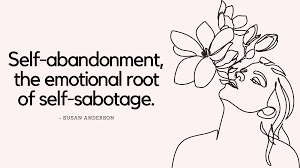
A reader recently reached out, explaining that he once in a while experiences losses that wipe out a large share of his monthly profits.  It is frustrating to trade well most of the time, only to lose discipline and seemingly sabotage all we've accomplished.  As the graphic above suggests, the root of self-sabotage is self-abandonment.  We temporarily lose sight of what we're meant to do and instead act on impulse.  In the terms of the Radical Renewal online book, we abandon the soul of what we do and allow our trading to become ego-driven.  

I have never been convinced that the root of such self-sabotage is a deep-seated, inner desire to hurt oneself.  It is usually not an absence of self-esteem that causes us to become reactive.  Rather, we experience "triggers" that set off automatic and often harmful actions.  The problem is a temporary loss of free will.  Under a certain set of emotional and physical conditions, we behave in pre-programmed ways and become reactive rather than active.  Quite literally, it is a loss of self-awareness that allows us to behave in ways that harm our best interests.

Consider the many situations in which we *never* go on tilt and behave reactively and self-destructively.  We're not careful in crossing busy streets 99% of the time, only to occasionally walk directly in front of traffic.  We don't operate machinery (lawn mowers, ovens) safely most of the time, only to occasionally cut or burn ourselves severely.  Why don't we go on tilt in those situations?  Reason one is that our egos are not involved, and reason two is that we are supremely aware of the dangers at hand.  If I don't *need* to cross the road quickly and I'm mindful of the busy traffic, I am perfectly able to wait for a break in the flow of cars to cross safely.  If I'm clearly aware of danger, I will act with caution.  Always.

This is where it's helpful to engage in a "check up from the neck up" prior to any risk taking.  If a surgeon is scheduled for a procedure, but is in an agitated state because of a personal circumstance, that surgeon will delay the operation.  "Above all else do no harm" is the operative principle.  If a pilot is about to take off for a flight, they reach out to the co-pilot and--together--go through the pre-flight checklist to make sure the plane is truly air-worthy.  If something is wrong mechanically, the flight will be delayed.  Above all else, do no harm.

The opposite of self-abandonment is self-awareness.  If we approach each session of trading--each trade!--the way a surgeon approaches an operation or the way in which a pilot preps for a flight, then we are in the state we're normally in when we're crossing a busy street.  The awareness of risk and danger enables us to do no harm.  It isn't discipline or "process" orientation that enables us to not go on tilt when we're handling a carving knife in the kitchen.  It's the immediate, acute awareness of danger.  The key is self-awareness:  knowing when we're in the wrong mindset for risk-taking.  Like the surgeon, like the pilot, we must take danger so seriously that we're willing to postpone our performance until we're assured that we will "do no harm".  If we've performed our own checkup from the neck up, we're not going to trade on impulse.  

Further Readings:

Understanding Trading Tilt

How to Overcome Tilt

Video on Tilt Trading

Advice on Tilt to SMB Traders

Radical Renewal and the Spirituality of Trading

.

Thursday, July 06, 2017

Self Awareness and State Awareness in Trading

One of the topics I'll be addressing in depth at the upcoming Chicago workshop (July 24-26) is understanding your physical, emotional, and cognitive states and how those contribute to good and bad decision making.  

Much of our behavior--in and out of markets--is state dependent.  How we interact with others, how we take risk, how we tackle challenges:  all of these are impacted by the degree to which we are energized or fatigued; calm or keyed up; fulfilled or frustrated; distracted or focused; etc.  

In the right states, we can access our greatest strengths.

In the wrong states, we fall victim to our greatest weaknesses.

Awareness and management of our states--and the ability to cultivate new states and extend existing ones--is central to peak performance.

One of the great challenges of trading is balancing market awareness and self-awareness.  

You have a trading process: a way of identifying opportunity, defining trades, and managing the risk and reward around positions.

Do you have a self-awareness process?  

We track price action closely; how aware are we of ourselves and whether we are in the right states for peak performance?

This is one of those areas where work on our trading requires work on ourselves: in becoming better traders, we become more self-aware and self-determining human beings.

I look forward to working on that self-development at the workshop.

.

Wednesday, August 17, 2016

Four Keys to Emotionally Intelligent Trading

A worthwhile lens for viewing your trading processes is that of emotional intelligence.  The above graphic depicts four aspects of emotional intelligence that are central to trading:

1)  Self-awareness - Are you able to stand apart from yourself and observe your strengths and vulnerabilities in real time?  Emotional self-awareness means that you observe and understand your emotional responses to market situations, and don't automatically get caught up in those.  Self-awareness also means being fully grounded in one's "edges" as traders and not straying from those.

2)  Self-management - Are you able to channel your thoughts, emotional responses, and behaviors in a constructive manner?  Self-managing traders set goals that guide their activity through the day.  They also behave in a rule-governed manner, whether it is with respect to entry/exit execution or risk management.  Self-managing traders are ones who continuously review performance, learn from it, and place the lessons into subsequent practice.

3)  Social awareness - Are you able to read participation in the marketplace?  Can you pick up cues from volume, volatility, the co-movement of instruments and assets, and responses to news items that tell you whether buyers or sellers are dominant.  The socially aware trader is keenly attuned to market flows, digging beneath the surface to figure out who is in the market, what they're doing, and the price levels at which they're acting.

4)  Relationship management - Are you networking with others to make yourself better?  Successful trading is a team sport, even when the trading is solo.  There is simply too much information relevant to markets to process and stay on top of at all times.  Successful traders filter out noise--the conversations, emails, and messages that contain little value--but actively filter in colleagues who have valuable perspectives.  Very often, fresh inputs from those colleagues lead to fresh insights and trade ideas.  Beneath every great individual performance is a well-functioning team, either real or virtual.

How well are you managing yourself and your trading relationships?  How well are you sustaining a high level of awareness of yourself and of market participants?  It's not a far stretch to imagine giving yourself a daily report card simply on these four dimensions to ensure that you're trading in a truly emotionally intelligent fashion.  Very often, failing to monetize smart trading ideas is the result of a lack of emotional smarts.  The good news is that, with practice, we can learn to be emotionally smarter:  better at sustaining awareness and managing our resources.

Further Reading:  Social Intelligence and Trading
.

Friday, December 16, 2016

The Power of Self Awareness in Trading

Bertrand Russell had a point.  A good part of wisdom is knowing what you don't know and being self-aware with respect to your flaws.

Here is an interesting observation.  Some traders I work with choose to share their journals with me daily.  In the great majority of cases, they are among the top performers.  It is quite rare that struggling traders keep a routine journal and, if they do, choose to share it.

Perhaps this is the reason:  the best traders sustain self-awareness.  They know they have flaws and they want to be aware of those flaws, so that they can minimize those.  They are also aware of their strengths and seek to stay grounded in those.  Traders lacking self-awareness can't be aware of flaws and so unwittingly repeat those.  They attempt to maintain confidence by overlooking vulnerabilities, not by sustaining awareness of those.

A self-aware trader can describe in detail his or her trading process.  A self-aware trader also has a process for working on himself or herself.  Humility and awareness of limitations become strengths when they are tied to a drive for self-improvement.

Further Reading:  Evaluating Yourself as a Trader
.

Thursday, December 22, 2016

Self-Awareness and Overcoming the Dark Side of Our Trading

Good market observers offer knowledge; great ones impart wisdom.  I'd put Peter Brandt in that latter category.  His Factor Commentary contains plenty of knowledge, tracking technical patterns across macro markets, but almost always comes across with heavy doses of wisdom.  So it was recently when he wrote about his end-of-year practice of halving his positions in the last two weeks of December and tightening stops on the rest.  Might he miss some market action as a result?  Yes, he points out:  that is precisely why he's stepping back during the quiet period.  He recognizes that compulsive trading is dangerous trading.  By stepping back from trading, he is controlling any compulsive tendencies and not allowing them to control him.

Peter writes in his recent commentary, "I have to always guard against my inner compulsive self...The decision [to get out of the market] has everything to do with gaining emotional distance from the process of market speculation in preparation for a new year."  Notice that Peter's strength is his self-awareness, not any Zen capacity to eliminate any and all negative emotion.  His ability to observe himself enables him to stay in control; not trading is a strategy that helps his trading!

The broad idea here is that many weaknesses represent strengths taken too far.  The passion for trading can turn into compulsive trading.  Confidence can turn into overconfidence.  Risk prudence can turn into risk aversion.  Every strength has a dark side at the point at which it is overused.  Creativity helps me generate unique and promising trade ideas.  Taken too far, creativity gets me tinkering with processes and losing discipline.  Look deeply into a trading weakness and you'll often find a strength to be harnessed.  Self-awareness helps us achieve that harnessing.

Further Reading:  Trading With Self-Awareness
.

Monday, December 08, 2025

Strengthening Your Trading By Leveraging Your Strengths


12/12/2025 - The subtitle of my book that will be coming out in late February is important:  Turning personal strengths into trading strengths.  We come to markets with talents, skills, and experience.  The challenge of developing as a trader is figuring out how to apply those to the various facets of trading process, from generating ideas to managing risk.  As noted below, your success as a trader will come from what energizes and excites you:  your passion will point the way to your purpose.  There is so, so much more to trading psychology than overcoming negative emotions.

Research in psychology suggests that there are four major sources of psychological well-being:  happiness (things we do that are enjoyable); purpose (things that we do that are meaningful); energy (things we do that build our vitality, strength, and endurance; and affection (things we do that connect us to others we care about).  The activities that provide our greatest success fire on all four of these cylinders.  Our challenge is to structure our trading--and the time of each day--to maximize the things that bring us joy, meaning, vitality, and closeness.

One of the strengths my research found is most closely associated with trading success is entrepreneurialism.  Great traders treat their trading as a start-up business, and they have the energy, enthusiasm, and passion that great entrepreneurs bring to their undertakings.  That is positive trading psychology--        

12/11/2025 - What we are passionate about reveals our strengths, and those reveal our values and our talents.  We don't have to push ourselves to get things done if what we're doing truly speaks to us.  Yes, there are always life's errands and to-do activities to get out of the way, but if we're looking forward to what comes after, it's never a problem to check the boxes.  Many beginning traders are passionate about making money, but that's different from being passionate about trading and understanding markets.  If those traders don't make money, they are left with nothing to support them emotionally.  They become frustrated, and that seeps into their trading.  When we identify our passions and our strengths, then we're in a position to creatively integrate those into our trading processes.  A great place to be psychologically is to be passionately involved and interested in markets even when we're not putting positions on.

=====================

12/10/2025 - What is the most important strength for beginning and developing traders?  Certainly high up on the list is emotional self-awareness:  the ability to recognize what you're experiencing at the time you're experiencing it.  This is useful in two regards:  1) it gives us the option to step back from trading when we're frustrated or confused, so that our trading does not become reactive; and 2) it allows us to more clearly recognize our intuition when we see patterns occurring in real time.  In other words, emotional self-awareness is what enables us to avoid poor trading that results from acting on impulse, but it also makes it possible to better perceive opportunity in real time.

Emotional self-awareness is possible to practice in any area of life where emotions can get us in trouble--or where they could help us respond to challenges constructively.  A great example of this is close relationships.  By avoiding reactive responding due to frustration, hurt, or overload, we can step back and deal with misunderstandings in a helpful way.  By recognizing our partner's needs in real time and empathizing with those, we can become better at reaching out and growing our closeness.

Everything in life that engages our emotions can be practice for emotional self awareness and control in our trading.  How we live either reinforces the best within us, or it reinforces our vulnerabilities.  Trading psychology is best worked on when it draws upon life psychology.

======================== 

12/9/2025 - What have been your best trades--and best trading periods--of 2025?  From generating the trade idea to expressing it, sizing it, and managing its risk, identify *specifically* what you did well in these best trades.  Very often, it is in analyzing our best trading that we can identify the cognitive and emotional strengths that contribute to our success.  For instance, a while back I analyzed my profitability as a function of time of day (since most of my trading was intraday).  Very early in the morning right after the NYSE open, I did poorly.  Later in the morning, I did quite well.  Around noon and midday, I was mediocre.  

What led to my success was patience and listening carefully to the market and understand who was involved and how--and *then* placing my trades.  I was successful only when listening--and I was specifically listening well during busy periods, because I could track the activity of the larger market participants.  Because of years of work as a trading coach, I understood large traders and their behavior patterns--and I was successful when I drew on that awareness.  When I simply tried to trade market patterns on my own, my results were basically random.

The point here is to dig deep into your best trading and figure out what makes you tick when you're successful.  The goal is not to be like anyone else; it's to be more and more like yourself at your best.

======================

12/9/2025 - Tomorrow's free webinar at 4:15 PM ET will focus on assessing your strengths and applying them to your trading. Registration will close by the end of the trading day today.

What are your relationship strengths?  What do you do best as a spouse, as a friend, as a family member?  How are you able to grow your connections with people at your work and in your community?  What makes you successful in collaborating with other traders?

This blog has covered the topic of teamwork and the value of being part of a trading group/pod/community.  But how can you best help others and best receive help yourself?  By drawing upon your relationship strengths, you can teach others (and thereby reinforce your own learning) and you can learn from others (and refine/broaden your trading).  

Your strengths as a person are the foundation for your growth as a trader.  

See you tomorrow!

=====================

12/8/2025 - As we get to the end of the year, many traders reflect on the year past and formulate goals for the year ahead.  An important concept in psychological research is that much of our growth comes, not from our top, "signature" strengths, but from expanding and developing what are called our "latent" strengths.  These are areas where we excel, but don't necessarily know we excel and so we don't consciously draw upon them during times of challenge.  We can think of these as relatively "hidden" strengths.  Perhaps they show up only occasionally in life or in a limited number of life circumstances.  They *are* strengths, however, and we can cultivate them to further our development.

My signature (top) strengths include a drive to learn and achieve.  If you were to ask those I live with, however (especially my cats!), they would say that my ability to listen and understand others are some of my best qualities.  Indeed, those have long driven my work as a psychologist.  In pursuing trading, however, I've only recently worked on ways of becoming a better listener of markets:  breaking down the market into components (sectors, subsectors) and hearing the (often unique) story each part of the market is telling.  Getting inside the market and truly listening has opened insights that I had missed despite my work ethic.

What areas of strength might be relatively hidden in your life that could take your trading to the next level in 2026?  How could you exercise those areas, so that your latent strengths get even stronger?  Very often, looking to areas of life very different from trading can alert you to what you do well that could creatively be imported into your trading processes.

In the upcoming free Wednesday afternoon webinar (December 10th; 4:15 PM ET), we'll not only evaluate your strengths, but also identify your latent strengths and discuss ways of growing them.    

Let's make the new year a year of new growth!


Sunday, March 21, 2010

Becoming a Self-Aware Trader

"When you are your own trading coach, there is always a part of you that stands apart from your decision-making and execution, observing yourself and exercising control over what you do and how you do it. The real value of the trading journal is that it structures the process of self-awareness and helps make it more regular and automatic. If you were walking on a familiar street, you would hardly think about how you walk; everything would be on autopilot. If, however, you were taking the same walk in a minefield, you would be exquisitely self-aware, conscious of every step that you took. Trading is neither a walk in the park nor a minefield...perhaps it's more like a walk in a beautiful, but somewhat dangerous park. You want to be absorbed in the walk, but alert and aware at the same time. That is the function of the trading journal: it enables you to monitor yourself, even as you are immersed in what you're doing."

The Daily Trading Coach, p. 102


.

Saturday, April 04, 2015

Why Do Disciplined Traders Make Bad Decisions?

We've all known traders who lack self-control.  They react rather than act, making decisions impulsively, often based on those twin fears of missing out and losing money.  It's no surprise when such traders draw down.  In a very real sense, they trade their hopes and fears, not the markets in front of them.

But how about traders with excellent self-control?  I know many: experienced money managers with long histories of success.  Once in a while they make mistakes that they describe as rookie errors.  They don't seem fearful or reactive, yet they will chase bad prices or stick with losing trades too long.  What's going on in such cases?  Aren't discipline and self-control supposed to produce good trading outcomes?

An interesting window of insight into the bad decisions of good traders comes from research conducted by Maria Konnikova that identifies the limits of self-control.  Konnikova finds that people high in self-control tend to be more overconfident than others in situations where control over outcomes is limited, but perceived control is high.  In other words, those with high self-control can also fall victim to an illusory sense of control.  That leads to poor decisions.

What is particularly fascinating in Konnikova's work is that people with high self-control are most likely to overestimate their actual control in situations when they are experiencing positive emotions.  Konnikova notes, "...the positive affect that usually accompanies both the illusion of control and high self-control can be an Achilles heel of high self-control in certain environments with limited actual control, creating a feeling of overconfidence that translates into suboptimal decision making."  It's when traders are winning and feeling good that their confidence is most likely to morph into overconfidence.  That leads them to overestimate their control over market outcomes and make decisions based upon illusory--not actual--control.

What is the solution to this dilemma?  Konnikova explains that the self-awareness of those high in self-control can help them recognize that positive emotions are a threat to their control, thus cooling them down when their confidence is running hot.  This fits very well with observations I have made in the course of working with traders: often the worst decisions are made when the trader has just made money, not when he or she has drawn down.  We don't normally think of positive emotion as a risk factor, but in fact any experience that takes our attention from markets and leads us to focus on outcomes rather than process is likely to interfere with performance.

We commonly hear that traders should take the most risk when they have the highest conviction in their ideas.  That can work as long as conviction doesn't come at the expense of self-awareness.

Further Reading:  The Lack of Profits From Market Prophets
.  

Wednesday, December 23, 2009

Sustaining Self-Awareness During Trading

One important element of working on trading performance is sustaining self-awareness during trading, so that you know which strategies (setups) and tactics (execution) you're using at the times you're trading. After all, if you're not fully aware of what you're doing when you're doing it, can you hold that in memory to reflect upon it later and learn from it?

Many traders think that more days, weeks, and years of trading will give them better skills. But that's not necessarily so. It's the awareness of performance that enables us to internalize it, adjust it, and learn from it. Performing on autopilot is a recipe for repeating a day's worth of experience 250 times, not achieving 250 days' worth of experience.

Consider this perspective from wrestling coach Nick Cipriano:

"The strategy and tactics that wrestlers employ in competition are conceived in the practice environment, but they are often perfected in competition under stressful conditions. Through experience, wrestlers learn to better track match developments, and they slowly learn to adjust strategy and tactics accordingly. In my experience, I have found that highly accomplished wrestlers (as compared with novice wrestlers) can recall explicit details of their matches. I believe their recall ability is directly linked to their ability to process and interpret match developments, not only more readily, but also much more accurately. In my judgment, the coach facilitates development of this important psychological skill by integrating technical training with psychological training and by constantly reminding the wrestler during sparring sessions to monitor developments and adjust tactics accordingly. One specific strategy I use involves encouraging wrestlers to maintain a broad focus of attention during sparring and to visualize the actions of their opponent from a third-person perspective (as if watching the sparring from the sidelines). Being able to assess match developments from an external perspective allows a more accurate interpretation of strategic and tactical adjustments that must be made."

Expert Performance in Sports
Starkes and Ericsson (Eds.)
p. 165

.

Monday, June 17, 2019

Trading Psychology Techniques - 9: Conquering Negativity

The past three posts in this series have dealt with building self-awareness; facing trading fears and anxieties; and overcoming frustration and anger.  In this post, we will tackle negative thinking patterns and how these can be turned around.

The first principle and most important practice is to live a positive life outside of your trading.  It is impossible to sustain an optimistic and constructive mindset during trading if what you are reinforcing during your other hours is negative.  If you take a look at the recent Forbes posting, you'll notice a non-traditional take on the recent Father's Day holiday.  The idea is to turn the holiday into a positive emotional experience by widening its meaning.  This is something that can be done in many areas of life.  Spending time with friends, relationship partners, family, and colleagues is great, but how can we make this time truly fun, inspiring, and meaningful?  As I point out in the book that I am currently writing (due out during the summer), the key is avoiding routine and seeking experiences that are special.

How can we possibly turn our thoughts and behaviors around if we are stuck in a life of routine?

The cognitive approach to conquering negativity is especially powerful.  That requires building the self-awareness to recognize when you are talking to yourself in ways that are not helpful and constructive.  As I've mentioned in my books, a great way to reinforce that self-awareness is to regularly ask yourself, "Would I be talking to someone else I cared about who is in my situation the same way that I'm talking to myself?"  This is helpful, because it reframes our thought patterns as conversations.  Very often, if we view our thoughts as ways that we're talking to ourselves, we can see that the conversations are negative and serve no constructive function.

Once we can recognize the negative thinking patterns, we want to tune into their destructive consequences.  By reminding ourselves that this kind of thinking robs us of energy, takes away our focus, and causes us to be less productive and creative in generating ideas, we gain the ability to become angry at our own negativity.  This is a very important principle.  We are most likely to change a pattern when we view it as an adversary: as something that stands in the way of our happiness and success.  Reminding ourselves of the consequences of our negative self-talk helps us marshal the energy to engage in a much more helpful processing of our situation.

That sequence--recognize negativity, challenge negativity, replace negativity with more constructive self-talk--can become a positive habit pattern if repeated multiple times per day for many days.  Yes, of course, negative thoughts will pop into your head, but you'll be able to quickly smack them down if you immediate recognize their consequences and generate more helpful ways to view the situation.  In my own trading, I turn negative thoughts into learning thoughts.  If each of my losses and mistakes can teach me something--something about me, something about markets--then I can actually value my mistakes and stay positive in the face of temporary drawdown.

Negative things always happen in life.  The resilient person doesn't internalize those setbacks.  Setbacks exist for a reason, and we can turn them into fuel for our personal development and the development of our trading.

EXPANDING YOUR MINDSET:  LESSONS FROM FATHER'S DAY
.  

Wednesday, August 10, 2016

Can Individual Traders Succeed in Today's Markets?

Lately I've encountered considerable hand-wringing as to whether individual traders can succeed in markets increasingly dominated by meddlesome central banks, high speed algorithms, and large amounts of capital in concentrated hands.  To be sure, the proportion of individual traders that makes consistent money is not high, particularly in the daytrading world.  Of course, much the same could be said of the proportion of young athletes, actors/actresses, or writers that succeed in professional careers.

What distinguishes successful individual participants from the others?  Having worked at multiple trading firms and interacted at a close level with many traders for over a decade, I've identified two factors that seem to be responsible for success.

The first distinguishing factor is uniqueness of perception, which is related to creativity.  If a developing trader isn't seeing something unique in markets, it's unlikely they will generate unique results.  The successful trader looks at different market data, different market strategies, different markets and relationships among markets.  There is not much "plain vanilla" in what they do.  In an important sense, they are playing a different game from consensus traders.

It is because of this uniqueness of perception that successful traders find unique edges in markets.  They cultivate the uniqueness by talking with successful market participants in different strategies and markets; reading out of the box market-related research; and trying out lots of new ideas in modest size.  They love innovation; they love tinkering; they are intellectually curious--and they have the practical bent to put new perspectives into practice.  Many times, the quantitative study of markets--searching for reliable patterns in markets--provides fuel for these fresh ideas.

The second distinguishing factor is self-awareness and self-understanding.  The traders successful in today's markets know their strengths, recognize their vulnerabilities, and craft strategies that play to their cognitive, as well as personality, strengths.  Per Kahneman's distinction of thinking fast vs. slow, the truly excellent traders are either deep thinkers or fast thinkers.  They either analyze markets in greater depth than others and see detail and nuance that others miss or they view markets broadly, seeing patterns emerge in real time.  The successful trader is distinctive in one of those forms of information processing--and they make the most out of that.  

It is this self-awareness and self-understanding that helps the successful trader take a good amount of risk when opportunities are present and stand aside when they are not.  It is also this self-awareness that helps the great traders hire assistants and build out teams that expand their skill sets and trading scope.  Very, very often, the successful traders have benefited from formal mentoring from a more senior, skilled trader.  Very often, the successful traders eventually become mentors themselves.  Success starts with raw materials (drive, persistence, curiosity) and develops through real-time mentoring and experience, just as it does for physicians and plumbers.   

The bottom line is that at every firm where I work, I do see successful traders who achieve success consistently.  The opportunity sets may have changed over the years (more on that in an upcoming post), but the talent and skills to capitalize on those new opportunities are alive and well.   A new generation of traders is emerging, doing new things to exploit those new opportunities.

Further Reading:  The Single Most Important Trait of Individual Traders
.

Sunday, June 04, 2017

How Do You Warm Up For Trading?

Notice how in most performance activities, top performers engage in warm up exercises.  Singers, musicians, athletes--all have their warm up routines.

What is your trading warm up, and are you truly warming up the functions you want to exercise?

Some time ago, I learned a simple trick for getting rid of any nervousness or tightness before giving a talk to an audience.  I showed up to the auditorium early and greeted guests as they arrived.  I chatted with them before the talk and generally had a good time.  By the time my presentation was ready to begin, I had already been speaking for a while and many people in the audience were familiar.  Exercising sociability as a warm up helped me be more engaging with my audience.

So it is with all warm ups.  We exercise the functions we most want and need to employ.  That means different warm ups for different performers.

Here are a few warm up exercises that come to mind for traders:

*  Self-awareness activities - Meditation and visualization exercises help us enter a calm, focused, self-aware state.  By warming up our self-awareness, we make it difficult to lapse into frustrated overtrading.  Reviewing journal entries to mentally rehearse our goals and how we will pursue them is an excellent self-awareness warm up.

*  Flexibility activities - I love to mentally rehearse different market scenarios as we approach the open.  The scenarios include how I would respond to early weakness or strength, what I would look for in a range or trend day, etc.  Contemplating many market possibilities helps ensure I don't get locked into any one.

*  Aggressiveness activities - Many times the difference between a decent trading day and a great one is the ability to take enough risk when solid opportunities are present.  Pumping up with active physical exercises while mentally rehearsing aggressive trading tactics in the right situations acts as a way of priming good risk taking.

*  Creativity activities - Scanning many markets prior to the open and/or watching many stocks in premarket trading can many times serve as an alert to early influences on the market(s) we're trading.  When we look at many things and identify commonalities, we can detect important market themes that may well persist into the trading day.  Conducting these scans in a team format, interactively, can further warm up our creative thinking.

No serious actor/actress, musician, or athlete considers going into a major performance without warming up.  Warm ups practice the functions we most want to employ.  Your trading warm up should put you in the mental, physical, and emotional state you need to be in to do your best trading.  Many, many trading problems occur simply because the right functions were never warmed up.  Your warm up should be your way of priming the functions you're employing when you're trading at your best.

.