Great quarterbacks, it is said, see the whole field. It may look as though receivers are covered and no passing opportunities are present if you're looking down the center of the field, but off toward the sidelines--or maybe even just off to your side--could be a good opportunity to complete a pass.
If all you were looking at yesterday afternoon was the S&P 500 Index (SPY, bottom chart above), what you saw was weakness through the day.
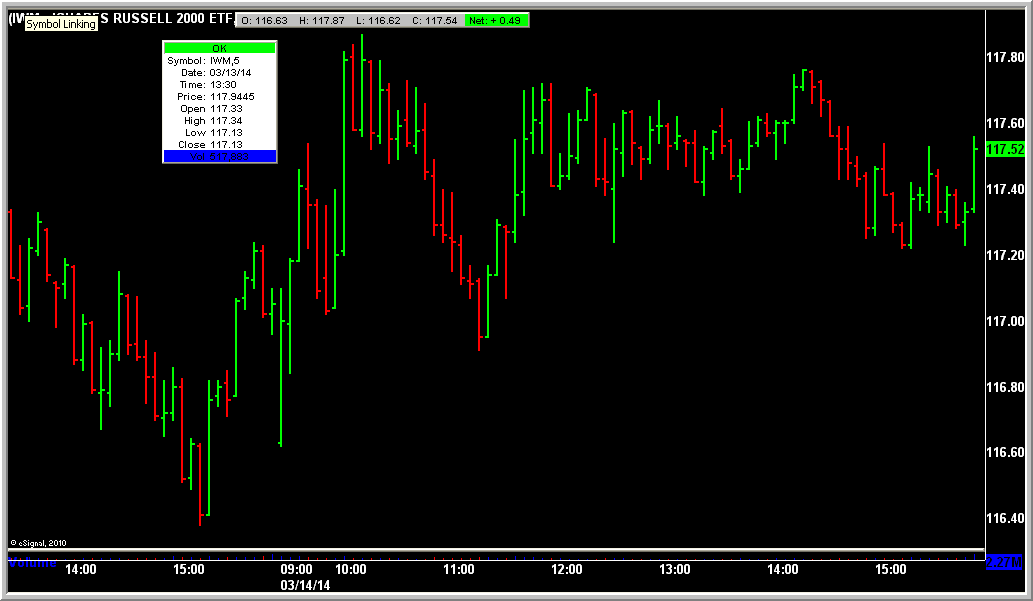
Had you been looking at the smaller cap Russell 2000 shares (IWM, middle chart above) or the emerging markets ETF (EEM, top chart above), you would have seen shares holding nicely above their morning lows.
There was significant selling pressure in the afternoon, with multiple NYSE TICK readings below -800, and yet by the end of the day we had 643 stocks making fresh monthly lows, compared with 685 the day before. Failing to trade below their prior day's lows were small cap shares (IJR); midcap shares (MDY); homebuilding shares (XHB); consumer discretionary stocks (XLY); raw materials shares (XLB); energy shares (XLE); EuroStoxx shares (FEZ); and utilities stocks (XLU).
If we see renewed broad weakness early Monday, we'll know that's fresh selling pressure-- and that would be information. If we see firmness in stock prices early Monday, a number of tunnel-visioned quarterbacks might just have to cover their shorts.
I recently posted a measure of intermediate-term market strength as well as moving average crossovers. Above is a short-term measure of breadth specific to S&P 500 stocks that I have found helpful. As with the intermediate measure, the raw data are from the Index Indicators site--shoutout to Mo Shaarani for a very useful site. I archive the data and construct the indicator and chart it within Excel.
This short-term breadth measure consists of a daily average of the percentage of SPX shares trading above their 3-day moving averages, their 5-day moving averages, their 10-day moving averages, and their 20-day moving averages. So when the index approaches 100, the vast majority of shares are in uptrends over all of those short-term timeframes; when it approaches 0, the vast majority of shares are in short-term downtrends. Interestingly, when the breadth index closes below 30, since 2013 the next five-day gain in SPY has been 1.25%, almost four times the average gain for the remainder of occasions (.33%). It's a great example of how markets that look and feel the worst--and that trigger the most stops for long positions--end up having the best near-term returns. Imagine short-term cycles superimposed on a long-term upward trend: that is the market we've enjoyed for the last couple of years or so. In such a market, it makes a lot of sense to be a trend follower--but to enter long positions in a countertrend mode. Further Reading: Breadth as a Market Tool
Here's a measure that has done a nice job for me of tracking intermediate-term market strength and weakness. You can see that we topped ahead of price, which is common, and have rolled over. We have not, however, reached oversold levels, despite yesterday's stiff decline. Those oversold occasions have marked very good buying opportunities in the past several years. The intermediate strength measure looks at the number of S&P 500 stocks making fresh 5, 20, and 100-day new highs and lows and takes a moving average of that composite. The data come from the Index Indicators site. Like the crossovers, I've tracked these measures for years. Daily posting of numbers and testing of relationships provides a learning experience that, for me, is far deeper than anything I can get from staring at screens. Further Reading: Implicit Learning and Trading Performance
So imagine you are following all common stocks trading across the major U.S. exchanges and you track how many each day are crossing above their 20-day moving averages and how many are crossing below their 20-day averages. If you take the net number of crossovers each day and track on a rolling five-day basis, you'd get a chart that looks like the above. You'll notice that thrusts in crossovers to the upside have tended to lead price peaks in the market. Troughs in the number of crossovers have corresponded with a number of short-term bottoms. After yesterday's rout, you can see we're in the range of many of those troughs. Indeed, since 2012, when (as yesterday) the net five-day number of crossovers has fallen below -1000, the next five days in SPY have averaged a gain of over 1.4%--about four times the average five-day price change over that period. There are plenty of current geopolitical factors that could erupt and turn the recent decline into a deeper dive, so one cannot blindly assume that the future will mirror the past. It's when tape action begins to confirm historical tendencies that you have a potential good short-term trade and NRK goes shopping. Further Reading: How Trading Systems Can Inform Discretionary Trading
FXI, the China ETF, has been underperforming U.S. stocks for a number of years and has moved lower recently in the wake of a domestic loan default and fears of a chain reaction. Emerging market bonds (EMB) have also moved down in recent days, but are still well off lows of the last several months. Note also the weakness in copper, which has been tied to the China trade in interesting ways. With banks cutting lending to sectors with high levels of shadow banking debt, this familiar story has gained a bit of urgency in recent days.
Here's a chart of rolling correlations among the major sectors of the S&P 500 stock universe vs. the S&P Index (SPY) itself. Whether we are in a more correlated or less correlated environment impacts the relative value of trading the index itself vs. stock picking within the index. Most recently we've been in a lower correlation mode. Indeed, as we see from the FinViz site, over the last three months, returns from the major sectors have varied from a high of 10.1% (healthcare) to a low of -17.4% (conglomerates). As a rule, the sectors tend to become more correlated during moves down and initial rises from lows and then less correlated during periods of short-term topping. It is during those topping processes that we see sector rotation and weaker sectors falling off while stronger ones hold their highs. My longer-term correlation metric has increased from .65 during 2005-2006 to .80 for 2012-present. That has been part of the stockpicking challenge in the large cap universe and (along with volatility and its collapse) is one of the reasons many short-term traders in the stock market have gravitated to smaller cap shares that move more idiosyncratically. It's yet another illustration of how market environments can shift over time and impact opportunity sets for traders. Further Reading: Adapting to Change
There is no more important coaching relationship than the relationship you have with yourself. How do you talk to yourself when you start your day? When you are in losing trades or drawdowns? When you are traversing your learning curve? Our self-talk creates our most immediate psychological environment. Do you talk to yourself the way you would speak with a loved one or a dear friend? Do you motivate yourself? Inspire yourself? Challenge yourself? Support yourself? You wouldn't want to work for an employer that wasn't constructive, motivating, inspiring, challenging, and supportive. Why would you settle for that as your internal workplace? Successful traders, I find, may or may not make use of formal coaching, but they are generally good self-coaches. They know when to give themselves a kick in the pants and when to be their own best friend. I've long defined my work as a psychologist as comforting the afflicted and afflicting the comfortable. That's also not a bad formulation for effective self-talk: staying constructive when things go wrong and challenging ourselves when things go right. Effective self-talk is much more than empty positive thinking: it's staying constructive no matter how challenging life and markets become. Further Reading: We Become What We Think
Here are readings and sites you can sink your teeth into:
Shoutout to Financial Juice, which has a running scroll of financial news and world developments. The site includes a calendar of upcoming global economic releases and latest pivot numbers from Pivot Farm, as well as links to webinars. Consistently the best and greatest number of links to financial media come from Abnormal Returns, including this recent curation that shows how high yield bond spreads have retraced their crisis move higher.
Suppose two traders applied for a position at your firm. One has a history of very consistent success with a winning strategy. The other has gone through ups and downs across many markets but maintained profitability over time. Which would you be inclined to select, if that is all you knew about the candidates?
It turns out that research from Angela Duckworth and team finds that "grit"--perseverance in the face of setbacks--is a significant predictor of future success. Indeed, a study of spelling bee winners found that those who sustain the greatest deliberate practice and display the greatest grit are most likely to succeed. The trader who has known nothing but success has little to fall back upon when markets change and fat tails create large losses. The trader who has been through winning and losing has cultivated resilience and is most likely to be emotionally prepared for losing--and prepared in his or her risk-taking.
A great formula for success: embrace setbacks and continually learn from them. Here's a talk on why passion and perseverance outweigh IQ as a determinant of success. Want to measure your grit? Here's a short test designed by Professor Duckworth. Further Reading: Persistence and Resilience in Trading
Simonton points out an interesting facet of creative genius: about 50% of creative ideas come from the 10% of contributors in a field who are most productive. One would think that creative geniuses bat out one creative masterpiece after another. That, Simonton's research finds, is not the case. The hit rate for the greatest geniuses--the ratio of works deemed creative masterpieces versus not masterpieces--is no higher for the geniuses than for their lesser competitors.
Those we come to know as great don't get that way by hitting home runs every time they come to the plate, so to speak. Rather, they go up to the plate more often: they produce many more works and a relatively constant proportion of those works end up becoming historical contributions. In other words, the signature characteristic of creative geniuses is prodigious productivity: they produce many more works than their peers and so are more likely to produce "mutations" that pass the test of natural selection.
What makes eminent contributors to their fields so unusually productive? Simonton observes that they are absorbed in their work and put in unusual numbers of hours doing what fascinates them. To paraphrase Seykota in the Market Wizards interview, they don't just have talent: the talent has them. This absorption in their work is a big part of what gives them the deliberate practice hours to achieve expertise.
The traders who I've seen maintain career success are also those who are absorbed by their talent. Their unusual productivity shows up in the constant flow of new ideas they generate and their continuous efforts at improvement and adaptation. One of the best tests of a trader is what they do when markets are closed. The best are absorbed in markets, whether markets are trading or not: theirs is a passion for mastery, not just a need to trade.
Kudos to Forbes for their New Year's list of inspiring quotes regarding greatness. As the Lee quote suggests, greatness is contagious: it is so much easier to find the best within us when we are surrounded by others who aren't afraid to think greatly. That principle applies to our psychological environment, as well. Greatness starts with doing something greatly every single day. How can we be the best we can be in life if we're not realizing our best day to day? Further Reading: The Power of Solution Focus
Here is a chart of the average true range for the stock market on a rolling 100-day basis going back to 1997. What you can see is that volatility has been all over the place. Anyone in 2012 who counted on markets moving similarly to the prior several years has been severely disappointed. Indeed, the current 100-day average true range is .88%, just a little over half the median level seen since 1997. For directional traders, that means that moves on any time frame are extending far less than they have historically. So let's say that a trader waits for price confirmation (i.e., for prices to move in the desired direction) prior to entering a position. Because moves extend less in a low-volatility environment, this means that going long on strength or going short on weakness (or adding to long positions on strength or adding to shorts on weakness) will give trades a particularly short half-life of profitability. By the time the trader has gained confidence in the move, it's ready to reverse. How frustrating is that? Since 2009, we've gained a little over 100 points in SPY. It's been quite a bull run, as the index has more than doubled. If we separate next-day returns based upon prior five-day returns, then we can see that only a little more than 13 points of the total move followed the strongest half of five-day periods. The remaining 88 points--nearly 90% of the total bull move--occurred following the weakest half of five-day periods. In a low volatility regime, the short-term trend is not necessarily your friend. It was great being a momentum trader in the late 1990s and many short-term traders I worked with did well during the volatility spike around 2008. It's been harder for those traders from 2013 forward.
How do you figure out what works in a more mean-reverting regime? Studying your successful trades can provide a valuable clue. It may be the case that you don't need to remake yourself. Rather, the challenge might be to simply stop doing the things that no longer work. Reverse engineering your best trades and isolating what makes them work can provide the best coaching of all. Further Reading: Stock Market Trends are Not Your Friends
This guest post is from Naomi Ruth Katz, who has experienced more markets than I could possibly study. It's an honor to share her wisdom; she is normally quite private.
When Brett asked me to write for his blog, I wondered, "What's this blog? It sounds like something that comes out of your nose." But Brett explained that blogs are a way of publishing without writing things on paper. In my day, when you wanted to write, you took out a pen and paper and put the letter in an envelope and mailed it. Now they have blogs. Go and figure. So what can I tell you about trading? The best trade I made was giving up my first husband. What a putz! For years I thought about ways of getting rid of him like that Hitchcock episode where the woman kills her husband with a frozen leg of lamb and serves it to the detectives. But you have to let those things go. You learn from your losses and you move on. Like I tell my son, the one with the tuchespunim: why always so farbissen?
But trading markets is different than getting rid of a cheating piece of dreck. You should keep it simple, otherwise you'll give yourself an ulcer. When you go to the store, do you shop for the most expensive things? Of course not. You look for a bargain. It's that way with stocks. You don't buy them when everyone wants them and the price is high. You wait for everyone to hate them, because that's when they go in the bargain bin. I love the bargain bin, like the one at the dollar store. I get things for 50 cents at the Flatbush outlet all the time, including a nice shampoo that doesn't make my hair frizz. Listen to me, you'll never make money trading with a goyishe kop. Never pay the retail price for anything. And make sure you return your library books on time, or they make you pay a fine.
One other thing, live a little. There are too many people like Brett getting up at 4 in the morning just to hock a chaynik about changing markets. Forget markets, worry about changing your oil. You can drive yourself farmisht with all these statistics. Hold onto your money, find good bargains, and take a vacation every so often. Only it shouldn't always be in the same place.
I just drew this chart on the fly. Imagine we're describing different kinds of people. The Y-axis captures whether the person predominantly talks about the world around them, ideas, and inspirations vs. talks about themselves. That Y-axis also captures a positivity dimension: many people who talk about ideas are supercharged by those ideas. Many who are self-focused come from a position of need, even/especially when they are in self-promotion mode. The X-axis captures whether the person mostly wants things from you and is in a taking mode vs. a sharing/giving mode where there is back and forth and true reciprocity. I've color-coded the quadrants. I find that the upper right, green quadrant is one that renews my energy. The lower left takes quite a bit of energy. A big part of success and happiness is surrounding yourself with the people and things that give you energy and minimizing the things that deplete energy. This is especially true in one's romantic life. One reason I like the idea of creating your own trading groups is that you have the opportunity to generate an oxygenated work environment. It's amazing how much growth and learning can occur when you're around growing, learning people. It's much easier operating with the right internal, psychological environment if you're in the right interpersonal environment. Further Reading: The Essence of Greatness
Many traders talk about having an "edge" in markets. Few actually measure and identify the sources of that edge. Let's say that roads never changed: there were never detours, road closings, new roads, etc. In such a situation, one would never need a GPS to get to work. One's memory and experience would be the source of edge: the driver could follow the same course and always arrive at the destination successfully. Now let's say roads changed routinely: the roads that were best to get to work one week might not be open or available the following week. In such a rapidly changing environment, one would lean heavily on an updated GPS. Without the guidance of the machine, it would be hit or miss as to whether one's past course would lead to the destination successfully in the future. Now imagine a driving educator who tells you that all you need to get to work is a chart of the roads, called a map. You're very excited, because this will tell you how to get to work each day. But the map never changes when roads open and close, so the best the map can do is aid your detours. But even the detours suggested by the map might be closed... Fortunately, there's a driving coach who tells you that your problem is that you lacked the discipline to follow your map and shows you several exercises to be a better map follower. The coach even shows you higher resolution maps to guide your commute. But the maps never change and the roads do. Much of my work these days consists of building better GPS systems for markets: systems that tell you when markets are changing, how they are changing, what drives the changed markets.. The GPS doesn't replace the driver; it informs the driver. The more roads change, the more important the GPS becomes. Meanwhile, drivers keep working on their map reading...keep running into detours...keep seeking out those coaches when frustration boils over... Further Reading: How to Identify an Edge in Markets
We've all had the experience of perceiving little opportunity in markets. Is there actually little opportunity, or are we in the wrong mindset to perceive opportunity that is there? It's an important question. Successful traders study themselves, the way Ted Williams studied his hitting as a function of where the pitch fell within or around the strike zone. That study told Ted which pitches to swing at and which to let go. As a trader, how well do you know your strike zone? It's only after understanding your sweet spots that you can properly differentiate between markets that have little opportunity for you and occasions when you are in the wrong frame of mind to perceive and act on legitimate opportunity. It turns out that exercise has a beneficial impact on creativity. Creativity also benefits from sleep and from positive mood. How you manage your personal life ends up being quite important to your ability to generate promising ideas. But all the creativity in the world won't help if you're swinging at pitches outside your strike zone. Further Reading: Trading Lessons From Ted Williams
One of the interesting tidbits from Jack Schwager's Market Wizards interviews is that many successful traders began their trading at a young age. This makes sense, in that it gave them more time to develop their learning curves. There are a surprising number of teenage traders out there. A great network for them is Leaders Investment Club. I recently caught two of their members, Julian Marchese and Austin Schwab, on CNBC and have had the pleasure of meeting both of them and hosting them for visits. The quality of the posts on the Leaders blog is just excellent. I predict that a good number of tomorrow's trading/investment leaders will come from this group. Further Reading: Devotion to Development
I want to thank those who commented on my post regarding a different kind of proprietary trading firm, and especially those who are using the comment section to reach out to others and create such a group. Please feel free to use the comments section to reach out to likeminded others and see if it might be possible to create trading networks that integrate trading research, mentorship, and coaching. I don't think it's necessary for participants to be trading the same way in the same markets. If I were in such a group and trading stock index futures, I'd be very interested in hearing what people were researching and trading in related asset classes and in single names. I'd also be interested in learning what others have done to break out of slumps or to keep an effective journal. The learning in a virtual trading group is as much about process as actual trade ideas. That is why a site like Stock Twits is very useful, but not a substitute for actual group participation. You can gather trade ideas from Stock Twits and you can use the service as an effective networking tool. It is difficult, however, to capture detailed research and process-oriented guidance in single tweets or even in a blog post. Much of learning is an interactive process and involves modeling behaviors, not just explaining them. I have often seen a discussion of research lead to fresh insights that were not a part of the initial research. That's tough to accomplish via text. Stock Twits would be a great way to reach out and poll traders for interest in group formation. User groups of particular software, such as Market Delta, would be another promising avenue. I suspect that many groups may start as individual collaborations between two committed traders and then branch out from there. The key is finding synergy: people who, when placed together, generate ideas and approaches that none of whom would have come up with on their own. Much of trading is a creative process; much of trading success is nurturing and managing that creative process. In life, as in trading, the right partners bring out the best in us. Further Reading: Conflict and Creativity in Trading
As noted in previous posts, I particularly like unique and effective visualizations of market data. One of the tools I've appreciated in that respect for a number of years has been Market Delta. The above chart was lifted from my archives; it is a great visualization of a breakout trade. Note how we were trading in a relatively narrow range before significant volume came into the market. Inside the bar, you can see the volume transacted at the bid vs. offer price as a way of identifying whether sellers or buyers were dominant. In the breakout trade, you can see that the increase in volume (bottom histogram) was occurring with trades dominantly hitting bids. A trader who picks this up early can ride a nice move until volume comes more into balance (side histogram).
I see that Market Delta has developed new ways to make it easier to read imbalances in buying and selling pressure. There is quite a bit more material on using the tool on their blog. It's a great way of assessing trader sentiment in real time.
Shout out to oilprivateer, who commented on the post concerning a different kind of proprietary trading group. His point was that Victor Niederhoffer's Daily Speculations site has been serving as an exchange of intellectual capital over many years. I could not agree more. In 2000, a visit to Victor's office served as the inspiration for my becoming much more empirical in my approach to trading, emphasizing the testing of trading ideas. Over the years, I have observed countless examples of his mentorship with developing young speculators.
I want to thank the readers who responded to the posts on what you need for trading success and finding the right mentorship. I will be responding to these comments and suggestions in coming posts. One of my long-term projects is to form a different kind of proprietary trading group. In the usual prop format, traders trade the capital of the owner(s) and share in profits. The traditional prop model can be very promising or very disadvantageous, depending on how the deal between owners and traders is structured. A different kind of proprietary trading group is one in which the capital that is traded is intellectual capital. Everyone keeps their accounts, everyone keeps their profits--there is no employment relationship whatsoever. The price for getting in the door is sharing ideas and research: everyone contributes to an idea pool and everyone benefits from the insights and discussion generated. Everyone shares their trading results and everyone mentors everyone else.
Imagine a virtual trading room connecting six hungry, dedicated, creative, savvy traders. With the right people, participants would experience an accelerated learning curve. Coaching, mentorship, and idea generation would be seamlessly integrated. Everyone would be a mentor, everyone would be mentored. It's not an idea for beginners, but would make sense for experienced, talented individual traders that wanted the advantages of belonging to a group without the usual strings attached. There is a saying in medical education: "Each one teach one." Advanced medical students teach beginners; interns teach advanced medical students; residents teach interns; attending physicians teach residents. The key is always seeing yourself as teacher and student. Trading intellectual capital: the idea is ridiculously idealistic and that's why I love it. Further Reading: Fighting the Isolation of Trading
It's understandable that traders who were long stocks would have stopped out after Monday's weakness and uncertain news. We made a multi-day low intraday and charts weren't looking so good. By Monday's close, we had between 20% and 40% of S&P 500 stocks trading above their three and five-day moving averages, so weakness was pretty broad. One of my query engines spit out that when we have that percentage of shares trading above their short term moving averages in a low VIX regime, the next four trading days averaged a gain of .52% (68 occasions up, 30 down). Across all other occasions, the average four-day gain was .08% with winning and losing periods pretty even. My short-term trading model, which had been modestly bearish, now was flattish to slightly bearish.
We opened firm on Tuesday, with NYSE TICK showing significant levels of institutional buying.
For those operating on the day timeframe, what's the trade? Once you see tape action confirming historical odds, you have a trade with potential. History doesn't always repeat itself, but trading with history on your side beats being ignorant of history. Further Reading: Trading by Handicapping Odds
Thanks to Trading Naked for the above graphic, and thanks to reader Todd who mentioned Jim Dalton's mentorship work on Market Profile in response to the recent post. There is nothing as practical as a good theory, psychologist Kurt Lewin once observed. What I like about Market Profile is that it is a good theory: a way of making sense out of market action. When I led a trading internship program in Chicago back in the day, Jim's book Mind Over Markets was the one required text. (See WindoTrader for a unique implementation of Market Profile). Once you understand markets as auction processes with bidders and sellers, shifts in volume and price over time make much more sense. Is it any wonder that a breakout from a trading range is more likely to continue to move away from the range if accompanied by higher volume and if it is occurring at times of day when liquidity is highest? Where has the market set value? When is a move away from value most likely to persist or reverse? Thinking in terms of auctions and the actions of buyers and sellers greatly illuminates market moves that otherwise might make little sense. Further Reading: Market Profile as a Best Practice in Trading
One of the themes emerging from the responses to the recent poll is the need for mentorship in trading. My experience is that this is a crying need among independent traders. At many money management firms, a junior professional with unique skills can join an existing team and add value from the start by applying those unique skills. That creates a situation where the junior professional can learn at the trader's side, both through observation and direct instruction. The best mentorship I have observed has come from trading teams. What is typically called "trader education" can provide useful information and perspective, but rarely has the ongoing element of deliberate practice needed for expertise development. Even at trading firms mentorship can be spotty, as traders are typically compensated for their trading, not their training of others. In my experience, Charles Kirk stands out as a dedicated mentor. He works with a subset of members to provide mentorship, but--in an inspired stroke--also requires advanced students to serve as mentors to the newbies. I have seen a similar dynamic at work at SMB, where there is considerable use of video resources on top of live mentorship from advanced students. Neither of these is free or cheap, but then again, neither is a quality education at any institution of higher learning. Many sites in the blogosphere do a good job of education/training, even if it's not the same as trading side by side with a mentor. Two that I've mentioned recently are Brian Shannon at AlphaTrends and David Blair at Crosshairs Trader; please feel free in the comments section to suggest others. I continue to believe that the development of virtual trading groups is a promising way to go for many enterprising independent traders. Connecting with just a few other dedicated learners and committing to sharing the learning can supercharge learning curves for all. The key is identifying the right fellow students: ones who are truly committed to be teachers as well as students. A valuable function of online communities is the opportunity to connect with like minded fellow travelers on the path of trading development.
It was late 1982, I had taken a tough hit in trading, and was more than a bit in the dumps. A friend asked me to a New Year's party, where I had way too much to drink. There I met a woman who wasn't yet divorced, had three kids, and was quite a bit older than me. Had I been in my right mind, I would have been friendly and quickly moved on to meet other people. But, in my haze, I talked with the woman, got her phone number, and last month we celebrated our 30th anniversary. Now that's a squiggly path! Trading offers its twisted paths of development as well. Rarely have I encountered straight lines to success.
So here's my question for readers: With so many online resources--books, blogs, tweets, charts, data, you name it--what more do you need for your trading success? What is the one thing that most help you in getting to that proverbial next level? And, specifically, what would you most like to see covered on this blog to help with your development? Please feel free to leave your ideas as comments (concise and constructive, please!) and I will make use of those suggestions in planning future posts. Thanks very much-- Brett
This last post in the Useful Trading Tools series covers an intraday measure of the percentage of NYSE stocks trading above their day's volume-weighted average price (VWAP). Previous posts in the series have looked at the upticks/downticks among Dow Industrial stocks; stock market breadth; unique data visualizations; volume data; and NYSE TICK. What makes the VWAP% helpful is that it is a real-time measure of breadth at an intraday level. In a trend day, we'll see the vast majority of shares either trading above or below their weighted average prices and stay at those elevated levels. In a range day, where we're likely to see sector rotation, we'll see more modest levels of VWAP% and often an oscillation above and below the 50% mark, as the above chart depicts. I get my VWAP% data from e-Signal. One can also construct VWAP% for Dow stocks only and for NASDAQ shares to get a sense for how large caps and tech-related shares are trading. It's a nice way to stay on the right side of the market: at a glance you can see if we're trading in a way that is trending and directional versus mixed and rangebound. Further Reading: Six Ways to Identify Trend Days in Stocks
Credit once again to Despair for that little piece of life wisdom. Optimism is great, but becomes a problem when it overshadows realism. On the Crosshairs Trader blog, David Blair makes the point that trading is all about "misses": being prepared to be wrong. What is important, he suggests, is envisioning--and preparing for--scenarios of both winning and losing. Stress inoculation is a psychological technique in which a person is exposed to negative or stressful scenarios and helped to cope with those before those scenarios actually occur. This has been used in the preparation of soldiers for battle and is a very useful exercise before getting into market positions. Visualizing what could go wrong and how you'd respond to it can make the difference between acting decisively in real time vs. being caught emotionally unprepared in the headlights. Indeed, once you figure out how to deal with a trade going south, you can even figure out where there might be opportunity in the situation. Ironically, it is by embracing the option of loss that we can free ourselves to identify the next round of opportunity. Further Reading: Inoculating Against Trading Stress
Just got back from an interesting visit and tour to the Two Roads craft beer brewery in Stratford, CT. What struck me from the tour is the degree to which the beermaking process has been automated and tightly controlled. From the proportions of the ingredients to the amount of time allotted to each process and the several step processes of cleaning the equipment, the manufacturing process is closely mapped and monitored. This makes the business an interesting combination of creativity--coming up with the right recipes, figuring out the most effective marketing strategies--and science. Indeed, it is this blend of inspiration and tight process control that makes the brewery successful. Much trading is like the homebrewing of craft enthusiasts. There are few controls on the process; each batch is likely to be unique. While this can make for fun tastings, it is unacceptable when one is offering a quality controlled product to the public. Once brewing becomes a serious commercial endeavor, it becomes process oriented, even as it retains creative inspiration. So, too, with trading. Putting observations together in unique ways and finding ways to trade those perspectives has a bit of creative art to it. But once the idea comes to life, there is a real science to trade sizing, structuring risk/reward, and constructing a portfolio. Professional traders differ from others the same way Two Roads differs from the average homebrewer: the rigor of execution ensures a high level of quality control. Further Reading: Reflections on Trading Process
Here's some interesting reading to take us into the new week: * Insightful New York Times article outlines how positive thinking about markets is associated with poorer returns and how positive thinking in our personal lives can lead to suboptimal outcomes; * Derek Hernquist offers a unique perspective on decision-making with trading tripwires; * Frank Zorilla on the significance of low volume rallies; * The importance of being data-driven and other great links from Abnormal Returns; * FinViz map shows that world-wide performance of equities was a bit mixed this past week;
This is a post about trauma and a unique way to overcome anxiety reactions after very stressful events. It is yet another way that I learned something about psychology from one of my animals, as we saw with Mali and Mia.
When we adopted Naomi, she was a traumatized kitten. She was visibly shaking in her cage and did not want to be petted or held. Once out of the cage, she hid under anything available and would not come out. Her level of fear was beyond anything I had seen in a cat. People clearly were a threat to her and she was always on guard. We tried everything to encourage Naomi to interact with us: soft voices, no sudden movements, reaching out with food, you name it. My first success was getting Naomi in our bathroom and then closing the door. Without a place to hide, she went behind the bathroom curtain and shook. I slowly moved the curtain away from her and she reached out to touch the moving curtain. I moved the curtain a little more and she again went after it. We continued this game for quite a while, with me giving her a little stroke, then moving the curtain, and Naomi going after the curtain. Interestingly, during the curtain game, she forgot to be afraid. She stopped shaking and was content to have me stroke her. This continued for a while until I picked Naomi up and put her on the bed (see above). She was very alert and wary. I placed my hand under the cover and moved it around. She immediately pounced on the hand. I scratched the sheet under the cover and she went after the sound. The game continued for quite a while--and for a number of days--until Naomi was comfortable being in the bed with us. To this day, she enjoys going after my hand under the covers.
If you met Naomi now, you'd think she was a shy cat, but not a traumatized one. Somehow she went from reacting to people as dire threats to playing with them. How did that happen?
No amount of coaxing or bribery with food could get Naomi out of her shell. She only overcame trauma by tapping into a motivating stronger than her fear: her natural hunting instinct and curiosity. Making the environment more safe--by itself--did not break through her fear. Rather, she overcame fear by replacing it with a different emotional experience and processing the world through that new experience. This, then, is the Naomi Principle: strong negative emotions can best be overcome by replacing them with strong positive ones. The most efficient and effective way to reprocess emotional experience is through new and powerful emotional experience. This is why we hold funerals: the power of bonding with those closest to us can overcome the grief of having lost a loved one. Some years ago I underwent emergency surgery for a near-ruptured appendix. Interestingly, my recovery was accelerated by the fact that the person sharing my room had obvious emotional problems. I became so concerned about helping my roommate that my physical discomfort was an afterthought. As the recent post suggested, outsized and unplanned losses can have traumatic emotional repercussions. How do you overcome those and get back to trading markets normally? The answer is to tap into positive sources of motivation that are stronger than your fear response. After difficult losses, I will double down on research and investigate new markets, new patterns. Inevitably I'll find something new, something promising. Like Naomi, I'll pounce on it: my eagerness to learn takes over. Before long, I see something so promising that I have to trade it--and I'll return to markets with fresh perspective and resolve. The Naomi Principle recognizes that our deepest passions transform us, whether it is by tapping into our creativity, our spirituality, or our love for others. It is difficult to be traumatized and mesmerized at the same time. Bringing out the best within us goes a long way toward overcoming the worst we've been through. Further Reading: What It Means to be Free
The function of risk management is not only to preserve your capital; it's also to protect your emotional well-being. Traumatic responses to market losses are the unacknowledged dark underbelly of trading. As I suggested a while ago, few in the trading industry find it in their interest to discourage overtrading. If anything, the emphasis is on apps and ubiquitous links to make it ever easier to place trades. I have yet to find newsletter writers who will pound the table and emphasize that there is little opportunity in the current market. That is not the message readers want to hear if they want to trade--and you always have to please the customer...
Here's a nice checklist that covers some of the signs of trauma that I've seen among traders. No, that trauma is rarely at the level that one would see in the full-blown post-traumatic responses of war veterans. Rather, it's more subtle, as in overreacting to small drawdowns after having taken large losses, finding one's mood rising and falling with P/L, and impaired risk-taking. Oversizing one's positions and portfolio creates drama and drama can lead to trauma. If your trading is truly planned, with maximum losses anticipated and wholly acceptable, there should be little drama in your trading. Yes, drawdowns will be disappointing and annoying, but they will not throw you emotionally. They will not impair your next round of trades.
If you have experienced a drawdown and are finding it emotionally difficult to come back, you know that your psychological risk-taking has been excessive. Ideally, you want to be learning from your losses, not reeling from them. Risk management keeps you in the game financially, but also psychologically.
As I mentioned in the last post, Naomi (above) came to us as a traumatized kitten. She could not tolerate being near people. I can only guess what had happened in her past. Now she is a sultry beauty who sits next to me on the kitchen island while I respond to mail and research markets. How did she make that transition? The next post will look at ways of overcoming traumatic responses--in markets, and in other areas of life.
Author of The Psychology of Trading (Wiley, 2003), Enhancing Trader Performance (Wiley, 2006), The Daily Trading Coach (Wiley, 2009), Trading Psychology 2.0 (Wiley, 2015), The Art and Science of Brief Psychotherapies (APPI, 2018) and Radical Renewal (2019) with an interest in using historical patterns in markets to find a trading edge. Currently writing a book on performance psychology and spirituality. As a performance coach for portfolio managers and traders at financial organizations, I am also interested in performance enhancement among traders, drawing upon research from expert performers in various fields. I took a leave from blogging starting May, 2010 due to my role at a global macro hedge fund. Blogging resumed in February, 2014.





 Posts
Posts


