Sunday, December 10, 2006

Finding the Zone With Hemoencephalography


Slowly, a subfield of biofeedback, known as hemoencephalography, is gaining recognition as a method for developing the cognitive skills of focus and concentration. Hemoencephalography is the measurement of voluntarily-controlled regional blood flow in the brain. Research suggests that, with practice, people can learn to increase the relative blood flow to their prefrontal cortex, which is the brain's executive center. This is one way of creating the kind of brain fitness activity advocated by cognitive neuroscientist Elkonon Goldberg. It is also a way of enabling people to develop the capacity to access "the zone": that region of consciousness associated with peak performance. The zone, as it turns out, is actually a state of sustained concentration and frontal activation.

Unlike some other forms of biofeedback, which measure the body's level of arousal and hence assess whether someone is stressed or relaxed, hemoencephalography measures skin forehead temperature. The idea is that, with infrared detection, it is possible to identify when blood flow to the frontal areas is relatively high or low. A skin forehead temperature index is displayed continuously for the user, providing the feedback. The goal is to enhance concentration, not induce relaxation. The technique originally was utilized by Dr. Jeffrey Carmen to control migraine headaches and by Dr. Hershel Toomim to enhance cognitive functioning.

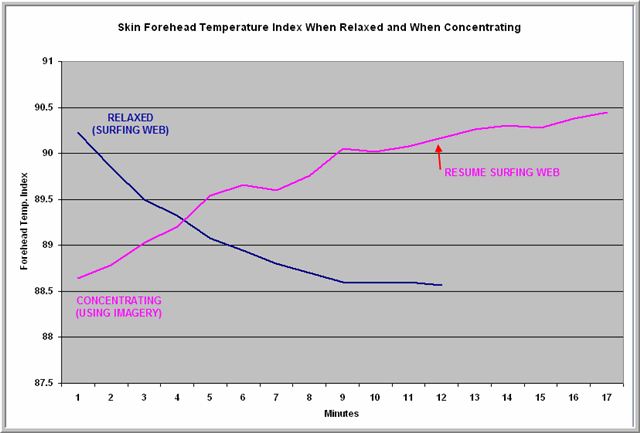
Above you can see my forehead temperature index readings while I was casually surfing the Web in a relaxed manner. The readings dipped over time, then stabilized (blue line). I immediately shifted to a cognitive imagery exercise that requires a high degree of concentration (red line). Note the steady rise in forehead skin temperature.

Now here's the fascinating part: After 12 minutes doing the imagery exercise, I immediately returned to casually surfing the Web. Now, however, I was doing so in a very alert, attentive state. Instead of my temperature dropping, it continued to rise. I was engaging the Web while in the zone; I was highly focused on what I was reading.

Subjectively, my surfing experience was quite different as well. Initially the material I was reading seemed routine and not especially interesting. After the imagery exercise, however, I found my reading material more engaging. My recall is better for the latter material as well.

This, of course, is far from a controlled laboratory experiment, but I believe it makes an important point: Our experience of the world is mediated by our states of consciousness. In one state, I have low concentration and process little of what I experience. In another state, the same material becomes more interesting, and I learn more of it.

Colin Wilson, following the Russian philosopher Gurdjieff, has pointed out that human beings habitually operate at a subnormal level of consciousness. In essence, we operate much of the time along the blue line, not the red one. With intentional exercise, however, we can more frequently engage the world with mental energy and alertness.

How might such capacity for sustained operation in the zone affect performance in trading and in all fields? Might we be less likely to make impulsive trading errors under conditions of heightened awareness? Could we accelerate our learning of trading patterns while maintaining elevated frontal blood flows?

Surely this is a worthy frontier for neuroeconomics. It won't be long before hemoencephalography units and similar devices become widely available to the public--as commonly used for self-development as fitness equipment. With such methods, we will increasingly become the executives of our own minds.

14 comments:

yinTrader said...

Hi Brett

This imagery exercise is what I need to increase my concentration and understanding power.

BTW what do you think of Photo Reading which is more akeen to speed reading rather than to heighten concentration as I see Hemoencephalography.

Brett Steenbarger, Ph.D. said...

Hi Yin,

Unfortunately I'm not familiar with Photo Reading. I do think that any sustained activity that requires calm, intense concentration can serve as a stimulus for "the zone".

Brett

Anonymous said...

off topic

Brett ,
I just wanted to thank you for your wonderful insights and the hard work that you put into this blog .You have helped me immensely , and I'm sure countless others.
Best wishes , HFT

Brett Steenbarger, Ph.D. said...

Thanks very much, HFT; that means a lot to me--

Brett

davidino said...

Doctor, great analysis. By the way I find your chart tool is unique that looks like the data feb by yourself, am I right?

I am looking for a chart tool which I can feed my own data to create a chart, do you have any good recommendations? Thanks.

Brett Steenbarger, Ph.D. said...

Hi Davidino,

Thanks for your note. I use Excel for my homemade charts; it seems to work fine for my limited purposes. By creating DDE links from my real time feed to Excel, charts will update in real time.'

Brett

Chad Patel said...

Doc,
Another great article and I'd like to echo an earlier comment - your blog has been a big help in my own work, thank you.
I wonder what cognitive exersizes you'd recommend to achieve this state. I imagine mediation on one's breath would work, but I wanted to get your suggestions...
Thanks!
-Chad

Brett Steenbarger, Ph.D. said...

Hi Chad,

Good question. Meditation on one's breath certainly has stood the test of time. I've also used mental math problems to keep focused and concentrated. One of my early experiments just had me watching the stock ticker on TV and mentally adding the digits of the numbers as they went by.

I find that focusing on a single point on my body and letting that fill my mind works very well. The key--which takes practice--is shutting off the flow of "internal dialogue" and fixing one's attention on something specific.

Brett

WilyTrader said...

Brett,

What equipment are you using to track your forehead temperature? I just purchased Wild Divine today and have been learning much working through the exercises so thanks,

WilyTrader

Brett Steenbarger, Ph.D. said...

Hi Jason,

My forehead temp unit is custom built. I haven't yet seen units on the market. A good contact would be Biocomp Research:

http://www.biocompresearch.org/contact_us.htm

Brett

Jim0soYoung said...

Very interesting stuff except that I cannot buy that one's prefrontal cortex is outside their skull - might as well measure the temperature on your big toe. The reported "increased alertness" sounds like a placebo effect. The old tech way is a yoga position and mantra. The new tech way is an expensive custom helmet. Next generation is a kevlar toe sock ;-)

Brett Steenbarger, Ph.D. said...

Hi Jim,

You're right to be concerned about placebo effects, especially with a new technology. The validation on HEG was performed, in part, on children as subjects, since ADHD kids were an early clinical population. That was helpful, because the kids didn't know what was being measured. By setting different conditions for the kids and seeing how their forehead temps changed with the demands of tasks placed before them, it was easy to see that the brain does, indeed, work as a heat sink and yield higher skin forehead temperatures during periods of frontal activation.

The method has been validated with infrared photography as well. The ultimate validation would be comparing skin forehead readings with fMRI images of regional cerebral blood flow.

It's quite dramatic to hook the HEG unit to a VCR and set the controls so that kids can only watch their movies if they sustain concentration and forehead temp. When the kids get distracted, the temp goes down, and the VCR goes on pause until concentration is renewed. Quite elegant.

Until, however, we see controlled outcome studies across academic centers, this is necessarily an investigational device. It's promising, but shouldn't be taken as a cure-all.

Brett

Thomas said...

Hi Brett,
what about wearing a wolly hat or a headband to rise temperature?

Thomas

Brett Steenbarger, Ph.D. said...

Yes, Thomas, I suspect that would be easier than learning how to concentrate! :-)

Alas, substituting effects for causes doesn't seem to work in psychology; if you tell a depressed person to smile, you'll have a smiling depressed person, not a happy one.

Brett